We live inside a noise no prior generation
has had to navigate.
Most people are not behind in their thinking. They are simply paying attention to too many things to think well about any of them. The cost is rarely visible — until the wrong decision is made on the wrong frame, and the source of the error cannot be traced.
The Signal is being released differently than any book before it. Not as pages, then a website. As a developmental field you can enter today — an interactive sequence of sessions, mediated by AI, that surface the splits in your own thinking — with the Kindle book now available as the canonical companion.
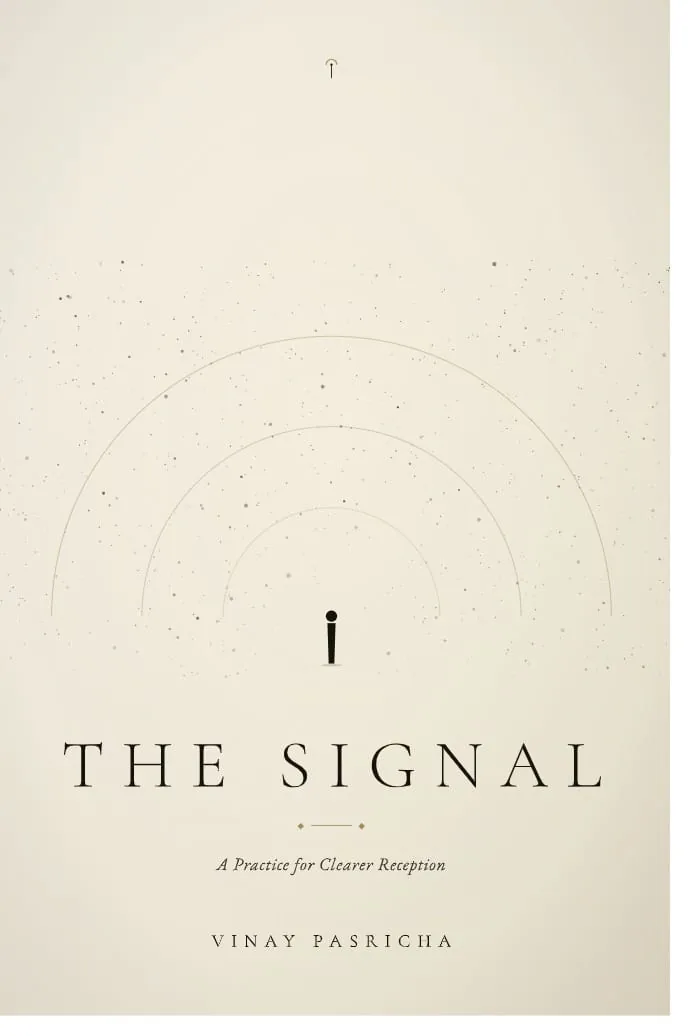
The Signal.
A Practice for Clearer Reception.
An AI-mediated developmental book.
The Signal is the first book where the reader is developmentally trained through interaction with the book itself — not by reading it, but by entering it. The Field is open now. There are no levels, no badges, no streaks. There is only a calm sequence of structured sessions.
Enter The Field →Eight chapters the book is built around.
These are the questions the book, published on 3 June 2026, sets out to answer. If you are someone these questions are alive for, the book was written with you in mind. About the book · Buy on Amazon ↗
What is noise, precisely?
A working definition that distinguishes noise from information, from data, from content. Noise is not the absence of signal — it is the structural condition of more signal than attention. Naming this precisely is the foundation everything else stands on.
How does signal degrade over the lifecycle of an idea?
Why the strongest ideas become weaker as they spread — and what to do as a reader who wants to encounter signal at its original strength, not its diluted final form.
The discipline of refusal.
A practical chapter on how to construct an information diet that protects your attention — not by abstinence, but by curation. Most reading lists are too long; the right one is shorter, deeper, and re-read.
The cost of fragmentation.
What actually happens to a mind that has trained itself on 30-second formats. The chapter is unromantic and based on observation, not on platform-shaming.
Sustained attention as a craft.
A practical manual for the unfashionable skill of reading something difficult, slowly, more than once. With concrete techniques and a defence against the productivity culture that disparages all of it.
Recursion: returning to ideas.
Why returning to the same text, the same problem, the same person months and years later is the most underused intellectual tool. Linear progress is a myth; recursive depth is the actual mechanism.
Reading as cognitive compounding.
The investment metaphor, taken seriously. What happens to a mind that compounds its reading over decades — and the specific habits that make it compound rather than disperse.
The long quiet life of an idea.
A closing chapter on the kinds of work that take a lifetime to make sense of — and the kind of attention required to keep faith with them.
Information has become abundant. Clear perception has not.
Decisions take longer than they should. Confidence reorganises itself overnight. The same conversation returns at the same time every year. Attention will not stay where it is placed for more than a minute. The inner voice does not stop talking. Books are read and forgotten the next morning. Frameworks are acquired faster than they can be lived. Insight passes through the system without changing anything.
This is not a failure of intelligence. The species has more intelligence than at any point in its history. It is something else. It is a failure of reception.
— From the Prologue of The Signal, “The Crisis of Modern Consciousness.”
