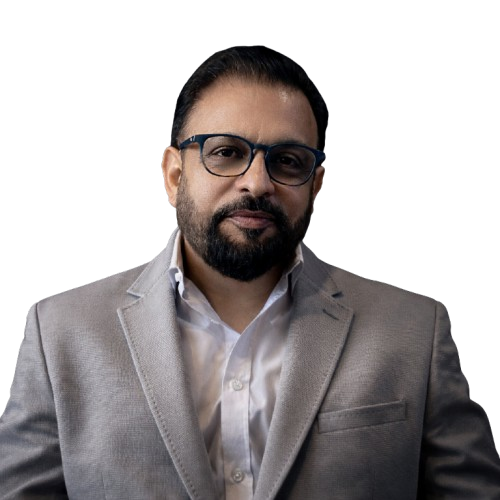
The Human
Before the work, before the ideas, before the technology, there is the person. This section explores the inner landscape from which everything else emerges.
A Contrarian by Nature
I have often been described as a contrarian. The description is probably accurate. I am instinctively drawn to questions that challenge prevailing assumptions. When an idea is widely accepted, my first instinct is to examine the possibility that it might be incomplete or entirely wrong.
Progress has often depended on individuals willing to see the world differently from the consensus around them. That does not guarantee they are correct—but it creates the conditions in which new possibilities can emerge.
Independent thinking is rarely comfortable, but it is essential.
Disturbed by the Present
Much of my thinking begins with a simple observation. The systems that govern human society feel profoundly out of alignment with the world we now inhabit.
Our political systems emerged in an era of scarcity and uncertainty. Our institutions were designed for smaller populations, slower communication, and limited knowledge. Yet today we live on a hyperconnected planet where information flows instantly and technological power grows exponentially.
Despite this transformation, many of the structures guiding human civilization remain rooted in older assumptions. Governance systems that concentrate power in ways that often reward incompetence rather than wisdom. Economic systems that produce both abundance and extreme inequality. National boundaries that divide a species living on a single planet. Weapons capable of destroying civilization itself.
These contradictions are difficult to ignore. They suggest that humanity may be approaching a period of profound structural change.
Technology and the Possibility of Abundance
The most powerful force shaping that change is technology. Artificial intelligence, biotechnology, energy innovation, and global digital networks are rapidly expanding the capabilities of human civilization.
For the first time in history, we are approaching the possibility of abundance in domains that were once defined by scarcity. If these technologies are guided wisely, they may allow us to solve problems that have defined human history for centuries:
- Poverty
- Hunger
- Preventable disease
- Extreme inequality
At the same time, the same technologies introduce new risks. Nuclear weapons already demonstrated how technological power can outpace the maturity of the systems managing it. The challenge of this century may be ensuring that our systems of governance and cooperation evolve as rapidly as our technologies.
The Evolution of Consciousness
Progress, however, is not only technological. It is also psychological. Human beings appear to be slowly changing in how they relate to one another.
The rise of global communication networks has exposed billions of people to perspectives far beyond their local environments. Younger generations often display less tribalism, less fear of difference, and a greater willingness to question inherited structures.
This shift is subtle but significant. As intelligence becomes increasingly augmented by artificial intelligence, the potential for collective learning expands dramatically. Human intelligence combined with machine intelligence may accelerate our ability to solve complex problems.
The question is not whether this transformation will occur. The question is whether we will guide it wisely.
Walking the Path
Despite the scale of these questions, personal growth remains a gradual process. The goal is not to leap instantly into some higher state of understanding. It is to evolve slowly. One step at a time.
For me, moments of clarity often arise during solitary walks, while reading or writing, or in deep conversations with thoughtful people. These moments do not arrive on command. They appear unexpectedly, revealing patterns that were previously invisible.
Improvement, in this sense, means that the mind becomes clearer. The inner dialogue shifts from defending identity to exploring possibility. Thought becomes a tool for action rather than an end in itself.
Ideas must ultimately be tested in the real world. Thinking without action is speculation. Action without thinking is chaos. Progress requires both.
Looking Forward
The challenges facing human civilization are immense. But so are the opportunities.
If humanity can learn to cooperate at a planetary scale, harness emerging technologies responsibly, and cultivate a deeper level of collective intelligence, the coming centuries could represent the most extraordinary period in the history of our species.
A future where basic needs are universally met. Where opportunity is determined by effort and capability rather than accident of birth. Where conflict between nations gradually gives way to cooperation on a shared planet.
And eventually, perhaps, where humanity turns its attention outward—toward the vast and largely unexplored universe beyond Earth.
The Journey Continues
This site is not a finished work. It is an evolving record of a journey. Ideas will change. Understanding will deepen. New questions will emerge.
The aim is simply to explore them honestly. And to contribute, in whatever small way possible, to a future where humanity learns not only to survive—but to thrive.