History looks like chaos.
Beneath it runs a direction.
Empires rise and fall. Technologies appear and make each other obsolete. Ideologies win, then vanish. Yet across thousands of years the deeper movement is unmistakable — knowledge accumulates, capability expands, cooperation scales. The details are uncertain. The direction is not.
Civilization is a framework for evaluating the direction of intelligent civilizations — eight directions, four Foundations and four Frontiers, that every enduring intelligence is pulled along. Not a map of the future. A compass for it.
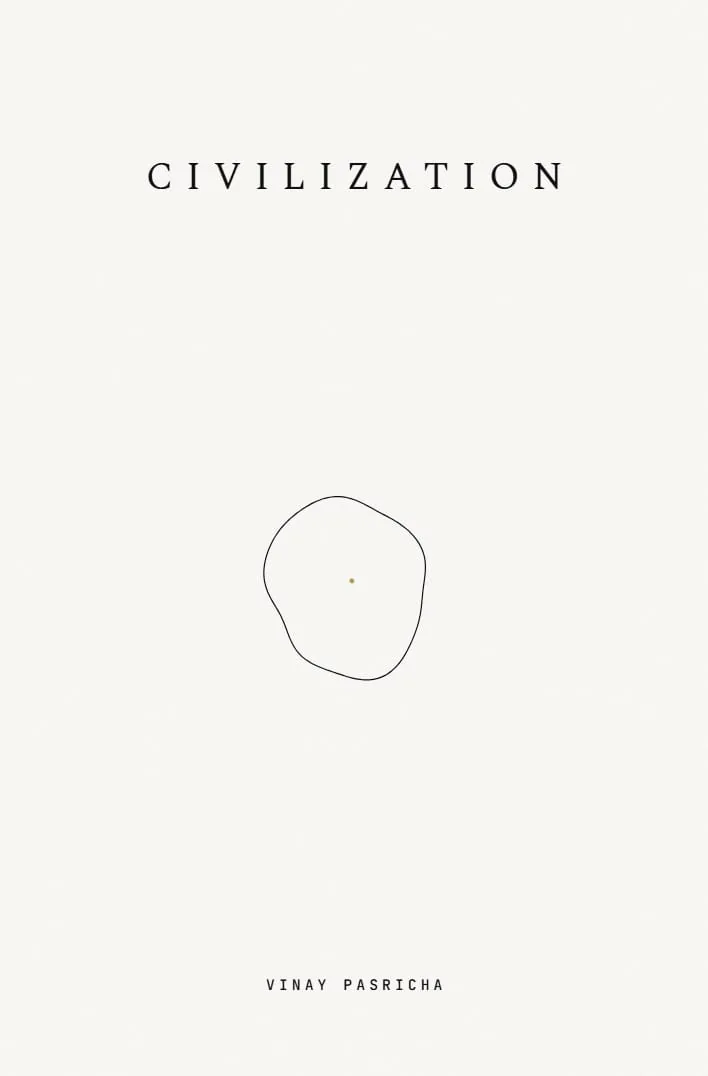
Civilization.
Every civilization is moving in some direction. Most never learn to read the compass.
Vinay Pasricha has spent much of his life building organizations and studying the forces that allow them to survive, grow, and adapt. Why do some ideas persist for centuries while others vanish? Why do civilizations rise, transform, and endure? Are there deeper patterns beneath the apparent chaos of history? Civilization is an attempt to explore those questions. He lives and works in India.
A shape lies beneath history.
Eight directions trace it. This book is the tracing. Set the chart aside when you are done — the shape remains. You are holding it.
Ask the book a question →Four Foundations. Four Frontiers.
The first four appear necessary for any intelligence that persists at all. The second four appear once the foundations are secure — the directions advanced intelligence moves toward over long timescales. The book treats them in that order, because the frontiers presuppose the foundations.
Continuity — the first foundation.
Before anything else, intelligence must persist across time. Memory, inheritance, and the structures that outlive their builders are all faces of one imperative: continue.
Truth — alignment with reality.
Continuity preserves; truth corrects. The discipline of keeping internal models matched to external reality — and of building loops that catch error before it compounds.
Capability — knowledge into action.
Truth alone is not enough. Capability is the conversion of understanding into effective action — and the pressure, under scarcity, to do more with less.
Cooperation — intelligence at scale.
Some capabilities have a minimum scale no individual can reach. Cooperation is how intelligence combines across many minds — and how it sometimes becomes coherence.
Expansion — the first frontier.
Every intelligence eventually meets a horizon. Expansion is extension into domains not yet reached — and every horizon crossed reveals another.
Creation — adaptive novelty.
Once intelligence arrives, something new must follow. Creation is recombination at the edge of the known — the generation of forms that did not previously exist.
Recursion — intelligence on itself.
When the modeler steps into the model. Recursion is intelligence examining and reshaping intelligence — different in kind from everything before it.
Purpose — direction held across time.
Recursion gives the power; something else must give the direction. Purpose is the long-held end — the framework's most exposed claim, and an intelligence that chooses itself.
Twelve candidates entered. Eight survived.
Survival
Can an intelligent civilization persist indefinitely without it? If yes, the candidate may be valuable — but it is not a primary direction.
Universality
Does it appear across biology, civilizations, and observable intelligence systems? A direction confined to one tradition or substrate is not foundational.
Independence
Can it be derived from the others? If a candidate is only another direction in different language, it is folded into the more fundamental one.
Reality
Does reality reward movement toward it and punish movement away? The strictest test — the historical record must show a measurable pattern, not a coincidence.
How to read a civilization.
A framework earns its keep only when it is used. Part Three turns the eight directions on four cases — locating each on every axis, naming its tensions, its surplus, its neglect, and its trajectory.
Rome — a position that did not stay still.
You already know the story. The framework reveals what the narrative hides: expansion that stopped three centuries early, and a continuity–capability lock-in beneath the fall.
China — the civilization that survived itself.
Why did one civilization repeatedly survive? Five phases over one persistent substrate — and a scientific revolution that did not quite happen.
Modernity — the substrate question.
The first case the reader inhabits. Maximum on almost every axis, strong on seven — and a race between correction and falsehood that is not yet decided.
Artificial Intelligence — the first non-biological case.
A position unlike any prior case, with pressures that arrive in months rather than centuries. Where the framework is most tested — and most necessary.
A framework that cannot be wrong is not a framework. It is a worldview wearing the costume of one.
For thousands of years humanity has tried to draw maps of the future. Some predicted endless prosperity, others collapse; some a world united by reason, others one consumed by conflict. Every generation believed it understood the landscape ahead. Every generation was wrong. The landscape changed; the maps became obsolete.
Yet beneath the changes, the deeper currents endured. Knowledge kept accumulating. Capability kept expanding. The scale at which intelligence operated kept rising. Perhaps, then, what we need is not a better map. Perhaps what we need is a compass.
So this book states, in advance, what would invalidate it: a long-lived civilization that violated most of the directions; a consistent pattern of aligned civilizations failing while indifferent ones flourished; a ninth direction that passed all four tests. Eight is not sacred. It is the current best estimate — and it remains a framework precisely because it can fail.
— Adapted from Part One of Civilization
Ask the book.
A conversational layer grounded in the full manuscript of Civilization. Ask a question, Explore the book through guided entry points, or Apply the framework to a country, company, institution, technology, or era.
A companion to the book — not the author, and not a general AI. Answers are drawn from the manuscript and shown with their sources. In Apply mode, book content and framework interpretation are clearly separated. If the book does not address something, it will say so.
Watch