Part Two: The Three Screens · Chapter 6 of 21
Chapter 6 The Cockpit
The cockpit is designed on one rule: the machine carries the complexity, and the human is never burdened with it.
Everything else about it follows from that rule, and most of what people expect of it is wrong because they expect the opposite. They expect a dashboard: a wall of charts, a hundred numbers, a screen that shows everything so that nothing is missed. That is the old company’s idea of visibility, and it is the old company’s mistake carried into the new. A wall of numbers burdens the human with the complexity the machine should be carrying. It asks her to find the one thing that needs her among ninety-nine that do not. The cockpit does the opposite. It shows her a short summary and anything urgent, nothing else until she asks, and when she asks, only that.
How to read the pictures
This chapter and the next two are built around pictures, one grammar for all of them, so that each can be read at a glance before it is read in detail. The grammar is this.
A person in warm light, standing on the plain floor, with no label, is a human. A figure made of cool blue light, standing on a disc of light, with a name and a role floating above it, is an agent. White light is data: the path, the wall, the floor. Gold is a result delivered: a signed mandate, an invoice raised. Amber is a warning: a slowing flow, or a customer who may leave. Red is stopped, or needing a human now. A glowing threshold on the floor is a gate, and it opens on her word.
Three people appear in the pictures, one for each layer. The aligner is the woman in the white shirt; she runs one vector, and every cockpit picture is hers. The master is the older woman in the dark jacket; she holds an Outcome, and her picture is the control room. The Keeper is the man at the table; he holds the company, and his picture is the command centre. A new face means a new layer. The agent beside each of them is a quartermaster: the aligner’s is her vector’s; the ones that stand before the master and the Keeper belong to the vectors that need them, never to the room. Beneath each picture is a three-line key: what the picture shows, who is in it, and what is happening.
One face
The cockpit is a quiet room, entered through a headset, and when the aligner walks in she sees one person.
It is an avatar that looks and speaks like a real human, with a name, a face, a voice and a personality of its own, and it is standing on a disc of light, which is how she knows it is an agent and not a colleague. This is the quartermaster. It manages the line agents, the five or seven or fourteen that do the steps of the chain, and it answers for the whole vector: the combined result, target against actual, every agent’s performance, the cost incurred and the value generated. It is the one she talks to. She talks to it as she would to a colleague she trusts, in words, and it answers in words, or puts the answer on the wall behind it in whatever form she prefers, a number, a chart, a list, a picture of the journey. The report is made for the question. The question is never made for the report.
Nothing else is on the walls. The line agents, each with its own name and face and voice, stand behind the quartermaster, out of sight until called. The agent maker, which builds and tests and checks the agents and is the tuner’s counterpart in the room, is there too, and equally unseen. She can call any one of them forward and speak to it alone, and the others step back. Or she can call a meeting, and everyone is present at once. But the rule is one face at a time, and the meeting is the exception, and most days she speaks only to the quartermaster.
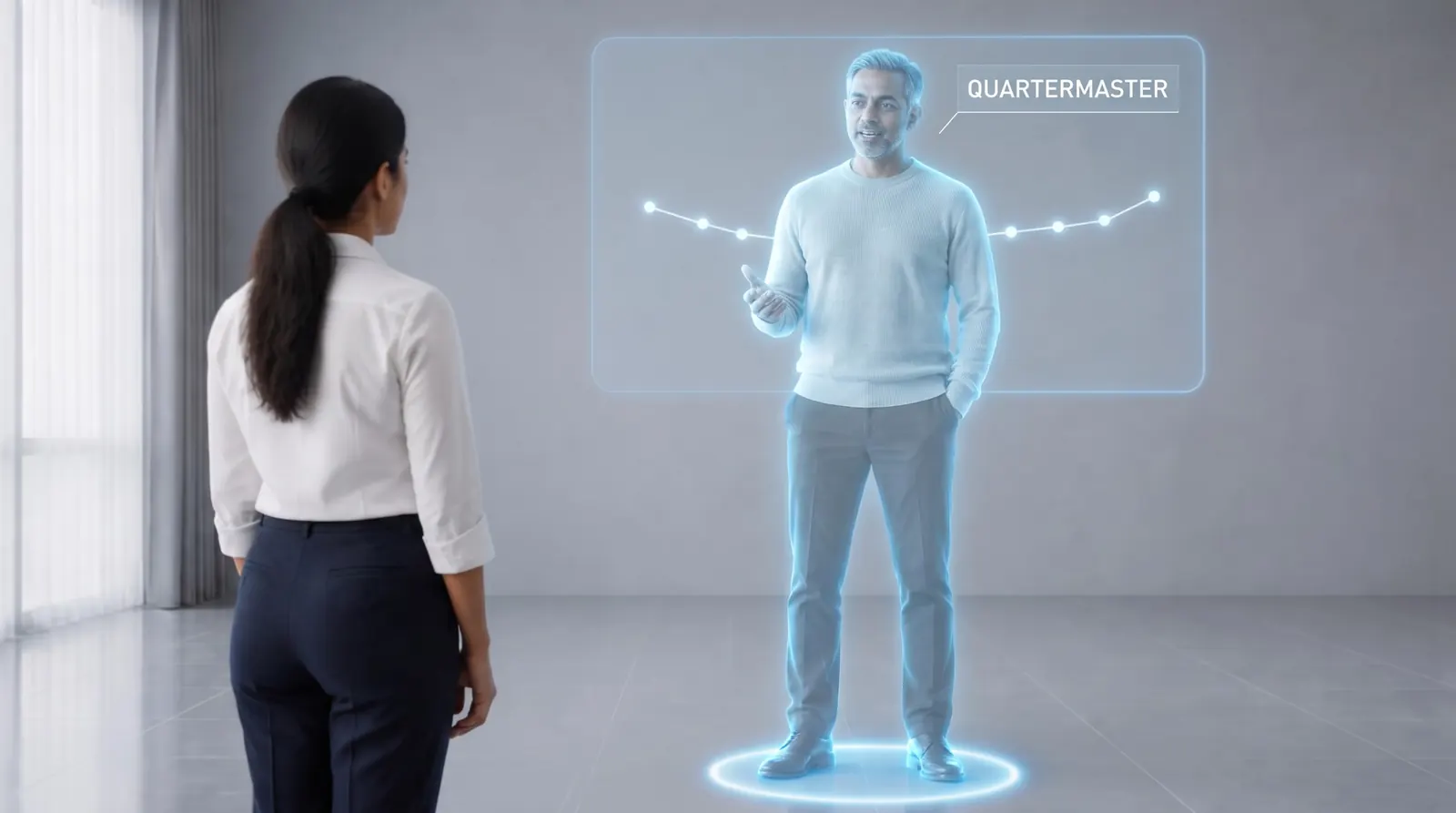
I want to dwell on why this matters, because it is the whole difference between a cockpit and a dashboard, and the difference is not cosmetic.
A dashboard is built by someone who does not know what question you will ask, so it answers every question it can think of at once, and leaves you to find yours. It is a photograph of the vector taken from the outside. A cockpit is built around the assumption that you will ask, and that the machine can answer anything you ask from the live state of the vector, so there is no reason to show you anything in advance. It is a conversation with the vector from the inside. The first burdens the human with finding; the second lets her simply ask. And a human who simply asks, and is answered, can hold a far larger vector in her head than one who has to read a wall, because she is holding the questions, which are few, and not the answers, which are many.
Aviation learned this before management did. The cockpits of modern airliners are designed on what Airbus calls the dark cockpit: when every system is normal, the switches on the overhead panel show no lights at all, and a light appears only when something is abnormal or needs the pilot.34 A dark panel is not an empty panel. It is a panel that has already checked everything and found nothing worth her attention. The cockpit of a vector is dark in the same sense, and for the same reason: the pilot of an airliner and the aligner of a vector both have one scarce thing, which is their attention, and a system that spends it on the normal has none left for the exception.
Four questions
There are no fixed screens, but there are four things she asks for most, and the room learns to have them ready.
Where are we? The whole path from first prospect to signed mandate, or from first application to placed candidate, or whatever the vector’s journey is, drawn as a journey, with every item in flight shown where it is right now. The quartermaster draws it on the floor as a path of light, and every mandate in flight is a white mark on it, and the gold marks at the far end are the ones that were signed. She and he stand at today, and he points at what comes next.
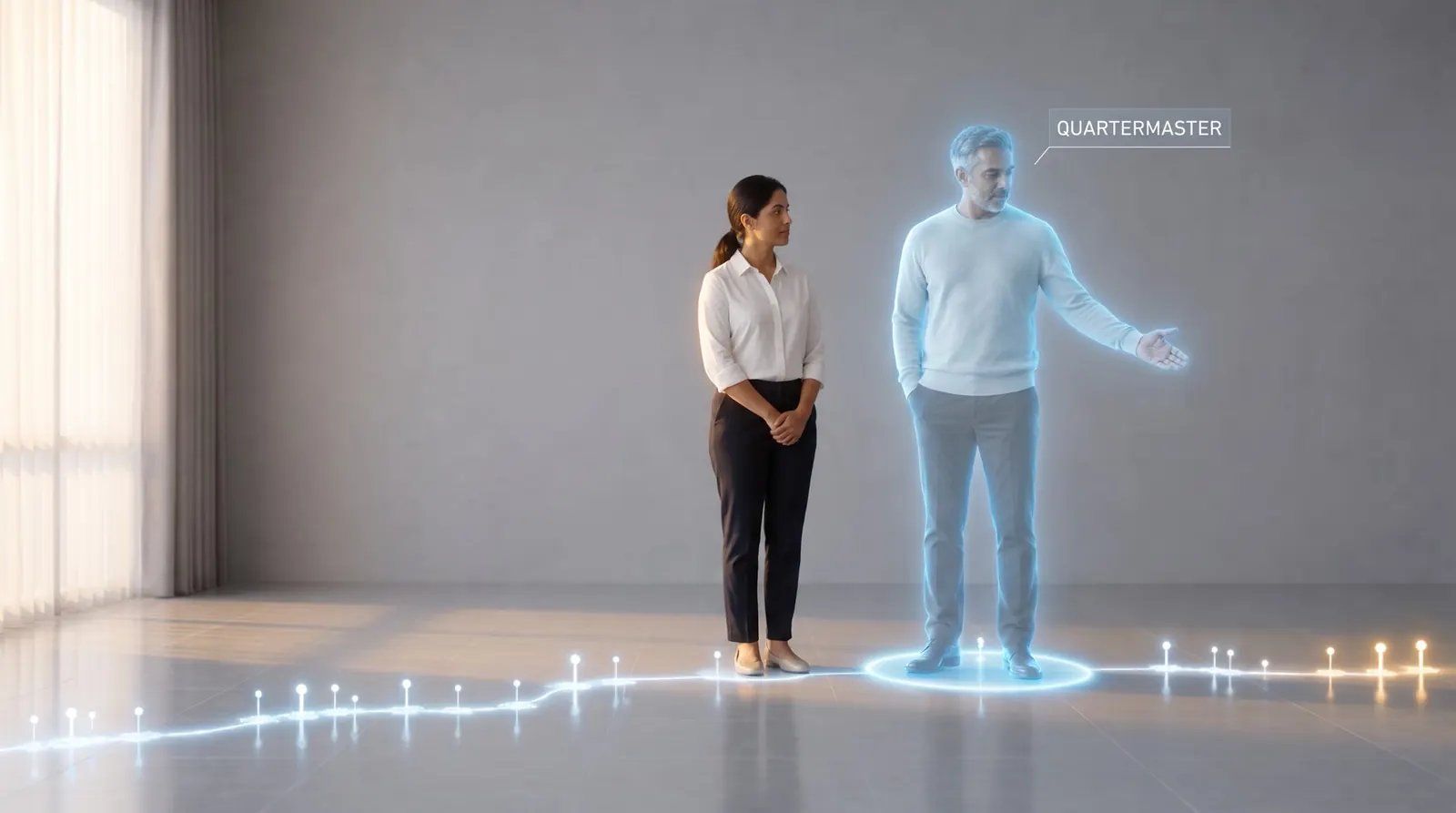
How are we doing? Target against actual, for the vector and for every agent, by day, week and month. This is the question that an old company answered with a monthly report, four weeks late. Here it is answered as of the last minute, because the chain reports its own flow continuously and the quartermaster has nothing to compute; it has only to say.
What is it costing and what is it earning? Cost incurred beside value generated, and the margin between them. The vector has a real cost, which is the agents’ running cost and the pair’s pay, and a real value, which is what its result is worth, and the quartermaster keeps both. This matters more than it sounds, because it means the aligner knows, every day, whether her vector is earning its keep, and does not have to wait for anyone to tell her.
What needs me? The releases waiting for her at the gates, the alarms since yesterday, the contracts waiting for her signature, and the absence switch. This is the question that makes the cockpit work, because it is the one that turns a thousand things happening into the four that need a human. On a good day the answer is short. On a bad day it is the first thing she deals with, and the room has already sorted it so that the worst is first.
The gates
The chain does the steps. She does none of them. What she does is stand at the gates between them.
A gate is the point between two agents where the first one’s work is released to the second, and it is where the aligner’s intention enters the vector. Agent one was set a quota of five hundred prospects overnight. In the morning she checks that it was met, samples the quality, and releases the batch to agent two. She checks agent two’s output and releases it to agent three. And so on down the chain, every day, at the hour she has chosen. The gates are conversations. The quartermaster says what is ready and what it recommends; she says release, or hold, or send it back, or stop. She cannot do a step, and she is never shown more than she asked to see.

That last sentence is the rule that makes the vector survive her. Gates default open. If she does not release a batch within the time the playbook sets for that gate, a day for most of them, the system releases it for her. The time is a setting, not a law: a gate whose wrong release costs a minute may open in an hour, one whose wrong release costs a client’s goodwill may wait three days, and the playbook says which. Not every gate: a reversible step, like a batch of prospects, defaults open, because the cost of a wrong release is small and the cost of a stalled chain is large; an irreversible step, like a signed contract, defaults closed, and waits for a human however long that takes. Gate policy follows the stakes. The effect is that a missed day costs the vector one day of inspection, not one day of flow. The chain keeps moving; what it loses, when she is not there, is her judgement on what moved, and it gets that back the next morning when she reads what the gates let through.
The signature
One act in the whole system is performed only by a human, and the cockpit treats it differently from everything else.
When the chain has brought a mandate to the point of commitment, a contract, a price, a promise the firm will be held to, the quartermaster does not release it. It reads it back. It stands with its own copy and reads the terms aloud, and the page hangs between them in the air, and she reads it too, and then she signs. The signature is hers, a digital signature in her name under her authority, and the agent that carries it afterwards carries it on her permission, within a limit she set. To the customer there is no difference between the agent, the human and the firm: the firm signed. Inside the firm, the signatory answers for what was signed, and the designer answers for why the agent tried to sign it.
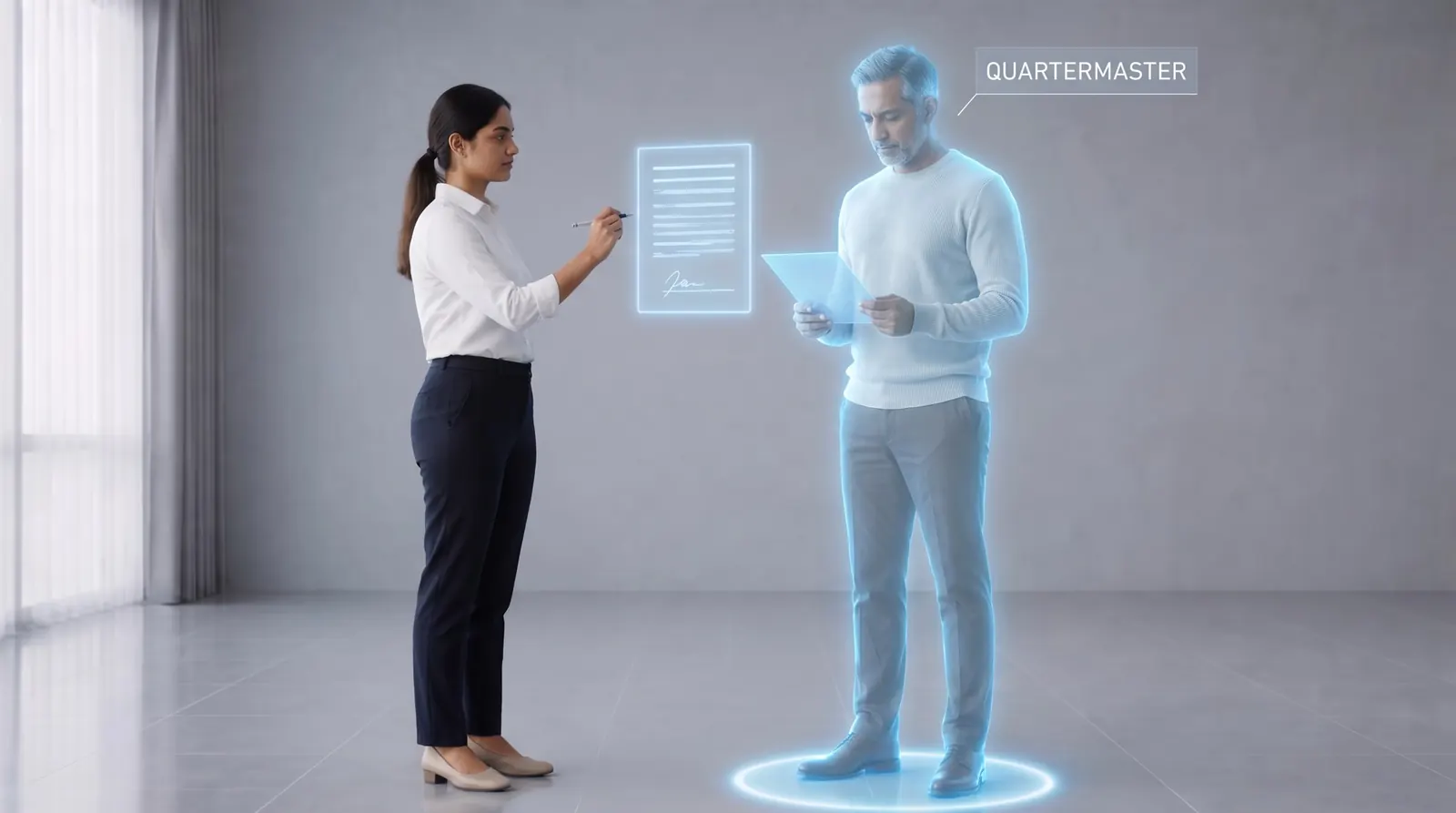
The read-back is not ceremony. It is the moment the vector slows down to the speed of a human reading, on purpose, because what follows cannot be undone. Everything before the signature is fast, automatic, and defaults open. The signature is slow, deliberate, and defaults closed. A company that gets this one distinction right can let its chains run as fast as they like, because it knows that nothing the firm will be held to has passed without a human reading it. A company that gets it wrong either slows everything down to the speed of signing, which is the old company, or lets the chains sign, which is the company that will be in court.
The meeting
One face at a time is the rule. The exception is the meeting.
Sometimes she needs the whole vector in the room: when something has gone wrong across several agents, when the tuner has changed the chain and she wants to see it run, when a customer has asked for something the chain was not built for and the answer has to be assembled from several agents at once. Then she calls everyone in, and they come: the quartermaster, the line agents, the agent maker, each on its disc, each labelled with what it does, standing in a half-circle around her. She is the only solid figure in the room, in warm light on the plain floor, and that is how anyone looking at the picture can tell, at a glance, which of the seven is the human.
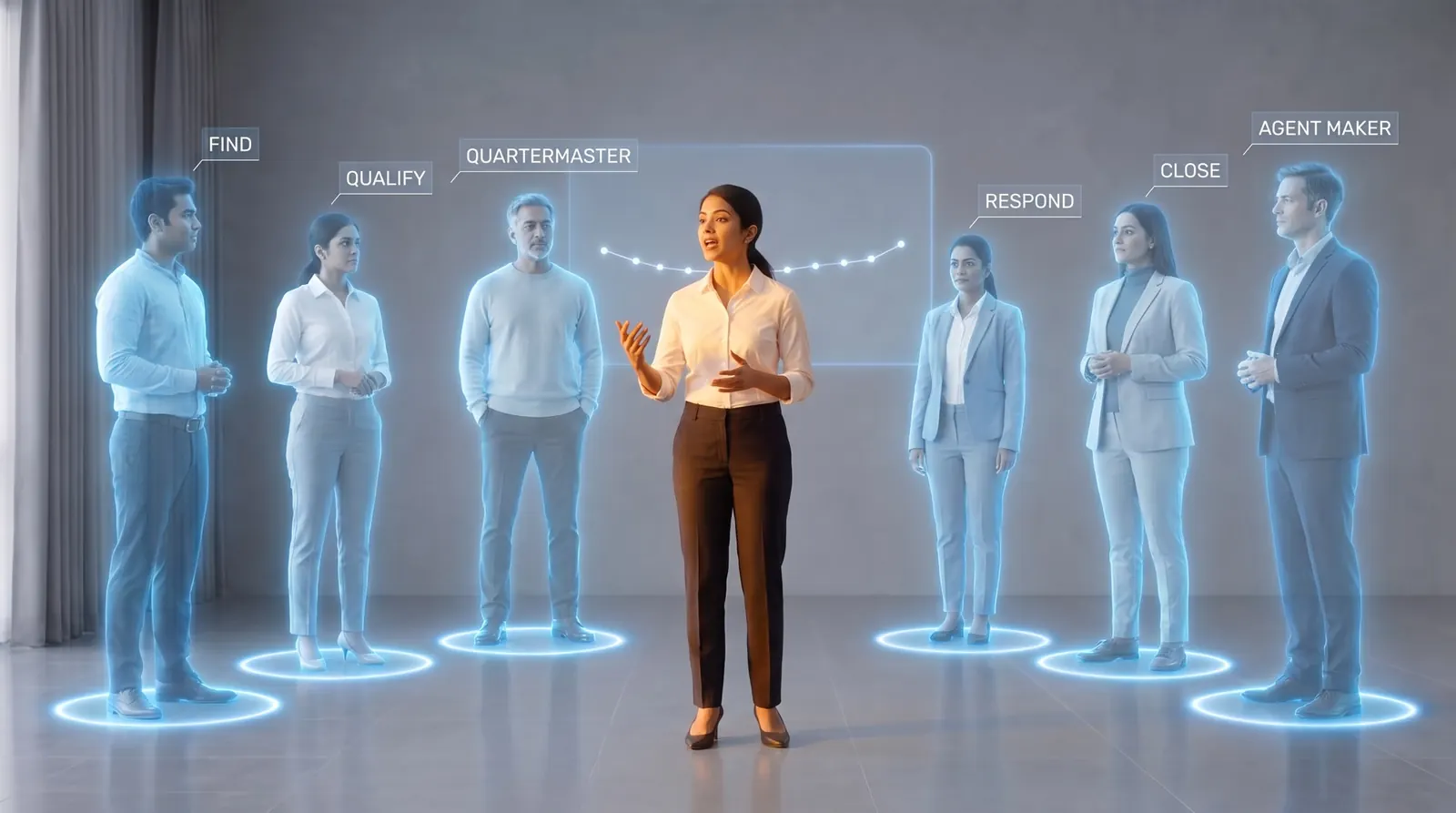
I have watched people’s faces when they first see this picture, and the reaction is always the same, and it is the reaction the picture was made for. Six agents and one human, and nobody has to be told which is which, and nobody has to be told who is in charge.
Her clock is her own
The agents work round the clock, in the customer’s time zone. The aligner works in her own.
Of all the rules in this book it is the one people find hardest to believe and easiest to live with, and it will return in chapter 10 as a tenet. She works where her attention is highest, when it is highest, for a number of hours she fixes in advance and then keeps. If her attention is highest at dawn, she works at dawn. If it is highest on a terrace with tea, the cockpit is a terrace with tea, because the room is wherever she is, and the headset goes with her. Half a world away the chain is working on a customer’s morning, and in the evening it will work on another customer’s morning, and she will read in her own morning what both of them did.

For the first time since the factory bell, the worker’s clock is decoupled from the customer’s. The industrial organisation bought eight hours a day of presence and got perhaps three of attention, because the work had to be done at the work’s hour. The vector buys the three, at the hour she chooses, and lets the agents cover the rest. Three dependencies that defined the office dissolve at once: team, because her team is the chain; place, because with no team to sit beside she works wherever she is; and time, because the chain serves Shanghai on Shanghai’s clock while she sleeps.
The daily contract
Two things are fixed; everything else is free.
First, a number of hours a day, chosen by the aligner in advance and then kept. Not set by anyone else, not the same for every aligner, not even the same every week; but chosen, and then kept, because a vector needs to know when its human will be there, and so does the master. Second, a full systems review every day, at an hour of her choosing. The review is the one act the chain cannot perform for itself: the aligner reads every alarm, clears every waiting decision, samples the quality of what the agents produced, and hands the tuner what needs to improve. Outcomes are judged by the month. Attention is judged by the day, and the review is its evidence.
Everything else is hers. Where she works, when she works, what she does with the hours she did not commit, whether she runs one vector or two: none of that is anyone’s business but hers and the result’s.
A day at GoodSpace
Let me put all of this together as a day, and I will take it from the company where the doctrine was first tried, because a day that has really happened is worth ten that I could imagine. The numbers and the way the work is done are GoodSpace’s. The particular mandates and the candidate in it are composites of several, with the details changed, because the people in a hiring decision are owed their privacy; but every one of them happened.
The Outcome is the one that earns most of GoodSpace’s revenue: a job description goes in at one end and an invoice comes out at the other. It runs as ten vectors. Each vector carries about fifty open mandates at any time, and a mandate is one role and one hire, so fifty mandates is fifty people some client is waiting for. In any week about ten of them are on hold, because the hiring manager is travelling, or the interviewer is on leave, or the client’s management has not decided whether it wants the role at all. That leaves about forty live, and the vector’s promise to each of them is about five strong candidates a week. Forty mandates, five candidates each: two hundred candidates a week, forty a day, each of them sent to a client with a human name behind it. In a month the vector closes eight to twelve of its mandates, and each close is an invoice.
Two people hold it, an aligner and a tuner, and here the doctrine meets the ground and bends a little, in the right direction. They split the forty live mandates between them, about twenty each, and both of them sign candidates out. The aligner owns the result and the decisions that shape it; the tuner turns what the interviews teach into a sharper search. Each of them is the other’s standby, and because the tuner signs off twenty candidates a day she knows every mandate in the vector as well as the aligner does. When one of them is away, nothing is lost.
The chain works through the night. For every live mandate it searches GoodSpace’s own pool and the open market, assesses what it finds, interviews the candidates who pass by voice, and lines up the best of them at the gate with their assessment, their interview and their Goodness Profile attached. Often it does not have to start from nothing. A candidate assessed for another company a few months ago is already in the pool with his Goodness Profile complete and his character checked; if his last skill assessment is recent, the chain does not ask him to take it again. The memory of every earlier mandate makes every later one faster.
The aligner puts on the headset at nine. The quartermaster tells her what happened overnight: candidates lined up for thirty-one of the vector’s mandates; two mandates moved to hold because a client’s hiring manager has gone on leave; one new job description arrived yesterday evening and its findability report is ready; interview feedback came in from three clients, and the chain has drafted what it thinks each one has learned.
She starts with the new job description, because it is the first of the three gates, and the one that decides whether everything after it is worth doing. Clients often ask for people who barely exist. The chain has researched the market and the pool and reports what it found: how many people with this profile there are, where they sit, what they earn, and how hard the search will be, on a scale of ten. This one is an eight. The client wants twelve years in a narrow kind of payments engineering, in one city, at a salary that the market stopped paying three years ago. The aligner does not accept it. She asks the chain to draft a note to the client with the numbers: widen the city, or the years, or the salary, and here is how many people each change brings into reach. If the client changes the brief, she accepts the mandate, and from then on it is final. Then the chain will send the client the second gate, a questionnaire of twenty questions designed to find everything the job description does not say: who the hire will report to, what the last person in the role did wrong, what the team is like on a bad day. A job description is what a client thinks he wants. The questionnaire is the start of finding out what he needs.
Then the third gate, which is most of the morning. The candidates lined up overnight are waiting, and every one of them must be signed out by a human before any client sees them. This is the signature of this vector, and the aligner treats it as one. She reads the chain’s assessment of each, and then reads the assessment of the assessment: what the chain was sure of and what it was not. She looks at the Goodness Profile, value by value. Where something is unclear she listens to part of the chain’s interview. And she picks up the phone and speaks to at least half of them herself, because once a candidate reaches a client the firm’s name is on him, and she will not put the firm’s name on a person she has only read about.
On the eleventh candidate she stops.
He is a senior engineer for a mandate the client wants filled this month, and on paper he is the best the chain has found for it. His skills assessment is strong. His interview with the chain was fluent, precise, and well within the brief. But his Goodness Profile shows a gap that the chain has flagged and cannot settle. On Reliability, his own assessment of himself is high, and the assessment of the people who supervised him is low, and the gap between the two layers is the widest on his profile. The chain has done what a chain can do: it has noticed the numbers disagree. Deciding what the disagreement means is not the chain’s job.
So she calls him. It is a good conversation for ten minutes, and then she asks him about the two projects on his record that ended late. He tells her, at some length, about the teams. One team was weak. The other had a manager who changed the scope every week. Neither was his fault, and he says so twice. She asks what he would do differently. He says he would choose a better team. She thanks him, puts down the phone, and holds him back. The chain logs her reason in a sentence: supervisor gap on Reliability confirmed on the call; attributes every missed deadline to others. He will not go to this client. The record stays in the pool, and if he grows, the next assessment will show it.
The chain had done everything right. It found him, assessed him, interviewed him and flagged the doubt. What it could not do was hear a man describe his last two failures without once using the word I. That is the moment a human is for, and it is why GoodSpace does not let any candidate reach any client without one.
By half past twelve she and the tuner between them have signed out forty-one candidates. Then the last of the morning: the interview feedback. One client rejected two candidates for the same reason, a reason that appears nowhere in the job description and nowhere in the questionnaire’s answers: he wants someone who has managed through a cost cut, because one is coming that he has not told anyone about. The tuner takes that, because turning what an interview reveals into a better search is exactly what tuning is, and by the evening the chain is looking for a different kind of person for that mandate. This is how the search learns. The first batch shows the client what is available. The interviews show the firm what the client actually wants. The second batch is aimed at that. By the time the third batch is due there should be a selection; if there is not, the pair do not send a fourth batch of the same. They sit down with the quartermaster and find where the vector failed, and plug it.
At one o’clock the aligner takes the headset off. Half a day, three gates, forty-one signatures between the two of them, one man held back, one job description sent back, one search turned. The chain goes on working on the afternoon’s interviews and tonight’s search. She does not need to be there for either, and she will know by nine tomorrow what both of them found.
Absence
Before a day away, she chooses one of three settings: pause the vector, set every reversible gate to automatic, or hand the controls to her tuner. If she simply does not appear, the vector chooses for her: it goes to automatic, or passes to her tuner, or to a named person in the master’s control room. There is no setting in which the vector waits in silence. That is the only rule about absence, and it is enough, because the chain does not stop when she does, and the question is only who answers the gates.
The connected boundary
One more picture, because the cockpit has an edge, and the edge is moving.
Everything I have described works where the work reaches the vector in real time: screens, phones, documents, payments, and machines with controllers. It does not yet work for hands. A shop floor, a loading bay, a surgery, a classroom are not yet inside the vector, because the work there does not reach it as data. Where that is so, the doctrine is honest: the aligner of a plant vector is also the supervisor of its twenty or thirty workers, and span of control survives there, and only there, because the work has no other way to reach the vector.
But the edge moves every year, and the direction it moves is into the vector. Sensors on every station, then machines that report every part, then machines that handle the parts themselves. The last of these is a humanoid, and when it arrives on the floor it arrives in the cockpit too, as an agent like any other, on its disc, labelled FLOOR, reporting on its own work.
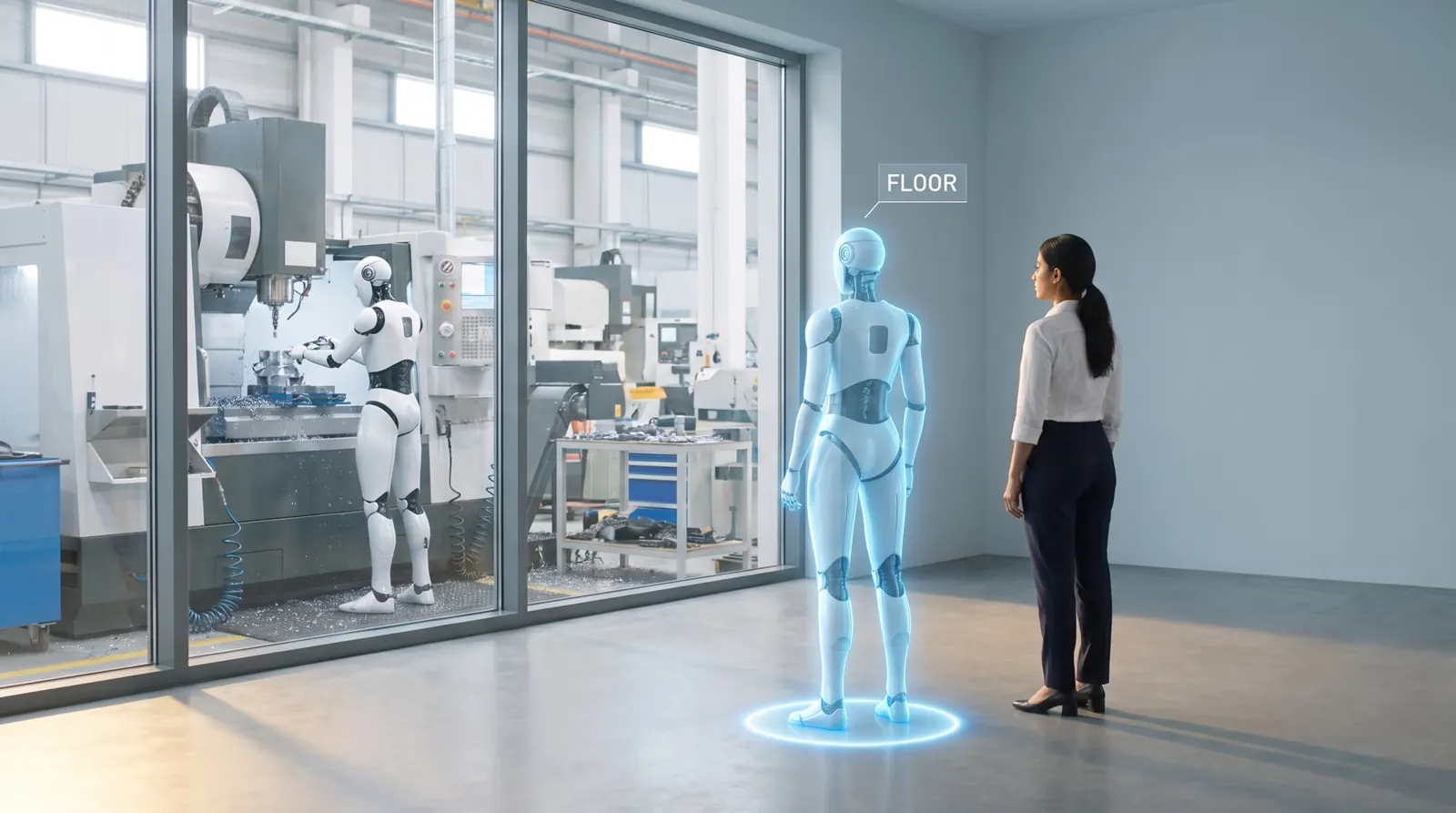
When the hands connect, the pocket closes, and the plant is a vector like any other. Until then, the cockpit stops at the glass, and the aligner walks through the door and supervises, the old way, for as long as the old way is the only way. The doctrine does not claim to abolish hands. It claims that wherever work reaches a vector in real time, departments are no longer needed, and that the territory where that is true grows every year and never shrinks.
The inversion
The nearest ancestor of the cockpit is not a dashboard but a loom. In the 1920s Sakichi Toyoda built an automatic loom that stopped itself the moment a thread broke, so that one person could watch many looms instead of standing over one.35 That idea became jidoka, one of the two pillars of the Toyota Production System, and on the assembly line it became the andon cord: any worker who sees a problem may stop the whole line, and the line stays stopped until the problem is solved.36 Toyota’s rule is that quality is protected by stopping. Nothing defective moves forward, and everything waits for the human.
The cockpit keeps half of this and inverts the other half. It keeps the machine that runs on its own and calls a human only when it must; that is why one aligner can hold what seven desks held, as one weaver could watch many looms. But it does not stop the line for everything. A reversible gate does not wait for the human: if she has not looked within the period the playbook sets, it opens, and her judgement arrives the next morning as a sample of what went through. Only the irreversible stops and waits, the accepted mandate and the signed-out candidate and the contract, because only those cannot be taken back. Toyota stops the line to protect quality because a car with a fault cannot be recalled from the customer’s driveway without great cost. A vector can let the reversible flow because a batch of prospects sent to the next agent can be recalled in a second. The rule is the same rule, applied to a different cost of being wrong: stop for what cannot be undone, and let everything else run.
That is the whole of what has changed. She is not watching the machine. The machine is telling her, at the hour she chose, what she needs to know, and asking her, at the gates, for the one thing it does not have.
The next chapter goes up one level, to the woman who holds a thousand of these rooms at once.
Notes
- Airbus describes its flight-deck design as a “dark cockpit” or “lights out” concept: with every system set for normal operation, the overhead-panel pushbuttons show no lights, and lights are colour-coded to indicate abnormal or fault conditions and selected or deactivated systems. See Airbus, “Flight Deck Philosophy” presentation to the ICAO AFI Flight Safety Symposium, 2017. ↩
- Sakichi Toyoda’s Type-G automatic loom of 1924 stopped automatically when a thread broke, so that a single operator could tend many looms; Toyota traces the principle of jidoka to it (Toyota Industries, company history). ↩
- Toyota describes andon as a tool of jidoka: any team member may stop the production line if they see a threat to quality, and the line halts until the problem is solved. See Toyota UK Magazine, “Andon – Toyota Production System guide.” ↩
From the text of Collapse or Collapse by Vinay Pasricha, shared here in full. © 2026 Vinay Pasricha. All rights reserved. Plain text (Markdown).