Civilization.
by Vinay Pasricha · Every civilization is moving in some direction. Most never learn to read the compass.
Intelligence does not evolve at random. Civilization, by Vinay Pasricha, offers a compass rather than a map: eight directions every enduring civilization is pulled along. Four Foundations — Continuity, Truth, Capability, Cooperation — hold it together. Four Frontiers — Expansion, Creation, Recursion, Purpose — carry it forward. The book does not predict the future. It tries to identify the currents that create one.
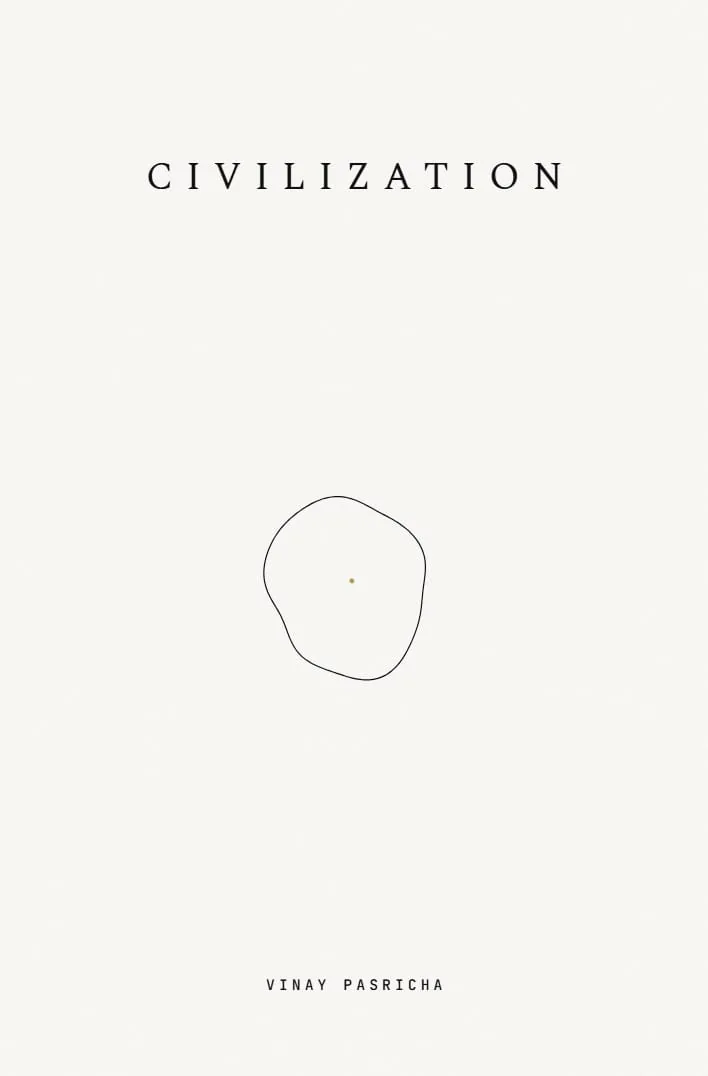
Civilization.
Every civilization is moving in some direction. Most never learn to read the compass.
For readers who need a compass, not another map.
Anyone trying to tell progress from mere motion — in a society, an institution, a technology, or a serious vision of the future. The book is a civilizational framework, not a manifesto and not a work of science fiction. Volume I turns the same eight directions on Rome, China, modernity, and artificial intelligence.
Three parts, and an epilogue.
Part One builds the compass. Part Two walks each of the eight directions. Part Three uses the instrument on real civilizations.
- IThe CompassWhy intelligence might have a direction, why a compass is more useful than a map, how twelve candidate directions were cut to eight by four tests (Survival, Universality, Independence and Reality), and what would prove the framework wrong.
- IIThe Eight DirectionsContinuity, Truth, Capability and Cooperation; an interlude, “When Foundations Meet Their Limits”; then Expansion, Creation, Recursion and Purpose; closing with “The Eight in Tension.”
- IIIReading a CivilizationHow to Read a Civilization. What Is a Civilization? Rome in Eight Dimensions. China: The Civilization That Survived Itself. Modernity: The Substrate Question. Artificial Intelligence. Possible Futures.
- EStanding at the Edge of the MapThe epilogue.
The eight directions, in one line each.
- Continuity: preservation of information through time.
- Truth: alignment of internal models with external reality.
- Capability: conversion of information into effective action.
- Cooperation: combining capabilities across multiple intelligences.
- Expansion: extension into domains not yet reached.
- Creation: generation of adaptive novelty.
- Recursion: intelligence taking itself as the object of inquiry.
- Purpose: coordinated action toward selected ends.
The first four are the Foundations, necessary for any intelligence that persists. The last four are the Frontiers, which advanced intelligence moves toward once the foundations are secure. The book’s deeper claim is that the eight are not a list but one system with eight axes: no civilization can push one direction to the maximum without paying for it in others. You can read and question the book on the Civilization path, and watch Rome Didn’t Fall. It Drifted.
The future is not arbitrary. The details may be uncertain. The direction is not.
The central claim of this book is that intelligence evolves along identifiable directions. These directions are not political. They are not cultural. They are not religious. They are not uniquely human. They emerge wherever intelligence emerges.
This book does not attempt to predict the future. It attempts to identify the deeper currents that create it. A civilization can move rapidly and still move in the wrong direction. Success and progress are not always the same thing.
— From the opening of Part One, “A Conscious Universe,” in the manuscript held on this site.
Before you buy.
What is Civilization by Vinay Pasricha?
A framework for evaluating the direction of intelligent civilizations. Eight directions — four Foundations and four Frontiers — form a compass for telling progress from mere motion. It is published by The Meridian Press.
Who is Civilization for?
Readers who want a reference frame for a serious vision of the future: a society, an institution, a technology, or an era. It is a framework that states, in advance, what would prove it wrong.
How long is Civilization?
The Kindle edition (ASIN B0H4GWZND6) is 284 pages. Amazon lists the publication date as 8 June 2026. The manuscript on this site is organised as nineteen chapters across three parts and an epilogue.
What are the eight directions?
Foundations: Continuity, Truth, Capability, Cooperation. Frontiers: Expansion, Creation, Recursion, Purpose. Part Three reads Rome, China, modernity, and artificial intelligence through that frame.
How were the eight directions chosen?
Twelve candidate directions were proposed and put through four tests: Survival, Universality, Independence and Reality. A candidate that failed any one of them was not treated as a primary direction. Eight survived. The book says eight is not sacred; it is the current best estimate.
What would prove the framework wrong?
The book names three kinds of evidence: a long-lived advanced civilization that systematically violated most of the directions; a consistent pattern of civilizations failing despite alignment with all eight; or a new candidate direction that passes all four tests on its own.
Watch