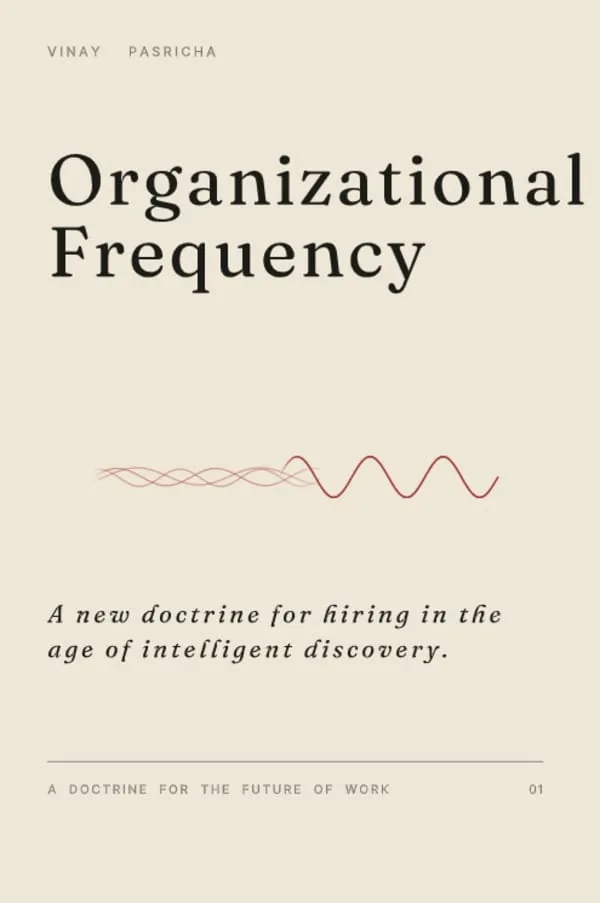
Organizational Frequency.
by Vinay Pasricha · Hiring is not convincing people to fit somewhere. It is discovering where they already belong.
Organizational Frequency is Vinay Pasricha’s doctrine for talent: every company carries a frequency, every person carries their own, and great performance happens when the two resonate. Most bad hires are not bad people. They are mismatched frequencies.
Organizational Frequency.
Hiring is not convincing people to fit somewhere. It is discovering where they already belong.
For people who hire, and people who have been hired wrong.
Founders, hiring leaders, and HR partners — and anyone who has made a bad hire, or been the wrong hire. It is Doctrine 01 in a series on the future of work: short, dense, and aimed at the moment a person who looked right on paper turned out wrong in the room. The practical platform built from the doctrine is GoodSpace AI. This page is the book.
Four stages, not a funnel.
The doctrine is built on four stages. Each is a posture a hiring organisation adopts before any individual hire is made, and each contradicts how most companies still hire.
- iUnderstand your own frequencyName your pace, decision style, tolerance for ambiguity and intellectual register. Until the frequency is named, every hire is a guess.
- iiDiscover where the person actually belongsAsk how people naturally operate, not only what they have done. Discovery uses conversation, work product and real interactions.
- iiiValidate against the environment, not the roleThe role is a snapshot. The environment is a living system. Validate by simulating the real environment.
- ivGrow both the person and the company togetherFrequencies shift as people mature and companies scale. Keep the two aligned, and notice honestly when they no longer are.
What it is not, and why that matters.
- Not culture fit. Culture fit often means “do they look like us, talk like us, agree with us.” Frequency is about pace, decision style and operating register, not sameness.
- Not personality testing. Tests measure traits out of context. The same person carries different frequencies in different environments.
- Not gut feel. “I just had a feeling about them” is the most common and most expensive failure in hiring. The book asks you to name what the gut was sensing, and test it.
- Not just AI screening. AI has made screening faster, not better. Until a company knows its own frequency, AI only speeds up the wrong question.
Before you read, you can try the free Find your organizational frequency self-reflection. For what a mismatch costs in rupees, read What a Bad Hire Really Costs in India. If you are hiring for a leadership role, leadership search applies the same doctrine to CXO mandates. If you are the one looking for work, Find your frequency uses it in reverse. The ideas are also in short videos on Watch, starting with The Hiring Mistake Every Company Makes.
Most hiring failures are resonance failures disguised as performance failures.
A resume is a snapshot of a person who keeps moving. An interview is a performance of a working relationship. A job description is the passport photo of a role that has already changed.
These are not bad tools. They are the wrong category of tool. We have been trying to capture the shape of a river with a still photograph, and then blaming the river when the photograph fails to predict what it will do tomorrow.
We believe we are measuring fit. We are not. We are measuring the performance of fit.
— From the Prologue and Chapters 1 and 7 of Organizational Frequency.
Before you buy.
What is Organizational Frequency by Vinay Pasricha?
A doctrine for hiring in the age of intelligent discovery. Companies and people each carry a frequency. Performance happens when they resonate. The book replaces convincing someone to fit with discovering whether they already do.
Who is Organizational Frequency for?
Founders, hiring leaders, HR partners, and anyone who has made a bad hire or been the wrong hire. It is the first volume of a doctrine on the future of work.
How long is Organizational Frequency?
The Kindle edition (ASIN B0H2NTL3XS) is 218 pages. Published 23 May 2026.
Is this the GoodSpace hiring page?
No. This page is the book. GoodSpace AI is the platform built from the same doctrine. The hiring path on this site is the longer essay. The bookshelf card used to send readers to that path; it now comes here.
What does “frequency” mean in the book?
A company’s characteristic pace, posture, decision style and tolerance for ambiguity. The book treats it as more fundamental than culture: culture is a downstream effect, frequency is the upstream cause.
Why do good people fail after they are hired?
Often because of mismatch, not ability. A talented person in the wrong environment can look mediocre within six months, while an ordinary hire in the right environment can outperform expectations.
Watch
 1:27 · Video
The Hiring Industry's Open Secret: Interviews Are Performances | Vinay Pasricha
Vinay Pasricha on 'professional theater': why the skill that wins an interview isn't the skill that wins the job, and why hiring must shift to discovery.
 1:48 · Video
Why the Best Talent Will Never Apply to Your Job Posting | Vinay Pasricha
Most companies don't have a hiring problem; they have a discovery problem. Vinay Pasricha on why post-and-pray hiring filters out the people you need.
 0:53 · Video
Would Your Best Employee Hire YOU Back?
A one-question retention test for leaders: if your best people could choose their company again today, would they choose yours? Vinay Pasricha explains.