The Execution Doctrine.
by Vinay Pasricha · One constraint governs each cycle. Identify it. Strengthen it. Repeat.
SIV produces understanding. The Execution Doctrine applies it. Vinay Pasricha’s field manual treats execution as a craft: see the work as a sequence, find the current limiting factor, and strengthen that point cycle after cycle until the capacity of the whole rises. It is not a productivity book and not a list of habits.
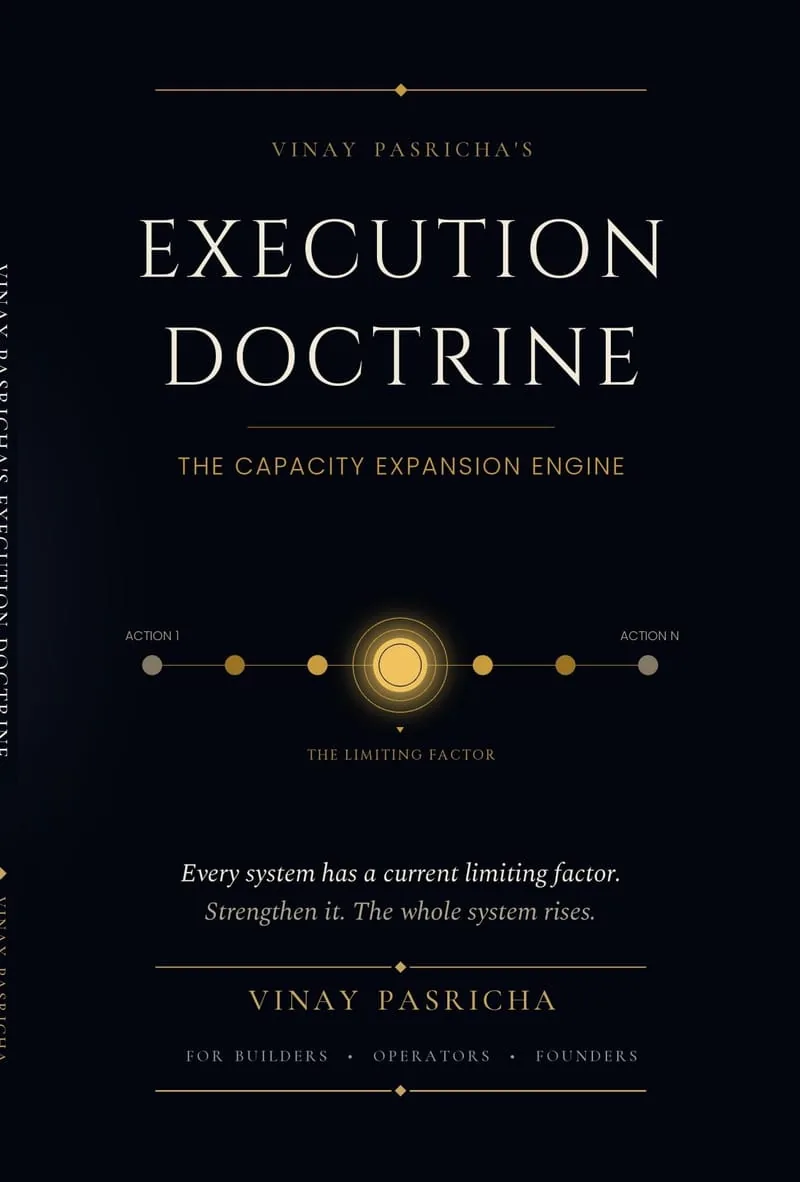
The Execution Doctrine.
One constraint governs each cycle. Identify it. Strengthen it. Repeat.
Eighteen chapters, one doctrine.
Each chapter has its own page: a short summary and a link to the full text.
- 01The Rise to Higher Execution
- 02What This Doctrine Is
- 03The Governing Limit
- 04The Capacity Expansion Engine
- 05The Base Loop of Execution
- 06From Action 1 to Action N
- 07Reading the Constraint
- 08Strengthening the Next Cycle
- 09The Discipline of One Constraint
- 10When the Bottleneck Is Human
- 11When the Bottleneck Is Structural
- 12Output as the Measure of Truth
- 13Improvement Across Cycles
- 14How Execution Fails
- 15Correction and Recovery
- 16Across Scales
- 17The Character of the Executor
- 18The Formal Doctrine
For operators who want to be apt, not merely fast.
Builders, operators, and founders — and the teams, companies, and missions they run. The doctrine is written for people who already execute and want a sharper grammar for it. The domain can change. The underlying logic does not.
The highest form of execution is mastery.
Execution is among the most consequential force multipliers in professional and personal life. It is the bridge between intention and reality, between strategic vision and tangible result, between possibility and built form. Every meaningful enterprise — whether a corporation, a product, a personal transformation, a body of work, or a long-term mission — rises or falls on the caliber of execution behind it. Ideas matter. Strategy matters. Talent matters. But ultimately, the world is shaped by what is actually executed.
Mastery in execution is not loud. It is not theatrical. It does not depend on permanent strain. It emerges from seeing the work clearly, structuring it properly, diagnosing what truly constrains it, and strengthening that point with precision.
— From the preface, “The Spirit of the Doctrine,” in the manuscript held on this site.
Before you buy.
What is The Execution Doctrine by Vinay Pasricha?
A universal system for finding the single point where weakness most limits output, and strengthening it cycle after cycle. It is a doctrine for building stronger pathways from intention to outcome, not a productivity method.
Who is The Execution Doctrine for?
Builders, operators, and founders who already do the work and want to be apt rather than merely fast. It scales from an individual to a team, a company, or a long-horizon mission.
How long is The Execution Doctrine?
The Kindle edition (ASIN B0GXVLX2G9) is 83 pages, in 18 chapters. Amazon lists the publication date as 29 April 2026.
How does it relate to The SIV Method?
SIV asks whether the situation has actually been understood. The Doctrine asks whether the right force is being applied, in the right sequence, on the constraint that matters. Understanding without execution is unfinished. Execution without understanding is the other failure.
Watch

 1:02 · Short
The Plan Was Never the Problem | Execution Doctrine
Why working harder doesn't close the gap between deciding and doing, and why finding your one limiting factor does. From Execution Doctrine.
 1:16 · Short
The Loop Nobody Runs Properly
Plan-Do-Check-Act breaks at 'Act'. Vinay Pasricha on strengthening the one constraint that limited output before the next cycle begins.
 0:26 · Short
Your Dashboard Is Lying to You
You only measure what you chose to measure. Vinay Pasricha on why green metrics hide the real bottleneck: the waiting, the handoff, the unowned step.