What This Doctrine Is: an execution framework, not a productivity method.
Chapter 2 · “What This Doctrine Is” · by Vinay Pasricha
What makes an execution framework different from a productivity method?
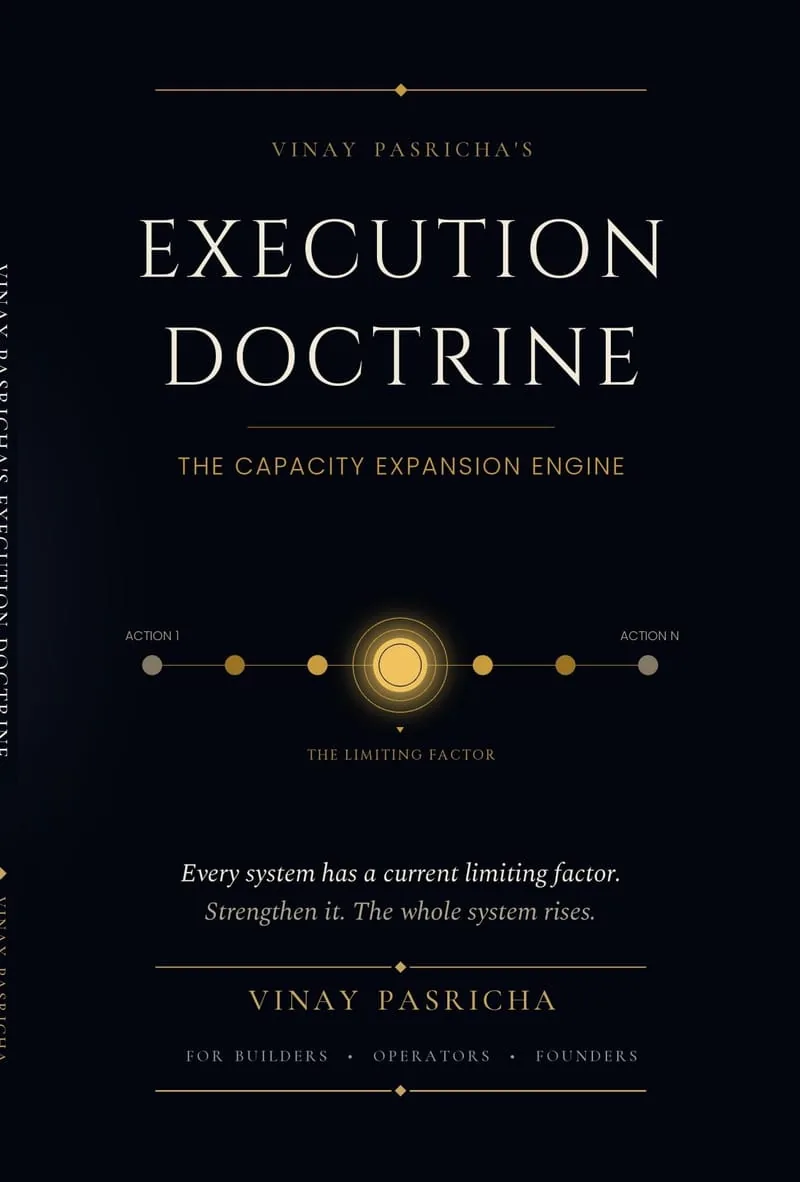
Chapter 2 defines Vinay’s Execution Doctrine as a universal system for identifying and strengthening the current limiting factor in any execution sequence. It is explicit about what it is not: not a time-management system, not a productivity hack, not a psychological intervention or a motivational framework. It is a structured method for converting understanding into reliable action and for building systems that become more capable over repeated cycles.
Its foundation is a single claim, and the chapter draws four implications from it. Parts of a system are not equally important for improvement: the weak link governs the strength of the chain. Execution is not primarily about effort, because better design, tools, information, resources or a corrected sequence can strengthen a system without more human strain. Execution is cyclical, since the constraint that limits cycle N is typically not the one that limits cycle N+1. And execution is measurable: capacity either expands or it does not.
The chapter is candid that the framework is formal and demanding. It asks for a clearly defined execution sequence, an honest assessment of where the system is actually weak, and the willingness to focus improvement on that point instead of spreading energy across many. In return it promises clearer thinking about what limits output, more focused improvement, more reliable results, and systems that do not depend on permanent heroic effort. It is written for founders, leaders, operators, builders and individuals committed to excellence over long periods.
The doctrine assumes the thinking has been done. When it has not, The SIV Method is the volume on understanding reality before execution. AI for Business Leaders makes a parallel case for AI: design the organisation before you scale it.
Every process has a governing constraint, and the quality of execution depends fundamentally on the strength of that constraint.
— Chapter 2, “What This Doctrine Is”
Chapter 2 in full.
The complete text of “What This Doctrine Is”, 502 words, as published in the manuscript on this site.
When the constraint is a leadership seat.
Vinay Pasricha leads searches for leadership and top-management roles in India: CXOs, the founder’s bench and functional heads. Tell him about the organisation and the role. The enquiry is recorded and sent to him directly.