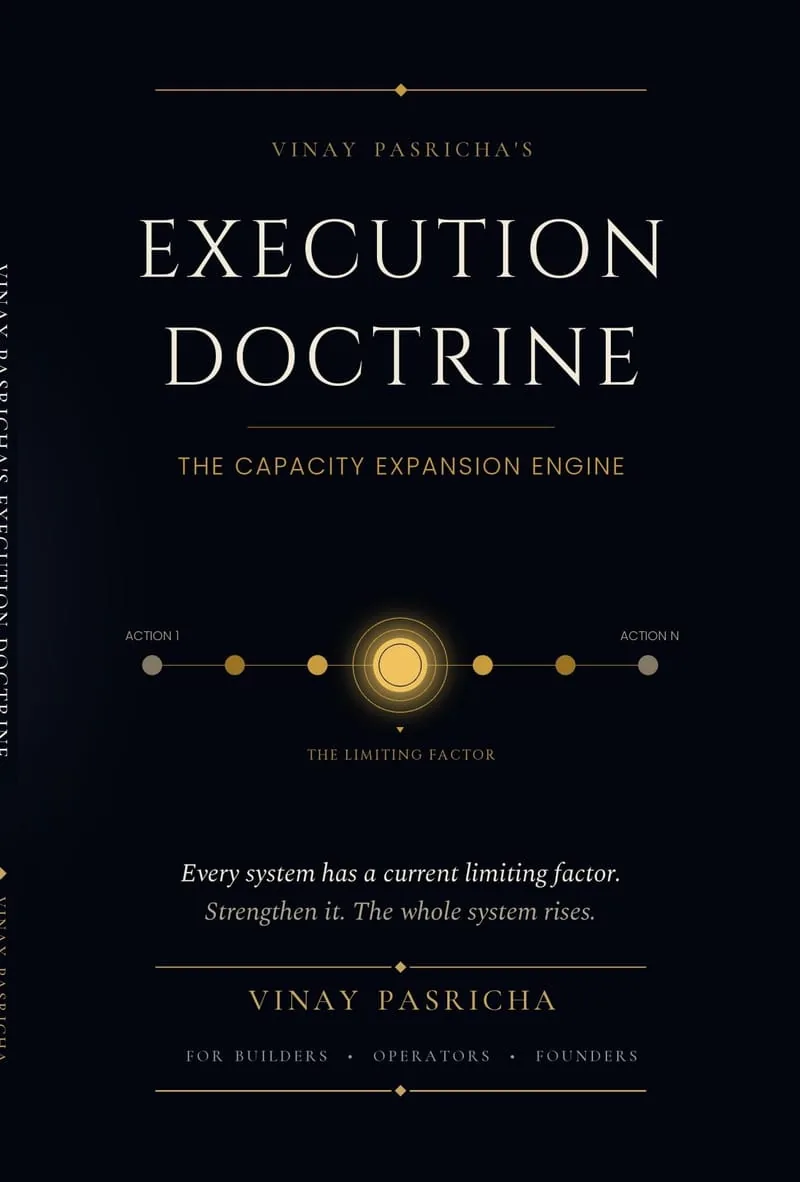
Vinay's Execution Doctrine is a universal system for identifying and strengthening the current limiting factor in any execution sequence.
It is not a time management system. It is not a productivity hack. It is not a psychological intervention or a motivational framework. It is a structured method for converting understanding into reliable action and building systems that become progressively more capable over repeated cycles. The doctrine operates on a clear philosophical foundation: every process has a governing constraint, and the quality of execution depends fundamentally on the strength of that constraint.
This foundation has several implications.
First, it means that not all parts of a system are equally important for improvement. The weak link in a chain governs the strength of the whole chain. Improving an already-strong element may have psychological value, but it produces minimal improvement in system output. Improving the weakest element produces proportional improvement in system capacity.
Second, it means that execution is not primarily about effort. A system can become stronger through improved design, better tools, clearer information, more appropriate resources, or corrected sequence — without necessarily demanding more human effort. In fact, the sign of mature execution is that systems become more powerful while demanding less strain.
Third, it means that execution is cyclical. A single cycle of action and improvement is never sufficient. The constraint that limits output in cycle N is typically not the same constraint that will limit output in cycle N+1. As the first constraint is strengthened, a new limiting factor emerges. A serious executor expects this and has a system for identifying and addressing each new constraint.
Fourth, it means that execution is measurable. Capacity either expands or it does not. Output either improves or it stagnates. The doctrine cares deeply about whether the system actually becomes stronger. Intention, effort, and activity are secondary to whether the real limiting factor was identified and whether the next cycle was actually improved.
This doctrine is formal, structured, and demanding.
It is not for those who prefer vague aspirations or hope-based planning. It requires clear definition of the execution sequence, honest assessment of where the system is actually weak, and willingness to focus improvement effort on that specific point rather than diffusing energy across multiple improvements. But for those willing to operate with this discipline, the returns are substantial.
The doctrine produces clearer thinking about what actually limits output. It produces more focused allocation of improvement effort. It produces more reliable results. It produces systems that become progressively more capable without depending on permanent heroic effort. And it produces the confidence that comes from knowing that each cycle is making the system materially stronger.
That is the promise of this doctrine.
It is designed for serious operators: founders, leaders, operators, builders, and individuals committed to excellence over long periods of time. It is written for those who understand that real progress comes not from motion or effort or sincere intention, but from the disciplined identification and strengthening of the actual limiting factors that govern performance.
Text from the manuscript published at /library/execution-doctrine/full-text.txt. © 2026 Vinay. All rights reserved.