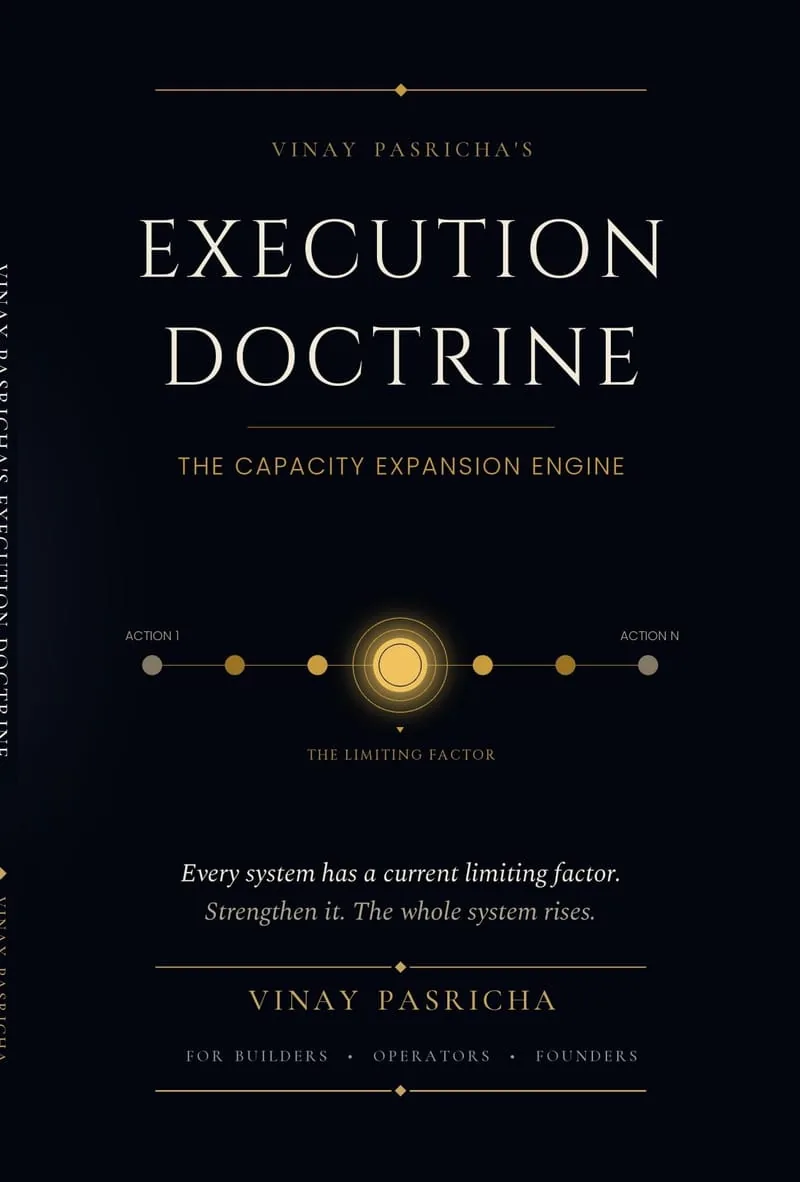
Every system that produces output has a current limiting factor. This is not a philosophical claim. It is an observable reality.
Imagine a sales organization. The elements include salespeople, marketing materials, prospecting methods, sales training, pricing, product quality, customer support, and payment processing. If sales are below potential, the shortfall is not due to all elements being equally weak. It is due to one or a small number of specific elements being weaker than the others and thus governing overall output.
Perhaps the limiting factor is inadequate prospecting, which means the sales team has insufficient leads to work with. Perhaps it is poor sales training, which means the team lacks the skill to close effectively. Perhaps it is inadequate pricing power, which makes the offering uncompetitive. Perhaps it is slow payment processing, which creates friction in the customer journey. One of these — or some other specific element — is more consequential than the others in determining whether sales rise or remain flat.
The same principle applies everywhere.
In a manufacturing process, output is limited by the slowest station on the production line, the availability of raw materials, the capacity of the shipping department, or the reliability of a key machine. In an athletic performance, a runner's speed is limited by cardiovascular capacity, leg strength, running economy, or mental discipline — whichever is weakest. In a research program, progress is limited by funding, talent, equipment, focus, or institutional support. In a team's ability to deliver a product, development is limited by technical capability, design clarity, decision-making speed, testing infrastructure, or resource allocation.
There is always a current limiting factor.
This is sometimes called the Theory of Constraints, the Goldratt principle, or the idea of the weakest link. But the specific name is less important than the underlying reality. In any system producing output, there is at least one element whose weakness disproportionately constrains the output of the whole. That element is the governing limit.
The strength of Vinay's Execution Doctrine depends on the executor's ability to identify this limit accurately. Misidentifying the constraint leads to wasted effort. If a sales shortfall is actually due to poor prospecting but the organization focuses on sales training, then sales training will improve while sales remain flat. If a manufacturing bottleneck is actually at the shipping department but production focuses on equipment speed, then equipment runs faster while the shipping backlog grows. If an athlete's speed is limited by cardiovascular capacity but training focuses on strength, then strength improves while speed remains unchanged.
The executor who misidentifies the constraint works hard in the wrong place.
An executor who correctly identifies the constraint and focuses improvement effort there produces disproportionate returns. The sales organization that identifies poor prospecting as the constraint and builds a prospecting system produces rapid sales growth. The manufacturer that identifies the shipping department as the bottleneck and expands shipping capacity increases output immediately. The athlete who identifies cardiovascular capacity as the limit and trains aerobic systems improves speed markedly.
Right effort in the right place produces visible results.
But identifying the true limiting factor is not always obvious. Organizations often mistake the loudest problem for the real problem. They mistake the most visible element for the most consequential element. They focus on what is already known to be weak rather than identifying what is truly governing output. This is why the doctrine places such emphasis on the discipline of accurate constraint identification.
The governing limit is not always where the most noise is.
A bad employee may be the loudest problem, but the true constraint may be inadequate hiring systems that continue to source bad employees. A customer complaint may be the most visible problem, but the actual constraint may be a product design flaw that creates the conditions for complaints. A missed deadline may be the most urgent problem, but the constraint may be unclear requirements that made on-time delivery impossible from the start.
Serious diagnosis requires looking past surface problems to the structural or systemic factors that actually govern output. Once the governing limit is identified, the entire focus of the execution cycle shifts. No longer is effort distributed across multiple improvements. No longer is the organization trying to improve everything at once. Instead, all improvement energy is concentrated on strengthening that one specific constraint. When this constraint has been adequately strengthened, output rises. Then, the executor identifies the next limiting factor and begins again.
This is the operational foundation of the doctrine.
Everything flows from the ability to see systems clearly, identify what actually governs their output, and focus improvement effort on that specific point. This is not intuitive for most people. Most people have an instinct to improve broadly, to address multiple weaknesses, to work harder everywhere. The doctrine demands a more disciplined approach: identify the one constraint that most limits output, strengthen that constraint with focused effort, repeat.
That is how execution rises above effort into mastery.
Text from the manuscript published at /library/execution-doctrine/full-text.txt. © 2026 Vinay. All rights reserved.