AI for Business Leaders.
by Vinay Pasricha · AI does not fix chaos. It scales it.
AI for Business Leaders is Vinay Pasricha’s guide for founders and operators who must move now and still want to move clearly — design the organisation as a brain, with memory, reasoning, action, and feedback, before any tool is allowed to amplify what is already there. The current edition is the Second Edition, revised and updated (hardcover, July 2026): The Company Brain Playbook for Founders, CEOs and Business Owners.
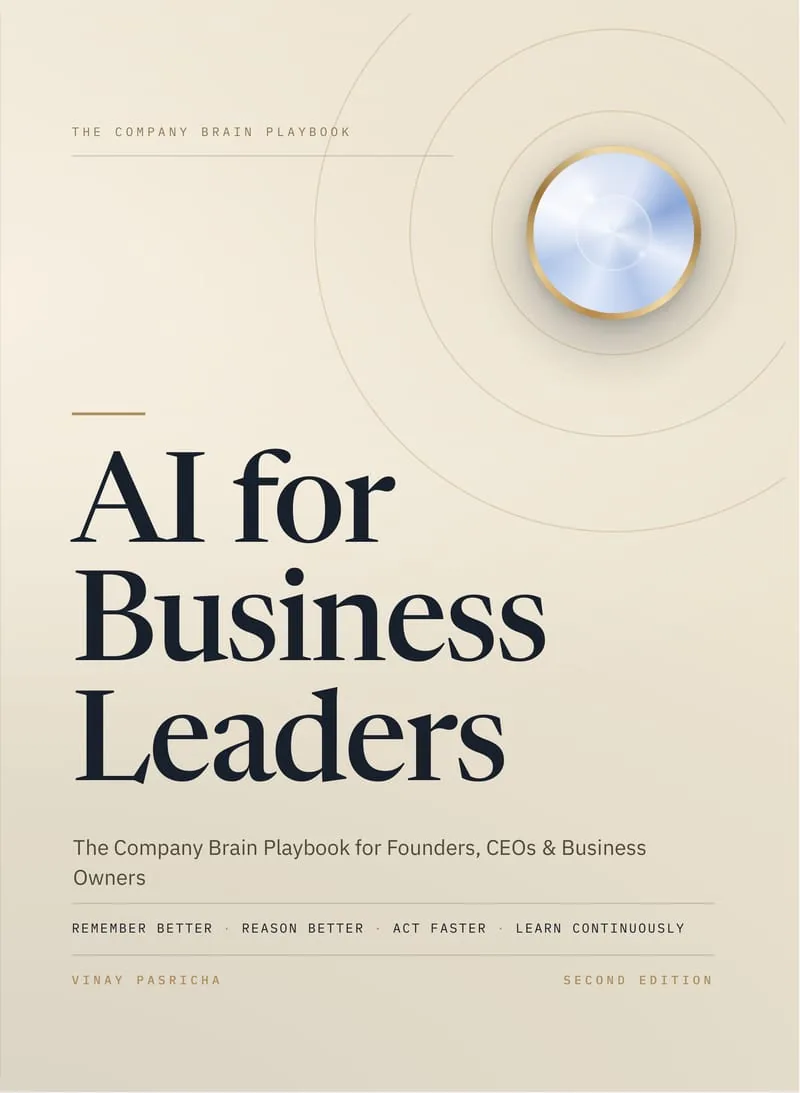
AI for Business Leaders.
AI does not fix chaos. It scales it.
Free delivery across India when you buy direct. Also on and .
The path, the essays, and the videos.
The path
Essays
Videos
For leaders who must move, and still think.
Founders, CEOs, CXOs, operators, and business heads. The book assumes you know how to run a company and asks where AI fits inside that craft. It is not a technical manual: no code, no jargon, and no futurism. In the book’s words, it assumes one thing: you are serious.
The Company Brain, and the tools built on it.
The Second Edition is organised around one idea, the Company Brain: memory, reasoning, action and feedback. These are the frameworks the book builds on it, named as the book names them.
- iThe Company BrainMemory, reasoning, action and feedback. “AI amplifies the system underneath it. So build a system worth amplifying.”
- iiThe Five Things AI Actually DoesIt automates work, supports decisions, powers agents, enables creativity and builds organisational memory.
- iiiThe AI Brain CellA small internal team of three roles. The rule behind it: do not outsource your brain.
- ivMinimum Viable MemoryCapture, structure, retrieve and contextualise what the company knows, so it can use what happened.
- vAutomate, Assist, EscalateAutomate the low-risk, reversible work; let AI prepare and a named human approve the judgement-heavy work; escalate the genuinely high-stakes.
- viThree Levels of AI StrategyEfficiency, effectiveness, advantage: rising from easily copied to compounding.
- viiThe Risk LadderTier 1 (low) to Tier 4 (critical), so that controls match the stakes. AI recommends, humans decide.
- viiiThe 90-Day AI Leadership PlaybookDiagnose (days 1–15), design (16–30), build and run (31–75), then decide to scale, fix or stop (76–90).
Try two of these frameworks on your own team, free: sort your tasks into Automate, Assist or Escalate, or rate an AI project on the Risk Ladder. Each ends with a one-page PDF.
What you take from it.
- A way to see your company as a brain, with memory, reasoning, action and feedback, and to fix the weakest part first.
- Function-by-function playbooks for sales, marketing, support, operations, finance and people.
- Nine implementation appendices, from a 21-statement AI Readiness Audit and a one-page 90-Day AI Pilot Charter to an ROI calculator, a vendor evaluation scorecard, a governance checklist and boardroom AI questions.
- Honesty about pace: start small, but start seriously.
It is not a coding book, and it names no tools. Short videos on the same ideas are on Watch, and AI for MSMEs in India applies them to smaller companies. If you are deciding who should own AI in your company, read Do You Need a Chief AI Officer?
AI does not fix a confused process. It makes the confusion visible — at speed.
That lesson reaches far beyond hiring. AI amplifies the system underneath it. If a company is unclear, AI accelerates unclear work; if its memory is weak, AI searches weak memory. But the opposite is also true: if a company has discipline, AI compounds it.
The companies that win will not be those that merely announce AI adoption. They will be those that use AI to become more intelligent organisations — remembering better, reasoning better, acting faster and learning continuously.
— From the Author’s Note and “A Final Word Before We Begin,” AI for Business Leaders, Second Edition.
Read the opening of AI for Business Leaders.
The Shift You Can’t Ignore
Rajiv Bansal ran a ₹180 crore auto-components company in Faridabad. His father had started it in 1991 with two second-hand machines, eight workers and one customer who trusted him more than his balance sheet. Over three decades it had survived delayed payments, labour trouble, raw-material shocks, three recessions, GST, demonetisation, a pandemic and the ordinary, unglamorous drama of Indian manufacturing. Rajiv had joined at twenty-four, taken over at thirty-four, and grown the company fourfold. By most measures, he was successful. Yet on the afternoon this story begins, he was sitting in his office feeling something he could not quite name — a low, persistent unease that his company was slipping, and that he could not see exactly where.
He was not careless, and the company was not primitive. It had an ERP that had cost a fortune and a consultant to run it. Sales used a CRM, at least officially. Finance produced dashboards every month. Every department had software, and every department was busy. And still the business had begun to feel heavy in a way it had not before. Proposals took a week when they should have taken a day. Follow-up was inconsistent — some customers were chased twice, others forgotten entirely. Inventory surprised him at the worst moments. Customers asked the same questions they had asked six months earlier, as if the company had no memory of them. Good people took months to hire and weeks to replace. And Rajiv himself was still pulled into decisions a company his size should have been able to make without him.
None of these was a crisis. That was exactly the problem. A crisis you can rally against. This was something quieter — a general loss of sharpness, a sense that the machine was running but no longer running well. He had put it down to scale, to a lazy sales team, to the market. He was about to learn it was something else. The Sentence That Stung
The Sentence That Stung
It came during a routine review with a customer his family had supplied for eighteen years — the kind of relationship built on Diwali visits and personal trust. Halfway through the meeting, almost kindly, the customer said the thing that would not leave Rajiv’s head for weeks.
Your quality is good, Rajiv ji. But the newer suppliers are faster. Their quotations come the same day, customised, with the working already done. Your team still takes a week.
It stung because it was true, and because it was not about quality — the one thing Rajiv had always believed was his moat. The newer supplier was smaller, younger, with no famous name and half the experience. But it was sharper at every edge that the customer actually felt: quicker quotations, cleaner follow-up, more responsive people, fewer dropped threads. When Rajiv asked his sales head how a company half their size was out-hustling them, the answer came casually, almost as a shrug: “Sir, they are using AI tools. Their follow-up is automated. Their quotations are half-drafted before the customer finishes explaining.”
Rajiv did not care about the tools. He had heard the letters — AI — a thousand times and filed them under “things the IT vendor will eventually sell me.” What unsettled him was the behaviour underneath the tools. A company with fewer resources than his was suddenly acting like a better-organised company: faster to respond, harder to shake off, more present in the customer’s day. He had assumed his competition was other established players who thought like him. He was wrong. His competition had quietly changed shape.
You are not competing with AI. You are competing with companies that use AI to become faster, sharper and more disciplined than you.
This is the shift this book is about, and it is worth stating plainly because most of the noise around AI hides it. The question on a serious leader’s desk is not “will a machine take my job?” or “is this all hype?” The question is narrower and more urgent: some of my competitors are becoming meaningfully better companies using this technology, and I need to understand how, before the gap becomes permanent.
Company names, examples and figures throughout the book are illustrative or anonymised composites and do not represent any specific organisation.
— The opening of Chapter One, “The Shift You Can’t Ignore”, AI for Business Leaders (PDF edition).
The book is in English.
Liked the opening? Buy the book here and read the rest now.
Before you buy.
What is AI for Business Leaders by Vinay Pasricha?
A leadership guide to using AI without scaling the chaos you already have. It treats the company as a brain — memory, reasoning, action, and feedback — and asks leaders to design that brain before they deploy tools.
Who is AI for Business Leaders for?
Founders, CEOs, CXOs, operators, and business heads who want AI to work for the organisation. It does not require a technical background.
How long is AI for Business Leaders, and when did it come out?
The current edition is the Second Edition, revised and updated, July 2026: a 232-page hardcover, sold on this site, ISBN-13 978-9360769628. The first edition came out in January 2026. The ebook lists a print length of 271 pages and a publication date of 10 January 2026.
How does this book sit with the others?
It is the AI-leadership book in the set. The later books — The SIV Method, Vinay's Execution Doctrine, Organizational Frequency — take up decisions, execution, and hiring once the AI question has a frame.
Do I need a technical background to read it?
No. In the book’s words, “This is not a coding book.” It is written for leaders who run a business, and it names no tools, because tools change while the leadership discipline stays constant.
Watch
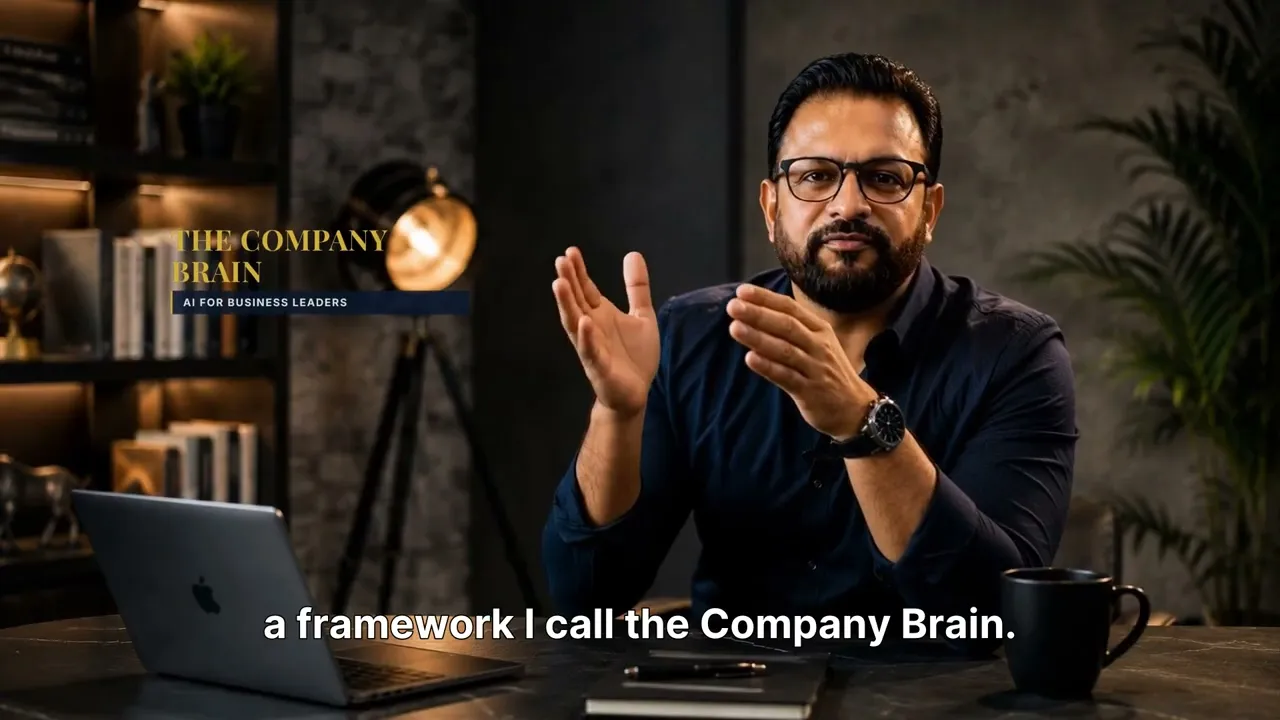

 0:38 · Short
Stop Chasing AI Trends. Start Building AI Systems.
The companies winning with AI have the clearest thinking, not the best tools. Vinay Pasricha on AI as an execution layer designed into the company.
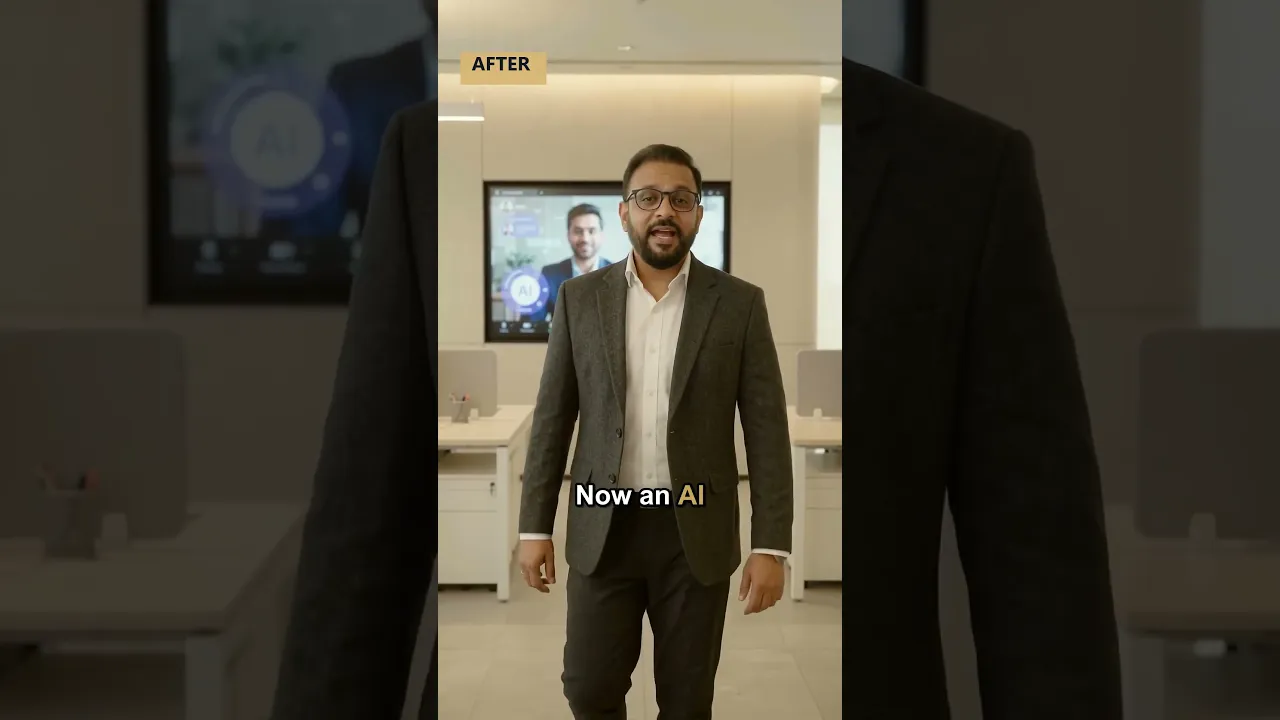 0:55 · Short
How We Figured Out Where AI Belongs in Hiring
How GoodSpace put AI only where hiring kept breaking: screening, offer follow-up and evidence-based decisions. Same team, less chaos, better hires.
 0:36 · Short
Why Most AI Projects Fail Inside Organisations
Many leaders fear moving too fast with AI. Vinay Pasricha argues the bigger risk is waiting for certainty while competitors learn, build and compound faster.
Short answers, from this book.
- Where Should a Small Indian Company Start With AI?
- Which Processes Should We Automate With AI First?
- How Risky Is It to Let AI Reply to Customers Directly?
- What Should a Company AI Policy Say About ChatGPT?
- How Much Does an AI Agent Cost in India?
- AI Agent or a New Executive: Which Comes First?
- How to Start Using AI Agents in a Small Company
- Can AI Agents Run Customer Service?
- How to Measure the ROI of AI Agents
- What Is an Outcome-Based AI Agent?
- How to Pick a First AI Agent Project
- Risks of AI Agents with Customer Data