Short answer: An AI strategy is not a list of tools. It's a short set of decisions: what you want AI to change in the business, where AI may act on its own and where it may not, who owns it, and how you'll know it's working. Start by choosing your level of ambition, find the weakest part of how your company remembers, decides, acts and learns, and fix that first. Then pick two or three use cases, match the controls to the stakes, name an owner and run one governed 90-day pilot. At the end, decide to scale, fix or stop.
I'm Vinay Pasricha. I run GoodSpace AI and I wrote AI for Business Leaders. When a founder or CEO tells me "we need an AI strategy", they usually mean one of two things. Either the board has asked for one, or the company has already run a dozen AI experiments and none of them changed anything. Both lead to the same place. This guide is the process I take them through.
What an AI strategy is, and what it isn't
Most "AI strategies" I'm shown are one of three things: a vendor list, a slide of use cases, or a budget line. None of those is a strategy. A strategy says what you will do, what you won't do, and why.
A useful AI strategy fits on one page and answers six questions:
- Ambition: what should AI change in this business over the next year?
- Foundation: what has to be true about our knowledge, data and processes before AI can help?
- Focus: which two or three use cases will we pursue first, and which will we deliberately ignore?
- Boundaries: where may AI act alone, where may it only assist a person, and where must it stay out?
- Ownership: who is accountable for the outcome, and who can stop a project?
- Proof: how will we know, in 90 days, whether it worked?
The rest of this guide walks through how to answer them.
There is one idea underneath all of it. AI does not fix chaos. It scales it. If a company is unclear, AI speeds up unclear work. If its memory is weak, AI searches weak memory. But if a company has discipline, AI compounds it. So an AI strategy is really a strategy for making the company worth amplifying.
Step 1: Decide what level you're playing at
In AI for Business Leaders I describe three levels of AI strategy. Be honest about which one you're aiming for, because each one needs different people, money and patience.
| Level | What it means | Example | How easy to copy |
|---|---|---|---|
| Efficiency | Do the same work faster or cheaper | Drafting proposals, summarising calls, matching invoices | Easily copied: your competitors can buy the same tools |
| Effectiveness | Make better decisions and do better work | Better demand forecasts, sharper pricing, faster and fairer hiring screens | Harder to copy: it depends on your data and your judgement |
| Advantage | Change what the business can do or offer | A service you couldn't deliver before, at a speed rivals can't match | Compounds over time: it gets stronger as you learn |
Most companies should start at efficiency, because it builds skill and confidence quickly. But don't stop there. Efficiency gains get competed away, because anyone can buy the same tools. The returns that last come from effectiveness and advantage, and those depend on the foundations in the next two steps.
Step 2: Look at your company as a brain
Every company already runs on four functions, whether anyone designed them or not:
- Memory: what the company knows. Customer history, past decisions, pricing logic, how things are actually done.
- Reasoning: how decisions get made, and by whom.
- Action: how work gets executed and handed off.
- Feedback: how the company learns from what happened.
I call this the Company Brain. Before you choose any use case, score each of the four honestly. Where is the company weakest?
- If memory is weak, because knowledge lives in WhatsApp groups, inboxes and one long-serving manager's head, then AI has nothing reliable to reason over. Fix memory first.
- If reasoning is weak, because decisions are slow, inconsistent or all routed through the founder, then AI can prepare better decisions, but someone still has to own them.
- If action is weak, because handoffs break and follow-ups get missed, then that's often where the quickest efficiency wins are.
- If feedback is weak, because nobody checks whether last quarter's decisions worked, then even good AI projects won't improve over time.
AI amplifies whichever part is strongest and exposes whichever part is weakest. Start with the weakest.
Step 3: Build a minimum viable memory
For most companies I see, memory is the weak spot. That's especially true in growing Indian businesses, where you often find an ERP in one corner, Tally in another, a CRM that sales half uses, and the real work happening on WhatsApp and Excel. That isn't a criticism. It's how a lot of good businesses grew. But it means AI has very little to work with.
You don't need a perfect data project to fix this. You need what the book calls minimum viable memory: just enough captured knowledge for your first use cases to work. That means four things:
- Capture. Get the important knowledge out of people's heads and chats. Think price lists, past proposals, standard replies, process notes and decisions with their reasons.
- Structure. Put it somewhere consistent, with clear names and an owner.
- Retrieve. Make sure people, and later AI, can find the right piece quickly.
- Contextualise. Record why something was decided, not just what was decided, so it can be applied correctly next time.
Do this only for the areas your first use cases need. You can widen it later.
Step 4: Pick two or three use cases, and sort the work
Now choose where to start. A simple way to generate ideas is to look at the five things AI actually does in a business:
- Automates work: takes over repetitive steps.
- Supports decisions: prepares options, analysis and recommendations.
- Powers agents: carries out multi-step tasks within limits you set.
- Enables creativity: drafts, designs and explores ideas.
- Builds organisational memory: captures and retrieves what the company knows.
Walk through each function, including sales, marketing, support, operations, finance and people, and ask where each of those five would remove a real bottleneck. You'll get a long list. Cut it to two or three, using three tests:
- It costs you something every week, in money, time or customers.
- You can measure it before and after.
- Someone senior wants it fixed and will own the change.
Then, for each use case, sort the individual tasks into three groups. I call this automate, assist, escalate:
- Automate: low-risk, reversible work that AI can do on its own. For example, tagging enquiries or drafting a first reply for review.
- Assist: judgement-heavy work where AI prepares and a named person approves. For example, a proposal or a shortlist.
- Escalate: genuinely high-stakes work that goes straight to a human. For example, a large credit decision or a complaint that could become legal.
If you want to do this sorting with your team, the free Automate, Assist, Escalate tool walks you through it task by task.
Step 5: Match the controls to the stakes
A wrong draft email is cheap. A wrong credit decision, a leaked customer list or a biased hiring screen is not. Your controls should match the stakes, not be the same everywhere.
The book uses a Risk Ladder with four tiers, from Tier 1 (low) to Tier 4 (critical). Low-tier uses need light checks and can move fast. High-tier uses need named human approval, logging and regular review. The rule across all of them is simple: AI recommends, humans decide.
For each use case, write down:
- Which tier is it on?
- Who checks the output, and how often?
- What happens when AI gets it wrong, and who decides what happens next?
- What data does it touch? In India, that includes your obligations under the Digital Personal Data Protection Act, 2023, whose rules were notified in November 2025 and come into force in phases.
You can rate your own use cases with the free Risk Ladder tool.
Step 6: Name an owner, and don't outsource your brain
AI projects rarely fail because the technology doesn't work. They fail because nobody owns the change after the demo.
The book recommends a small internal team, the AI Brain Cell: three roles that together own how AI is used in the company. In a smaller company that may be three people with other jobs. In a larger one, it may be a dedicated team. What matters is that they're inside the company, they understand how the work actually happens, and they have the authority to stop a project as well as start one.
Use vendors and consultants for what they're good at. But the rule is simple: do not outsource your brain. The understanding of how your company works, and how AI fits into it, has to live inside the company.
Whether you also need a Chief AI Officer is a separate question. I've written about it in Do You Need a Chief AI Officer?
Step 7: Run one governed 90-day pilot
Don't launch ten pilots. Run one properly. The book's 90-day AI leadership playbook has four phases:
| Days | Phase | What happens |
|---|---|---|
| 1–15 | Diagnose | Score the Company Brain, confirm the use case, measure the baseline (how long it takes, what it costs, how often it goes wrong). |
| 16–30 | Design | Sort the tasks into automate, assist and escalate, place them on the Risk Ladder, build the minimum viable memory, and agree who approves what. |
| 31–75 | Build and run | Run the pilot on real work, with the people who do that work. Check results every week and adjust. |
| 76–90 | Decide | Compare against the baseline. Then scale, fix or stop. |
Write the pilot down on one page before you start: the problem, the baseline, the target, the owner, the risk tier and the decision date. The book's appendices include a one-page 90-Day AI Pilot Charter for exactly this.
Stopping is a valid outcome. A pilot that ends in a clear "stop" has taught you something cheaply. The pilots that cost the most are the ones that drift on for a year because nobody wanted to decide.
Step 8: Turn pilots into a loop
A weak company runs pilots. A strong company builds loops.
After the first 90 days, the strategy isn't finished. It repeats: take what you learned, strengthen the memory, pick the next use case and run the next cycle. Each loop should leave the company a little better at remembering, deciding, acting and learning, not just a little more automated. That's how you move from efficiency towards effectiveness and advantage.
Review the one-page strategy every quarter. Keep what's working, drop what isn't, and update the boundaries as you learn where AI can be trusted.
A one-page AI strategy you can copy
| Question | Your answer |
|---|---|
| Ambition: what should AI change here in 12 months? | |
| Level: efficiency, effectiveness or advantage? | |
| Weakest part of the Company Brain: memory, reasoning, action or feedback? | |
| First two or three use cases | |
| What we will not use AI for | |
| Automate / assist / escalate split for each use case | |
| Risk tier for each use case, and who approves | |
| Owner (and who can stop a project) | |
| Baseline and 90-day target | |
| Decision date: scale, fix or stop |
If you can fill this in honestly, you have an AI strategy. If you can't, the gaps tell you where to start.
Mistakes I see most often
- Starting with tools. Choosing a platform before deciding what should change. Tools change every few months. The decisions above don't.
- Too many pilots. Ten small experiments with no owner teach you less than one governed pilot with a clear decision date.
- Skipping memory. Expecting AI to reason well over knowledge that lives in chats and people's heads.
- The same controls for everything. Either everything is locked down and nothing moves, or nothing is checked and something expensive goes wrong.
- No authority to stop. If nobody can end a project that isn't working, every project becomes permanent.
- Expecting AI to fix a messy company. AI makes the confusion visible, faster. Fix the process, then amplify it.
Where the book and the course fit
(Disclosure: I wrote the book and run the course mentioned below.)
Everything in this guide comes from AI for Business Leaders, the Second Edition, in hardcover. The book goes further than I can here. It has function-by-function playbooks for sales, marketing, support, operations, finance and people. It also has nine implementation appendices, including a 21-statement AI Readiness Audit, the one-page 90-Day AI Pilot Charter, an ROI calculator, a vendor evaluation scorecard, a governance checklist and the questions a board should ask about AI. Buy AI for Business Leaders on Amazon.
Building the strategy with your leadership team? It works far better when everyone has read the same frame. For copies for your whole team, use the bulk order form.
Want to check where you stand first? Take the free AI Readiness Check. If you're a smaller business, my guide to AI for MSMEs in India has six low-cost places to start.
FAQ
What is an AI strategy for a business?
It's a short set of decisions about what AI should change in the business, where AI may act on its own and where it may not, who owns it, and how you'll measure whether it's working. A good AI strategy fits on one page. It is not a list of tools or vendors.
How do I create an AI strategy for my company?
Choose your level of ambition (efficiency, effectiveness or advantage). Find the weakest part of how the company remembers, decides, acts and learns, and fix it. Pick two or three use cases, and sort their tasks into automate, assist and escalate. Match controls to the stakes, name an owner, and run one governed 90-day pilot that ends in a decision to scale, fix or stop.
How long does it take to build an AI strategy?
You can write the first one-page strategy in a few weeks. The real test is the first 90-day pilot: 15 days to diagnose, 15 to design, 45 to build and run, and 15 to decide. After that, the strategy becomes a loop you repeat every quarter.
Where should a company start with AI?
Start with one bottleneck that costs you something every week and that you can measure. Before choosing a tool, make sure the knowledge that use case needs is captured and findable. Starting small is fine, but start seriously, with an owner, a baseline and a decision date.
Who should own AI strategy in a company?
A senior person with the authority to stop projects, usually the CEO or founder at first, supported by a small internal team that understands how the work actually happens. Vendors and consultants can help, but the understanding of how your company works should stay inside it.
Where to go next
The full framework is in AI for Business Leaders, the Second Edition, in hardcover: get it on Amazon. For your leadership team, use the bulk order form.
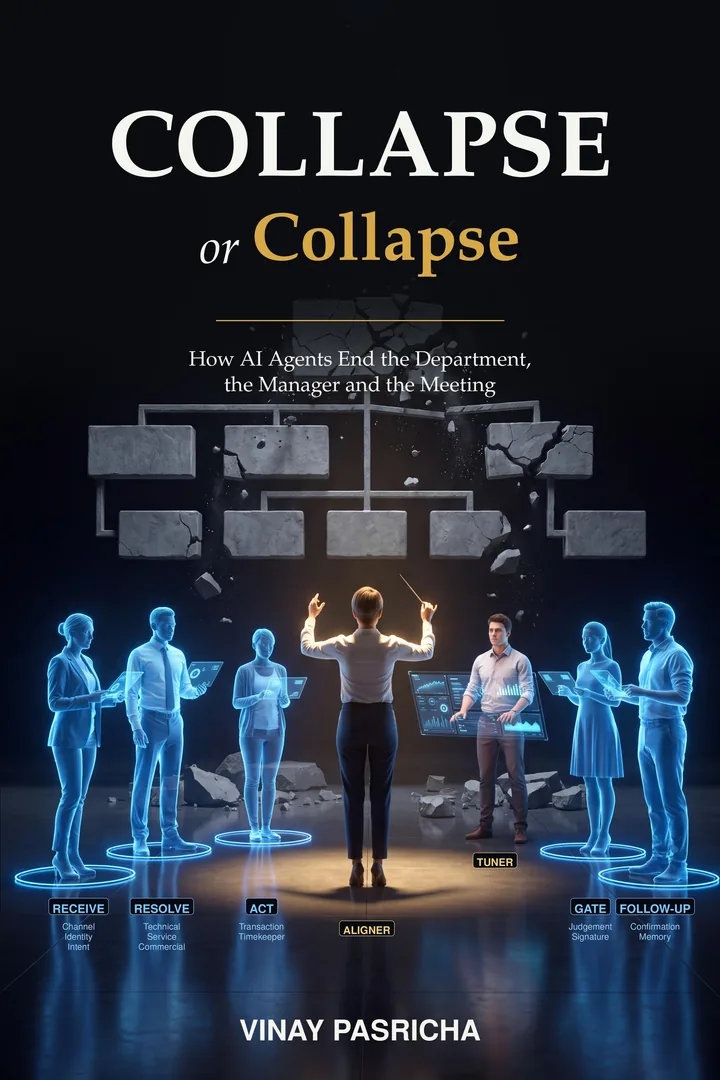
Installing an agent inside each department is a different question, and it is why a lot of AI spend does not show up in the result. Read Why AI isn’t improving productivity, AI organisation design and How to restructure a company for AI. The argument those pages come from is Collapse or Collapse.
Sort your first use case with the Automate, Assist, Escalate tool, rate its risk with the Risk Ladder, and read Do You Need a Chief AI Officer? when you're ready to decide who owns it. For more on AI in Indian companies, see AI for Indian Business.
Vinay Pasricha is the founder of GoodSpace AI and the author of six books, including AI for Business Leaders. Watch his videos on YouTube.
Published 5 October 2026