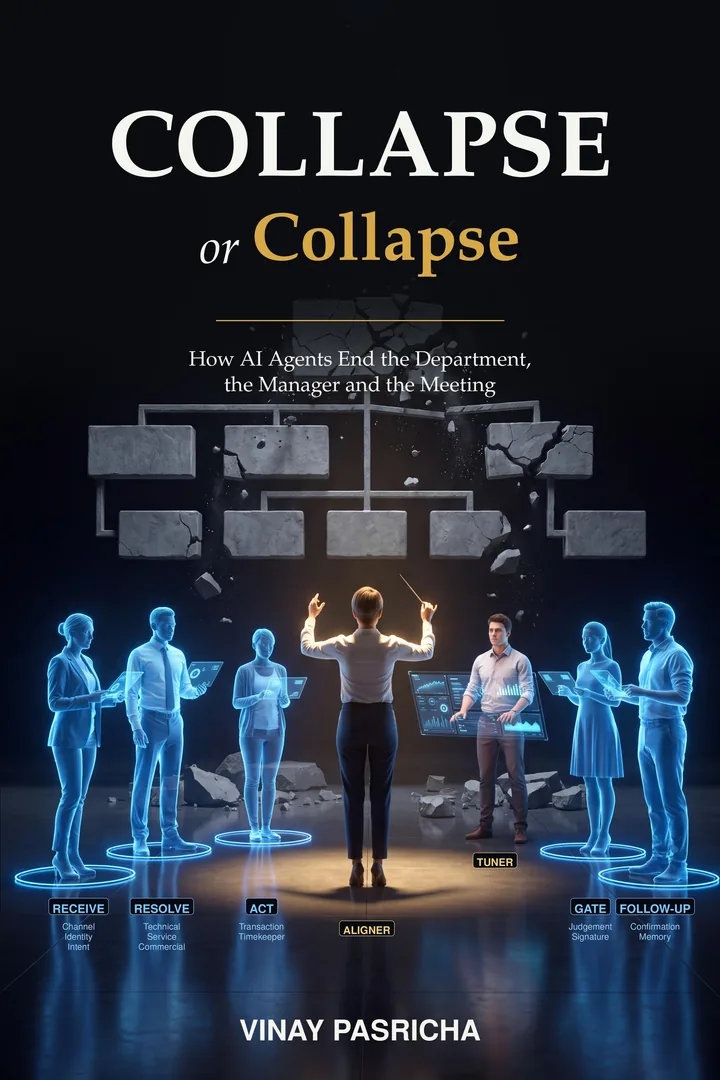
Short answer: Departments exist because no one person could hold every skill a result needs, so companies cut the work by skill and hired managers to pass it between desks. A chain of AI agents can hold those skills in one system, without the handoff. The department was a workaround for a constraint. The constraint has gone, and with it the reason for the department.
I’m Vinay Pasricha. I founded GoodSpace AI, and I am founder and chairman of WLCI. I have built departments, and I have watched a machine do in an afternoon what one of them did in a month. Collapse or Collapse is the case for taking the department down on purpose. A shorter page, the end of the department, sits beside the book. This one is the argument at the length a search question deserves.
The cut
Start with what a company is for. It produces outcomes for someone outside it. Each of those is a single thing to the person who receives it. The customer does not experience sales, then production, then dispatch. He experiences a machine arriving, or not arriving. The outcome is whole on the receiving end.
It comes apart on the producing end, for a reason so old that nobody wrote it down. An outcome needs many skills, and no one person has all of them, and even if one did, no one person has the hours. So the outcome is divided into the parts a single person can carry. Each part is given to a specialist. The specialists are grouped by what they are good at. The groups are called departments.
Note what has happened. The company has stopped being organised around the thing the customer feels and started being organised around the things its people are good at. That is the whole change. Two centuries of management writing describe the consequences. Almost none of it named the cause, because the cause was true everywhere, the way water is invisible to a fish. Chapter 2 names it, because it has stopped being true.
The workaround hardened honestly. Each generation answered the same constraint with the best tools it had. Smith’s pin factory showed what dividing the work could do, and the pin then belonged to nobody. Taylor put the thinking in a different person from the doing; that person is still called management. Ford laid the pieces in a line. The corporation drew the chart. Drucker told managers to look at the customer, and could not tell them how to remove the function, because the constraint still held. The business school taught the workaround as a science: where to cut, how many pieces one manager can hold, how to run the handoffs. Not one course asked whether the pieces needed to exist.
Hammer and Champy saw the leak and said companies should be organised around outcomes. They were right, and the attempt failed, because one person still could not hold every skill. The heads re-formed into desks. Reengineering was this collapse, attempted without the machine that makes it possible.
The price, which the customer pays
Every time an outcome crosses from one desk to the next, three things leak. Context leaks: the second desk knows less about the customer than the first, and the fifth knows almost nothing. Urgency leaks: the person who took the call felt it, and the person who received the file did not. Ownership leaks: at every desk someone did his part correctly, and at the end nobody is wrong, and the result still failed.
The book gives the same leak in ordinary results, and they are illustrations, not a client list. A hire that crosses desk after desk, so the brief is a little further from the client at each one. A loan that takes weeks for a yes that was knowable on the first morning by anyone who held the customer, the numbers and the policy in one head. A discharge in which each desk does its part, and the patient who was well at nine leaves at six. The state, which cut every permission into as many pieces as possible and called the result accountability. It is not accountability. It is the leak made into a building.
Chapter 3 adds the arithmetic. Every result is the product of ability, intention and time. Any term at zero makes the outcome zero. Ability, for most steps, was never the scarce term. Intention that holds when nobody is watching, towards a result that is not your own, is rare. The department hid the person who had switched off inside a function still “doing its part”.
The workaround built the modern world. There was no other way, with the tools then available. What the department does not deserve is to be mistaken for the job.
Why an agent inside each department is not the end of the department
Putting an agent at every desk leaves the cut in place. The desks are faster. The three leaks still happen at every joint, because the joint is still there. Why AI isn’t improving productivity is that story told through the factory. The short version is the cow-path test: if your sentence about the project begins with a department, you have not ended the department. You have given it a better tool and asked it to improve the only number it can see, which is its own.
There is no third category, once you are willing to ask the question the business school could not form. Work that produces a result someone outside would miss becomes an outcome. Work that is a skill used in producing someone else’s result becomes an agent inside the chains that need it. A compliance check, a credit check, a quality inspection, the screening of a hire: skills. Raising capital from the market: a result, and therefore an outcome of its own, with its own chain, not a department beside the chief executive with a hold over every result and responsibility for none. Chapter 13 is the afternoon in which a company sorts itself by that test, and the order in which it then takes the pieces down. Revenue first, and the revenue chain whole. A chain with one department left standing in the middle is not half collapsed. The vectors on either side wait on it, and a vector that waits is a department with a new name.
What the people are for, after the boxes
The end of the department is not the end of the person. It is the end of the person as a carrier of fragments. The chain holds the baseline. A pair of humans hold the gates, sample what passed, and sign where an act cannot be undone. Above them, a master holds an outcome, which is many chains running one playbook. A keeper holds the company: which outcomes exist, which should be born, which should be allowed to die. Two layers, not a pyramid of boxes. AI organisation design is that structure. AI and middle management is what happens to the career that was a climb up the boxes.
If you want the decisions that come before an agent is allowed to act, use the Risk Ladder and Automate, Assist, Escalate, and read AI strategy for business. Those are about controls and use cases. They do not, by themselves, remove the department. The department goes when the result is carried whole.
Read the chapters
- Chapter 2: The Department Was a Workaround, two centuries of the cut and the price of it.
- Chapter 3: Where Outcomes Leak, ability, intention and time.
- Chapter 13: The Collapse Itself, the order for taking the departments down.
FAQ
Will AI agents replace departments?
They remove the reason for departments. Departments were a workaround for the fact that no one person could hold every skill a result needs. A chain of agents can hold those skills, and a named pair holds the gates. The boxes do not fall down by themselves.
What happens to the work a department did?
If it produces a result someone outside would miss, it becomes an outcome, run as a chain. If it is a skill used inside someone else’s result, it becomes an agent in the chains that need it. There is no third answer, and the third answer is how departments survive.
Why isn’t adding AI to each department enough?
Because the delay, the lost context and the lost ownership sit between the desks, not at them. A faster desk leaves the joints where they were. The book calls that paving the cow path.
Vinay Pasricha is the founder of GoodSpace AI and the founder and chairman of WLCI.
Read Collapse or Collapse on Kindle
The full argument is in the book, on Kindle. The chapters linked above are the whole text.