Short answer: AI organisation design is the design of chains, not of boxes. A company is a set of outcomes. Each outcome runs as one or more vectors: one result, one market, one chain of AI agents, one pair of humans at the gates. The organisation chart of functions was a workaround for a constraint agents have removed. Draw the chart again and you will rebuild the workaround.
I’m Vinay Pasricha. I founded GoodSpace AI, and I am founder and chairman of WLCI. When a board asks for an “AI org structure”, it usually means a head of AI, a centre of excellence, and a pilot in each function. That is the old chart with a new box. Collapse or Collapse argues for a different structure, and this page is the design.
Organise around the thing the customer feels
Chapter 2 is the history of the other design. An outcome needs many skills. No one person could hold them all. Companies cut the outcome into skills, grouped the skills into departments, and hired managers to carry the purpose the desks could not see. Organisational design, as it was taught, is the science of where to make that cut: by function, by product, by geography, by matrix, and the trade-offs between them. Every word of it assumes the outcome must be divided.
When one system can hold every skill, there is one design, and it is the outcome itself. There is nothing to cut. Span of control was the limit of a human’s attention over other humans doing work she could not see. When only the things that need a person reach her, the pyramid does not grow a third layer, because a third layer has nothing to carry.
Functional strategy goes the same way. There is no marketing strategy, operations strategy and HR strategy, each optimising its own piece. There are outcomes, and each has one strategy, which is the result it exists to deliver. The work the functions used to do divides in two, and the test is one question: is this a result, or a skill? A result becomes an outcome. A skill becomes an agent inside the chains that need it. No answer gives it a department. The end of departments is that test at full length.
Why the old words rebuild the old chart
Chapter 5 is stern about vocabulary, and it is right to be. The words were built for the workaround, and they rebuild it every time they are used. Say “team” and the reader sees six people in a room dividing a result. The person who runs a chain has no team in that sense. Her team is the chain. Say “manager” and the reader sees someone who stitches pieces together and sits in the meetings the stitches require. Say “department” and the reader reaches for a head, a budget and a number of his own.
The book uses a small set of words so the chart cannot sneak back in through a synonym.
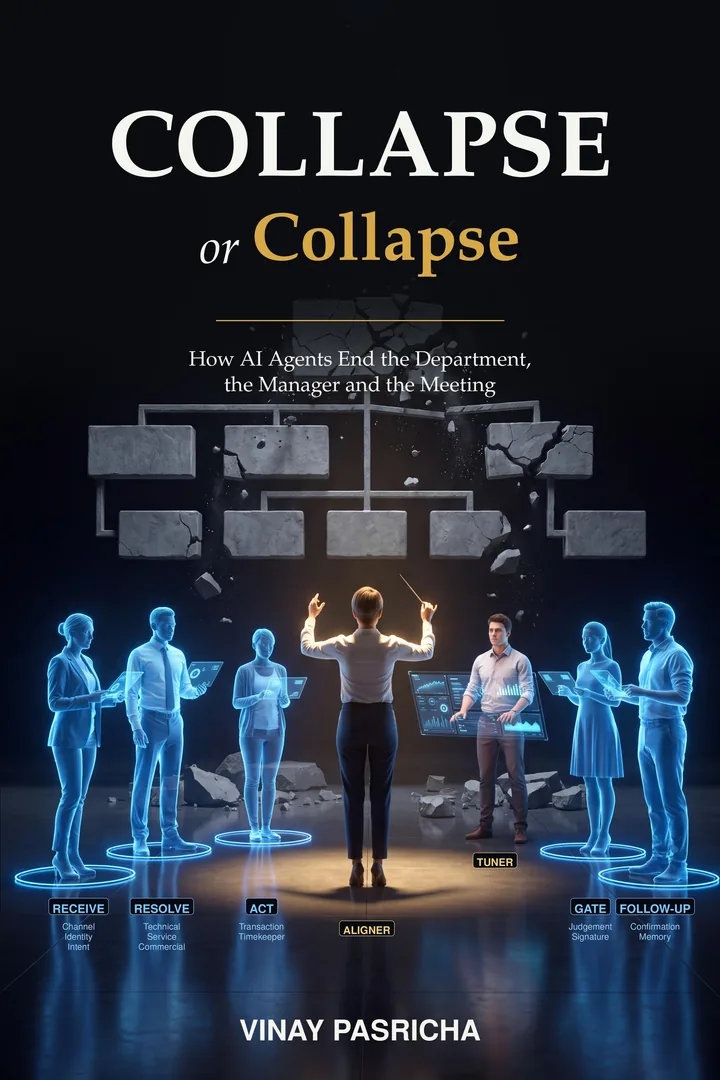
The keeper holds the company: what it exists to produce, which outcomes serve that, which should be born or allowed to die. A master holds one outcome, which is many chains running one playbook. A vector is one running copy of that playbook: one result, aimed at one market, carried by one chain of agents, held by one pair. The aligner owns the result and holds the gates. The tuner builds and changes the chain, and each is the other’s standby. An agent is one step. A gate is the point between steps where the work may pass, or must wait for a signature.
You do not need to adopt the words to see the design. You do need to notice when a familiar word has smuggled a department back onto the page. A pod that still hands work to another pod is a department. A centre of excellence that sells agents to the functions is the workaround selling tools to itself.
The unit that actually produces something
Nothing smaller than a vector produces anything a customer would notice. An agent on its own is a skill, and a skill delivers nothing until it sits in a chain. Nothing larger is necessary. If you can build one vector, you can build the company, because the company is that vector copied.
Inside one vector sit the chain, the gates, the alarms and the pair. Gates follow the stakes. Reversible gates default open after a period the playbook sets; the aligner samples them. Irreversible gates, where money leaves, a name goes out or a promise is made, wait for a named person however long it takes. Every agent reports its own flow. A vector that can stall unseen is a department with software. The aligner does not manage a room of people. She speaks, by default, to one agent that answers for the whole chain, and she can go deeper when she asks.
Chapter 10 is the doctrine once the stories are over: twelve lines, each with a Monday-morning test. I will not paste all twelve here. Four of them are the org chart.
The department was a workaround. Organise around outcomes, not activities: work that produces a result is an outcome, and work that serves a result is an agent. Every outcome runs on a vector. Count vectors, not employees. The size of the company is the number of results it carries at once, not the number of people who carry fragments of them. A company that can only describe itself by headcount is still counting the wrong thing.
The other tenets hold the design in place: machines hold the baseline and humans supply the peaks; pay for intention, not for skill, because skill is in the chain; no silent stalls; every vector has a standby. GoodSpace, where I first tried this, does not yet hold every tenet, and the book says so. A design that can say where it fails is a structure. A design that pretends to be finished on the first Monday is a slogan.
How to draw it on one page
List the results a customer outside the company would miss if they stopped. Not the departments. The results. For each, name the chain that could carry it from the first word to the moment the customer feels it, and name two people. Everything that does not appear in any chain is either a result you forgot, in which case it is an outcome of its own, or a skill you have been housing in a department, in which case it belongs inside the chains.
Then look at who reports to the top. For each person, ask what outcome she masters. If the answer is a function rather than a result, the department has come back in through the front door. That is the book’s test for the functions kept beside the chief executive: legal, finance, people, technology, each with a hold over every result and responsibility for none. Some of that work is a real outcome. Raising capital is. Most of it is a check that belongs at a gate.
Do this on paper before anyone moves. How to restructure a company for AI is the order after the drawing: revenue first, and that chain whole. Outcome-based organisations is how the pair is paid and judged. The controls on any single agent, before it acts, are the Risk Ladder and Automate, Assist, Escalate. An org chart that skips those controls will ship promises no one signed.
Read the chapters
- Chapter 2: The Department Was a Workaround, why the old design existed.
- Chapter 5: A New Vocabulary, the words that do not rebuild it.
- Chapter 10: The Twelve Tenets, the Monday tests.
FAQ
What is an AI-native organisation structure?
A set of outcomes, each run as chains of AI agents, each chain held by a pair of humans at the gates. The company is counted in results, not in departments or headcount. A head of AI beside an unchanged chart is the old structure with a new title.
What replaces the department?
An outcome, if the work produces a result someone outside would miss. An agent inside those chains, if the work is a skill used in producing a result. The book allows no third thing.
How is this different from a matrix organisation?
A matrix is still the cut: two ways of slicing the same fragmented work, with two managers stitching it. The design here does not slice the result. One chain carries it, and one pair owns it.
Vinay Pasricha is the founder of GoodSpace AI and the founder and chairman of WLCI.
Read Collapse or Collapse on Kindle
The full argument is in the book, on Kindle. The chapters linked above are the whole text.