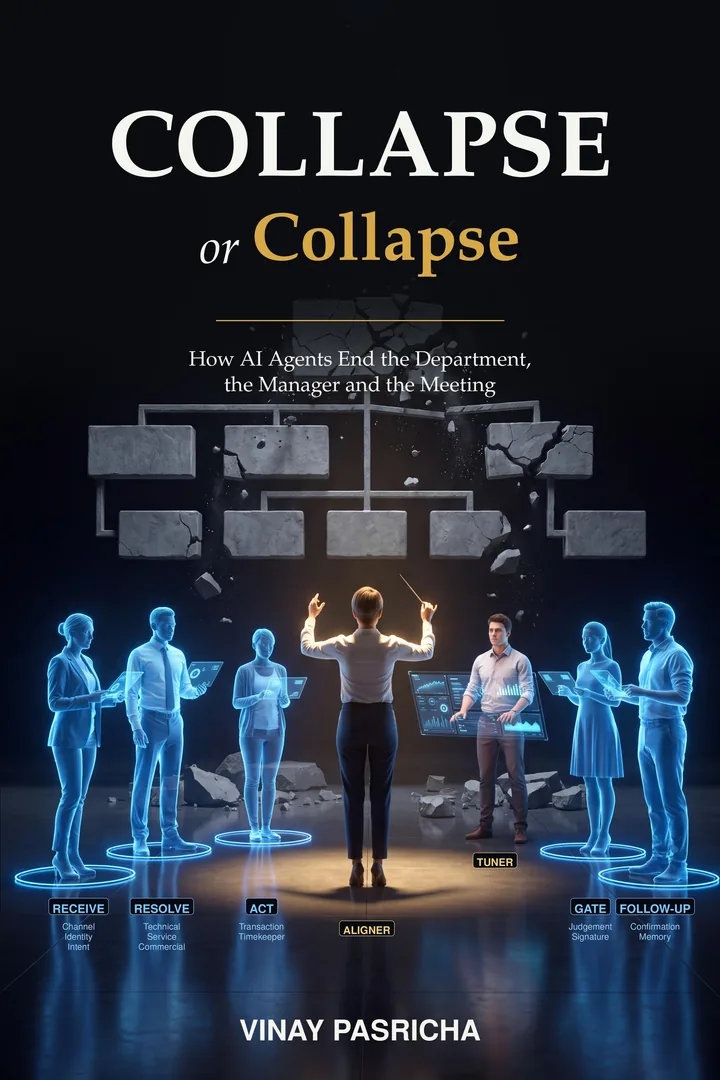
Short answer: An outcome-based organisation is not a department paid on a KPI. It is a company whose unit of work is a result someone outside would miss, carried end to end by a chain of AI agents, held by a named pair, and judged on that result. Activity, tokens and “tasks completed” are not the outcome. If you cannot name the result, the limit, and the person who signs, you do not have an outcome-based design. You have a target stuck on a tool.
I’m Vinay Pasricha. I founded GoodSpace AI, and I am founder and chairman of WLCI. “Outcome-based” has become a pricing phrase. Collapse or Collapse uses it as a structure. This page is the structure. The short answer to the pricing phrase is what is an outcome-based AI agent.
A result is what the receiver feels
An outcome is a change the receiver feels: a mandate that becomes a person who joins, a patient discharged, an invoice paid, a machine that ships. An activity is a step towards one. The old company organised around activities because activities were what its people were good at. The person in sales was good at selling. The person in delivery was good at delivering. Each hit a number. The customer fell into the gap between the numbers.
An outcome-based organisation closes the gap by refusing to draw it. Chapter 9 builds the recruiting case, because sales is the work people assume cannot be run this way. At GoodSpace the tempting line is a signed mandate. It is clean, and it is wrong, because a signature is not what the customer feels and it is not what the company is paid for. The book draws the result where both sides feel it, matches the vector that wins the work to the vector that delivers it, and measures them on the same number. A winning chain that brings in work the delivery chain cannot close has not done its job, however many signatures it collected. A delivery chain that fails on good work has not done its job either. Neither has a department to blame.
That is the first rule. Design backwards from the result, and draw the result where the customer feels it. When the result sits between two chains, size them together and measure them together.
The chain is then the steps, one agent per step, with gates between them. Most gates are reversible and open on their own after a period the playbook sets. A few are irreversible, and they wait for a person. The pair is an aligner, who owns the result and signs, and a tuner, who builds the chain and can run it when the aligner is away. Around them stand the agent that answers for the whole chain when a human asks, and the agent that proposes improvements to the others. AI agents for business is that chain from the buyer’s side. AI organisation design is the company made of many of them.
The second sentence, which keeps the first one true
Chapter 10 states the tenet in two sentences. Organise around outcomes, not activities. Work that produces a result is an outcome; work that serves a result is an agent.
The second sentence is the one companies skip, and it is the one that stops the department from returning under a new name. Whenever a piece of work does not obviously belong anywhere, ask whether it produces a result in its own right, one that someone receives and would miss, or whether it is a check or a skill used in producing someone else’s. Raising capital is a result. It is an outcome, with its own chains and a master who signed up to deliver it. Compliance is a skill. So is the finance check on a price, the legal review of a contract, the inspection of a batch, the screening of a hire. Each is an agent, standing inside the chain at the step where it is needed. The same word, finance, can name an agent in one company and an outcome in another. The test is never the name of the work. It is the outcome wanted.
The dangerous version of the function is the one at the top: the legal head, the finance head, the head of people, sitting beside the chief executive with a hold over every result and responsibility for none. List every person who reports to the top. For each, ask what outcome she masters. If the answer is a function, the department has come back through the front door, and no amount of outcome language in the bonus plan will evict it.
Pay follows the result, and it pays for intention
Chapter 11 is the pay of this organisation, and it is easy to vulgarise, so I will stay with the principle and leave the worked numbers in the chapter. They belong to an imaginary firm. They are a design, not a payroll you should copy.
The old company bought time and hoped for attention. It paid for skill and seniority, called people its greatest asset, and paid them like a cost. Skill is now in the chain, and the chain’s cost is a fraction of a salary. What remains scarce is intention that holds: on a bad week, in the month before a bonus, after the third rejection, towards a result that is not only your own. The doctrine selects for that once, at the door, and pays it very highly, far above the market, because one person with that intention and a chain beneath her produces what a department produced.
The formula has two parts, equal at the target the vector was designed for. A base, fixed. A share that moves with the result. Below target the share falls and the base is untouched. The company does not raise the target because the pair have beaten it. A company that re-targets has told its pairs that the way to be paid is to grow slowly. Pay follows the vector. It does not lead it. The book is plain that GoodSpace does not yet pay at the level the doctrine describes, because the vectors do not yet produce enough to carry it. Attention is read from the work, from the record, not from watching the person. The result is the appraisal.
What “outcome-based” gets wrong
Three mistakes account for most of the phrase as it is sold. The agent is treated as the owner. It is not. The person who signs is the owner, including on the day the agent is switched off. The outcome is drawn at a convenient internal event, a signature or a ticket, rather than at what someone outside would miss. Or the outcome is a department’s own KPI with an agent tied to it. “HR will screen more CVs” begins with a department, which is the cow-path test in why AI isn’t improving productivity. An outcome-based organisation deletes the function’s number and keeps the customer’s.
Sort the steps before the chain goes live. Automate, Assist, Escalate is the sort. The Risk Ladder is the stakes. AI strategy for business is the one-page set of decisions around them. Then read the chapters, because the strategy page will not, by itself, redraw the company.
Read the chapters
- Chapter 9: The Vector, where the result is drawn and the chain is built.
- Chapter 10: The Twelve Tenets, including “organise around outcomes, not activities”.
- Chapter 11: Pay for Intention, Measure Attention, how the pair is paid.
FAQ
What is an outcome-based organisation?
A company whose unit of production is a result someone outside would miss, carried by a chain of AI agents and held by a named pair, judged and paid on that result. It is not a set of departments with outcome language added to their targets.
How do AI agents fit an outcome-based organisation?
One agent does one step. The chain of agents carries the result end to end. A person signs where the act cannot be undone and owns the result. An agent that only speeds up a department’s activity is not yet inside an outcome-based design.
How should people be paid in an outcome-based company?
On the result their chain carries: a fixed base set high, for the intention the company selected, and a share that moves with the result against a target that is not raised just because they beat it. The book’s numbers for this are a design for an imaginary firm, not a salary survey.
Vinay Pasricha is the founder of GoodSpace AI and the founder and chairman of WLCI.
Read Collapse or Collapse on Kindle
The full argument is in the book, on Kindle. The chapters linked above are the whole text.