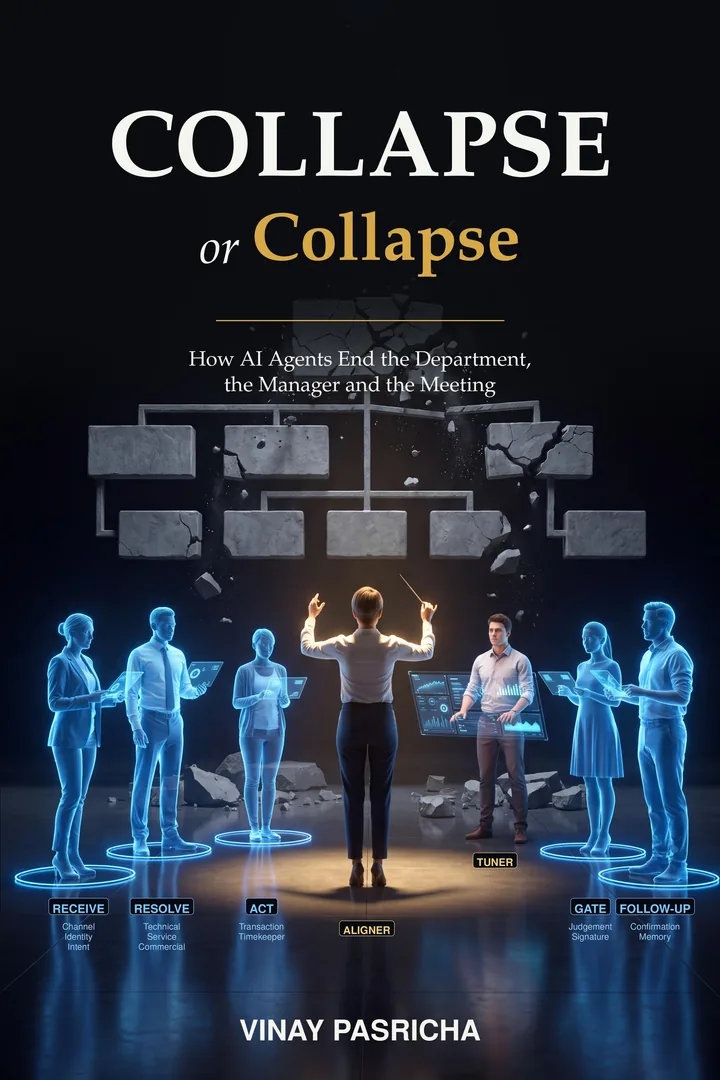
Short answer: AI isn’t improving productivity in most companies because the agents are being installed inside the old structure. Each desk gets faster. The delay was between the desks, in queues, handoffs and meetings. Factories that put an electric motor where the steam engine stood saw the same thing: little gain until the floor was rebuilt around the new machine.
I’m Vinay Pasricha. I founded GoodSpace AI, and I am founder and chairman of WLCI. The question I hear, once the demos have been applauded, is why the company does not feel faster. Collapse or Collapse answers it with a factory, a phrase from 1990, and a one-minute test. This page is that answer.
A motor where the steam engine stood
In the 1890s a mill could take its steam engine out and put electric motors in the basement, belted to the same shafts, the same pulleys, the same rows of machines. The power was new. The floor was not. The historian Warren Devine’s line, which the book quotes, is that replacing the engine and leaving the power distribution unchanged was the usual way a new technology was laid onto an old frame. Nobody there was foolish. The shafts were paid for, and they worked.
The book follows the economic historian Paul David on what happened next. The motor worked from the beginning. The delay was in the factory. For years the usual electrification added motors to the equipment a plant already had, with the old belts and shafts left in place. The plant then carried two systems where it needed one. The gain came when the factory was rebuilt around the new machine: a motor at each machine, the building no longer shaped around overhead shafting, the machines arranged in the order of the work rather than in rows beside a shaft. David’s warning, which I have not been able to stop thinking about, is that you cannot wait for an information structure to wear out. Departments do not fall down. Somebody has to decide to take them down.
The line shaft is the organisation chart. It is the fixed structure through which all the power runs, which every machine must stand beside, and which turns from morning to night whether one file is moving or forty. A department holds its weekly review on the same rule. A chain of agents, one result, laid out in the order of the customer’s journey, is the unit drive: power at the work, not power at the centre with belts to every desk.
The four ways companies pave
I have stood in that basement more often in the last three years than I can count. It is not in Connecticut. The owner agrees with some of the argument and then describes a copilot at every desk, a chatbot in front of the same desks, a pilot owned by the department being changed, or an agent dropped in where the people were and still scored on the department’s number. Chapter 4 names all four. The joints stay. Give a department an agent and it will use the agent to improve the number it is measured by. The slow desk downstream receives more, not less. Nobody owns the outcome, because the agents were bought and judged by functions, exactly as the desks were.
Michael Hammer’s line, which the book takes up from 1990, is to stop paving the cow paths: companies use technology to speed up old ways of doing business and leave the processes intact. His Ford example is the copilot, thirty years early. Helping the clerk investigate mismatches faster was the small improvement. Preventing the mismatches was the different design. The chapter has the citation. I will not borrow the percentages.
Robert Solow wrote in 1987, in a sentence the book quotes, that you can see the computer age everywhere but in the productivity statistics. The tools are visible. The floor has not moved.
The cow-path test
Here is the test, and it takes a minute. Describe any AI initiative in your company in one sentence, by saying what it makes faster. If the answer begins with the name of a department, you are paving.
“The claims desk now reads documents with an agent.” Paving. “HR screens CVs with AI.” Paving. “Finance closes the books in fewer days.” Paving, however welcome the fewer days are, because the sentence is about a department’s own piece. Say it the other way, beginning with what the customer feels. “The car is repaired and the owner is paid in the days he was promised, and one chain holds registration, assessment, survey, approval and payment.” That sentence does not mention a department, because there is none in it.
Three questions follow, and an owner can ask them of any project on the desk. How many handoffs will the outcome cross after this goes in, and how many did it cross before? Who signs for the outcome the customer feels, by name? Which desk will not exist a year from now? If the count of handoffs has not changed, if the signature belongs to a function, and if no desk is going, you have bought a motor for the basement.
Why the chart of gains looks like a J, and why paving never climbs it
Later work gave that history a shape the book borrows carefully, and I will not repeat figures here. A general-purpose technology needs new processes, not only new machines. Measured output stalls while the company reorganises, and rises when the new way is actually in use. Drawn, it is a J. The bottom of the J is the reorganisation: paying for the new way while the old one is still running.
A copilot at every desk is designed to need none of that reorganisation. The desks, the handoffs, the approvals and the meetings stay. So the company never climbs the J. It stays at the bottom, with the motor and the shafts both on its books, paying for the agents and for the departments. That is the most expensive company there is.
The other path does the reorganisation on purpose, and whole. Chapter 13 is the order: revenue first, and the revenue chain taken whole, not one department a quarter for five years. There is a dip. It is the weeks in which the new chain runs beside the old one and the company pays for both. Running both with a day on which the old chain stops is a test. Running both with no such day is a motor in the basement, and the shafts still turning overhead.
The chapter also says, plainly, that the worked example later in the book is a design, not a measurement of a real firm. Do not take a composite’s figures as your forecast. Take the shape: the gain waits on the floor, not on a better motor.
What to do this month
Pick one result your customer feels, from the first word to cash. Map every desk it crosses. Count the handoffs. Name the person who will sign. Read AI agents for business if you need the chain, and how to restructure a company for AI if you need the order. Sort the tasks with Automate, Assist, Escalate before you let an agent act, and rate the stakes on the Risk Ladder. The decisions that belong in a one-page strategy are in AI strategy for business. None of them is “buy a copilot for each function”.
Read the chapters
- Chapter 4: A Motor Where the Steam Engine Stood, the history, the four forms of paving, and the cow-path test.
- Chapter 13: The Collapse Itself, the order in which a company rebuilds the floor.
FAQ
Why isn’t AI raising productivity?
Because the agents are being put inside the old structure. Desks get faster, and the delay was between the desks. The gain waits on redesigning the work around the outcome the customer feels.
What is the electric-motor analogy for AI?
Factories that replaced a steam engine with a motor and kept the shafts and the layout saw little of the new power’s benefit. The gains came when the factory was rebuilt around a motor at each machine. The book argues that an agent at every desk is the same mistake.
What is the cow-path test?
Describe an AI initiative in one sentence by saying what it makes faster. If the sentence begins with a department, you are paving the cow path. Say it again from what the customer feels.
Vinay Pasricha is the founder of GoodSpace AI and the founder and chairman of WLCI.
Read Collapse or Collapse on Kindle
The full argument is in the book, on Kindle. The chapters linked above are the whole text.