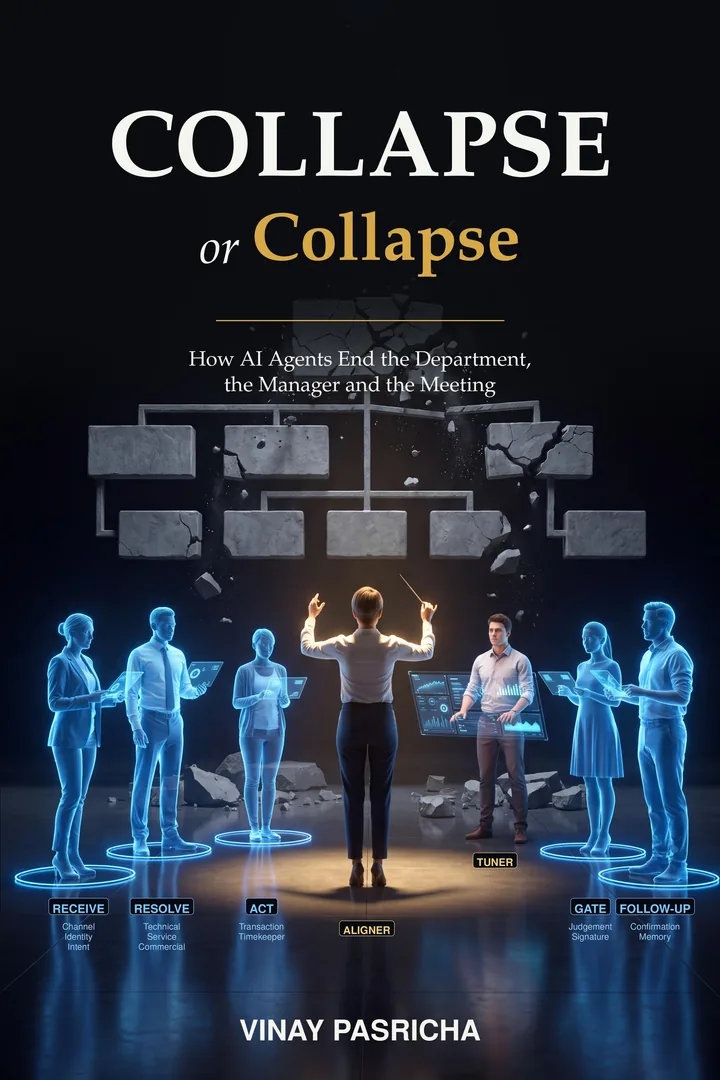
Short answer: Do not bolt an agent onto each department, and do not try to redraw the whole company on one morning. Restructure around outcomes, in an order. Take the revenue chain first, because its result is the one nobody can argue with, and take that chain whole, from the customer’s first word to cash. Sort everything else by one test: does it produce a result, or is it a skill inside someone else’s result?
I’m Vinay Pasricha. I founded GoodSpace AI, and I am founder and chairman of WLCI. A firm cannot collapse one thing a quarter for five years and call the result a collapse. It also cannot collapse everything before breakfast. Collapse or Collapse gives the order in Chapter 13, worked through an imaginary pump maker so the sequence can be seen. The figures in that chapter are a design, not a measurement of a real firm. This page is the order, without those figures. If you only have a month and one result, Chapter 20 is the small version. Do that before you touch the whole company.
Two rules before any calendar
The first rule is revenue first. The outcome closest to the invoice goes before any other, because its result is the one nobody in the building can explain away. When a quote that took days goes out the same morning and the order comes back, the owner holds a number. Every later change happens in the shadow of that number. Collapse the plant first and the owner spends a year defending a cost saving. Collapse the revenue chain first and the year is about a result the customer felt.
The second rule is that the revenue chain goes whole. The path from a customer’s first word to cash runs today through sales, an order desk, contracts, dispatch, invoicing, collections, and the people whose job is carrying messages between them. A chain with one department left standing in the middle is not half finished. The new work on either side waits on the surviving department, and a chain that waits is a department with a new name. So that chain is switched on one day, every department in it, and nothing else in the firm is touched that day. The rest follows one outcome at a time, each proven before the next, by the only test there is: the result for the week, with no department left in the chain.
Why AI isn’t improving productivity is what happens if you ignore both rules and put an agent in each department instead. The pilots succeed. The joints, which is where the time lives, are the part the pilots were designed not to touch.
The afternoon sort
Before anyone moves, sort the work on paper. It takes an afternoon, and there is one test. Does this work produce an independent result, something someone outside would miss, or is it a skill used in producing one? There is no third answer. The third answer is how the department survives the meeting.
In the book’s worked example, winning an order is a result. Cash against an order shipped is a result. A finished unit from raw material is a result. A first unit of a new design, shipped, is a result. Capital on the balance sheet, on terms, is a result. Buying, inspecting, invoicing, the credit check, the contract review, payroll, the systems that keep other systems talking: skills. They become agents inside the chains that need them. They do not keep a head, a budget, or a seat beside the person who owns the result.
Apply the same test to the people who report to the top. If what they master is a function rather than a result, the department has come back through the front door. Some of the owner’s own desk will fail the test. Statutory accounts, filings, the work that feels unsayable because the auditor knows the people by name: skills, inside the outcomes they serve. The book leaves that desk until late on purpose, and then applies the test anyway. An owner who exempts his own people has not restructured the company. He has restructured everyone else’s.
Write the order down and say it in one room, to everyone, before the rumours say it for you. Which month, which seats, that most people will not be in those seats, and how the people who leave will be treated. Chapter 13 is blunt about this, and a page that smoothed it would be a lie. AI and middle management is the career that remains for the people who hold a chain.
Build beside the old chain, then switch
Do not turn an agent on inside a live promise and hope. For the revenue chain, the book’s sequence is: design the seats, build the agents, run them beside the departments on live enquiries and live orders with nobody acting on them, and then switch a department off rather than an agent on. The overlap is a test. It has a last day. An overlap with no last day is the motor left in the basement while the shafts keep turning, which is the failure Chapter 4 is about.
On the day itself, the old posts in that chain stop and the vectors start. A quote is priced against live capacity and one person signs. An invoice does not wait for a department that batches on Fridays, because invoicing sits in the chain. A vector that fails is rebuilt, not given a person to paper over it. Adding a person is how the department returns in week three.
Then stop. Prove the chain before the plant, the design office or the corporate centre is touched. When the plant’s turn comes, the people between the machines go before the hands at the machines. The chasing and the recording are the workaround. The book does not pretend a chain of agents replaces a person standing at a machine on day one.
If you only have a month
Nothing in the book asks you to believe it. It asks for one month and one vector. Chapter 20 lays it out as a calendar, with a Monday as day one.
Week one: find the vector. One result a customer outside the company receives and would miss. Not a department’s output. Map every desk it crosses. Name a pair.
Week two: build a chain of agents beside the old one. Do not switch.
Week three: switch. The old path for that one result stops.
Week four: read the record. Days from first word to cash, against the instances you measured in week one. Handoffs, against the number you counted. Gates, against the approvals you used before. Write the decision in one line: keep it, fix it, or stop.
That month will not restructure the company. It will tell you whether you are willing to take one result whole. If the line you wrote is “keep it”, go back to the two rules and take the revenue chain.
Before any agent acts, sort the tasks with Automate, Assist, Escalate and rate the stakes on the Risk Ladder. AI strategy for business is the one-page version of those decisions. AI organisation design is the company when the order is finished.
Read the chapters
- Chapter 13: The Collapse Itself, the order, month by month, through an imaginary firm.
- Chapter 20: The Reader’s Month, one result, four weeks.
- Chapter 4: A Motor Where the Steam Engine Stood, why a pilot inside each department is not this restructure.
FAQ
Where should a company start restructuring for AI?
With the revenue chain, from the customer’s first word to cash, taken whole on one day. Its result is the one nobody in the building can argue with. A chain with one department left in the middle is not half done.
Can we restructure one department at a time?
Not if the department is a slice of a result that still crosses other departments. Sort by result, not by the name on the door. Skills become agents inside the chains. Results become outcomes. A department-shaped pilot never touches the joints.
How long does the restructure take?
The book’s small version is one month and one result. The full order is a year of sequence, not a year of spreading the change thinly: prove the revenue chain, then the next outcome, with the owner’s own desk included before the end. The imaginary firm’s figures are a design, not a forecast for yours.
Vinay Pasricha is the founder of GoodSpace AI and the founder and chairman of WLCI.
Read Collapse or Collapse on Kindle
The full argument is in the book, on Kindle. The chapters linked above are the whole text.