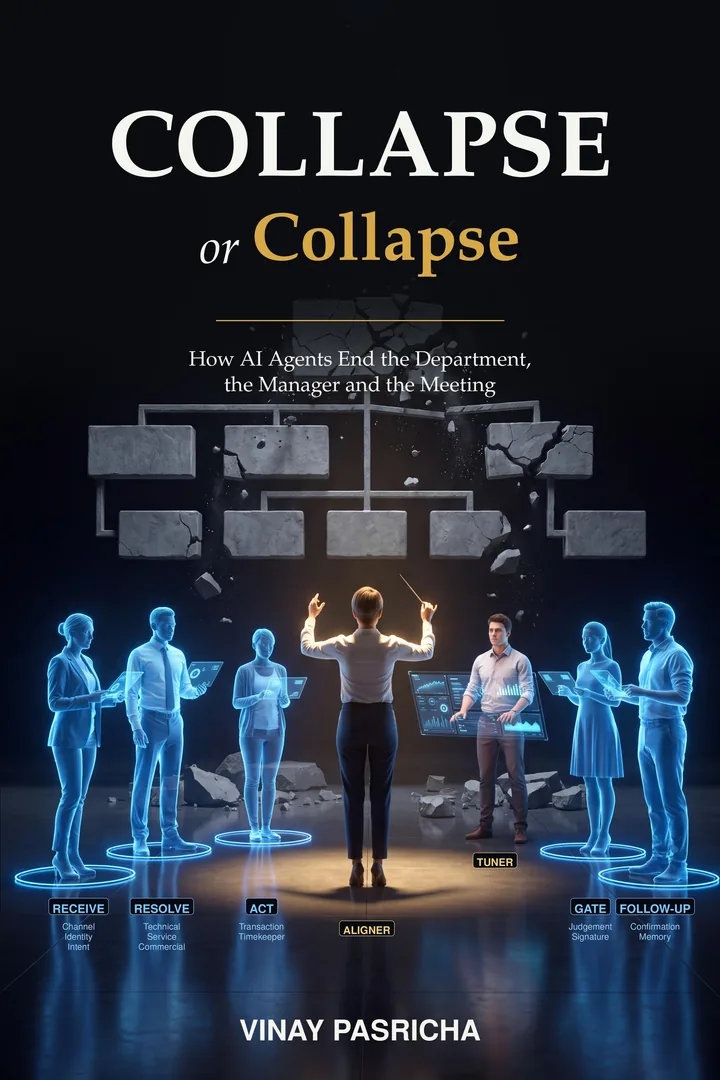
Short answer: An AI agent helps a business when it sits in a chain that carries one result a customer would miss, with a named person holding the gates. An agent that only makes one desk faster is a skill with nowhere to deliver it. The result still waits in the queues between desks.
I’m Vinay Pasricha. I founded GoodSpace AI, and I am founder and chairman of WLCI. Collapse or Collapse is the argument I wrote after watching companies buy agents and leave the organisation chart exactly as it was. This page is that argument, applied to the question people actually type: what are AI agents for in a business?
What an agent is for
A business exists to produce something someone outside it can feel. A hire who joins. A loan in the account before the order is lost. A patient who was well at nine and is home by lunch. A repaired car and a payment that arrives when it was promised. The customer does not experience your departments. He experiences the result, or the wait.
An agent, in the sense that matters here, takes a step in that result. It finds, qualifies, drafts, checks, schedules, prices, or chases. On its own it is a skill. A skill delivers nothing until it sits in a sequence with the other skills the result needs, and until someone owns what comes out the other end. Chapter 9 calls that sequence a vector: one result, aimed at one market, carried by one chain of agents, held by one pair of humans.
That is the whole design. Nothing smaller produces anything a customer would notice. Nothing larger is required to produce it. An outcome, in the book’s vocabulary, is many vectors running the same playbook. A company is many outcomes. If you can build one vector well, you can build the company, because the company is that vector, copied and varied.
Why a faster desk does not change the result
Most of what I am shown, when a founder says they are “using agents”, is a motor put where the steam engine stood. The old floor is still there. The agent is belted to it. It comes in four forms, and Chapter 4 walks through each of them.
A copilot at every desk. The brief is written faster, the search is wider, the screen reads more files an hour, the offer is drafted in a minute. Every desk can prove it is faster, with a number for its own step. The customer still waits, because the wait was never at the desks. It was between them: the queue, the brief that lost a little of the customer at every pass, the diary that nobody else can see.
A chatbot in front of the same desks, so the front door is new and the house is not. A programme whose pilots are chosen by the departments that will run them, so each pilot succeeds and none of them touches a joint. An agent put where the people were, still inside the department, still scored on the department’s number, with nobody at a gate owning what the customer feels.
The agents in all four cases can be good. The failure is not the model. Give a department an agent and it will use the agent to improve the number it is measured by, which is the only rational thing for it to do. The screening desk screens more, so more paper arrives at the desk that was already the slowest, and the customer waits a little longer for a little more paper. Every piece is better. The pieces still have to be carried by people whose job is carrying.
Draw the result where the customer feels it
The first decision in building a chain is where to draw the result, and it is the decision most companies get wrong. It is not a technical decision.
At GoodSpace, the recruiting company I founded, a signed mandate looks like a clean result. A client agrees terms and sends a job description. It is easy to count, and it is the wrong line, because it is not what the customer feels and it is not what the company is paid for. Mandates fail for ordinary reasons: the client was shopping, the candidate does not join, another firm fills the role, the position is put on hold. A vector measured only on signatures can hit every target it is given while the company earns less than the targets imply, and the people downstream spend their mornings on work that will never close.
So the book draws the line around the thing both sides feel: a person who joins, and an invoice that is paid. One vector wins the work. One vector delivers it. They are measured on the same number. Neither can blame the other, because there is no gap between a “sales” number and a “delivery” number. The old company drew that gap on purpose and put a department on each side of it. The human gate on the winning chain is the signature: the person who reads the record and signs, because from that moment the firm has made a promise.
What stays with a person
Most gates can be reversible. The book’s rule is that a reversible gate opens on its own after a period the playbook sets, and the person samples what passed. An irreversible gate, where money leaves, a name goes out, or a promise is made, stays shut until a named person signs. A signature that a senior person can overrule is not a signature. It is a recommendation, and a recommendation has no owner.
Two more rules keep the chain from becoming a department with software. Every agent reports its own flow, so a stall cannot hide in a weekly status meeting. And the person who owns the result is not a manager of a team. She has no team in the old sense. Her team is the chain. She works from one face, the agent that answers for the whole vector, until she asks for more. Chapter 10 puts the division in one line: machines hold the baseline; humans supply the peaks. The peaks are intention, urgency, and judgement. Everything else a person used to do at a desk, the chain can hold.
Before an agent is allowed to act, rate the stakes on the Risk Ladder and sort the steps with Automate, Assist, Escalate. The eight decisions before that are in AI strategy for business. The short version of an outcome-based agent is the founder answer.
What to do with the next agent you buy
Describe the initiative in one sentence by saying what it makes faster. If the sentence begins with a department, you are paving a cow path. Say it again from what the customer feels. Then ask three questions. How many handoffs will the result cross after this goes in? Who signs for it, by name? Which desk will not exist a year from now? If the handoffs have not changed, if the signature belongs to a function, and if no desk is going, you have bought a motor for the basement.
Pick one result a customer outside the company would miss. Name two people. Build the chain beside the old one before you switch. How to restructure is the order for a whole company. Why the productivity numbers do not move is why the desk-by-desk version fails.
Read the chapters
- Chapter 9: The Vector, which builds one chain of agents step by step.
- Chapter 4: A Motor Where the Steam Engine Stood, on why agents inside the old floor do not change the result.
- Chapter 10: The Twelve Tenets, the rules the design cannot do without.
FAQ
What are AI agents for in a business?
They carry the steps of one result a customer would miss, inside a chain held by a named person at the gates. An agent that only speeds up a department’s own task leaves the handoffs, and the handoffs are where the time was lost.
Should every employee get an AI agent?
Only if you are content to make each desk faster and leave the wait between desks where it was. The book’s test is whether the sentence describing the project begins with a department or with what the customer feels.
Who is accountable when a business agent is wrong?
The person whose signature released the result at the last irreversible gate. The chain can prepare the work. It does not own the promise.
Vinay Pasricha is the founder of GoodSpace AI and the founder and chairman of WLCI.
Read Collapse or Collapse on Kindle
The full argument is in the book, on Kindle. The chapters linked above are the whole text.