The Signal.
by Vinay Pasricha · What you cannot detect, you cannot think about.
There is something happening inside the modern mind that has not yet been adequately named. Not depression, not anxiety, not burnout — a persistent sense that something has gone slightly wrong with the way we think. The Signal, by Vinay Pasricha, calls it a failure of reception: the faculty intelligence depends on, and that almost no one has trained. The book is out now.
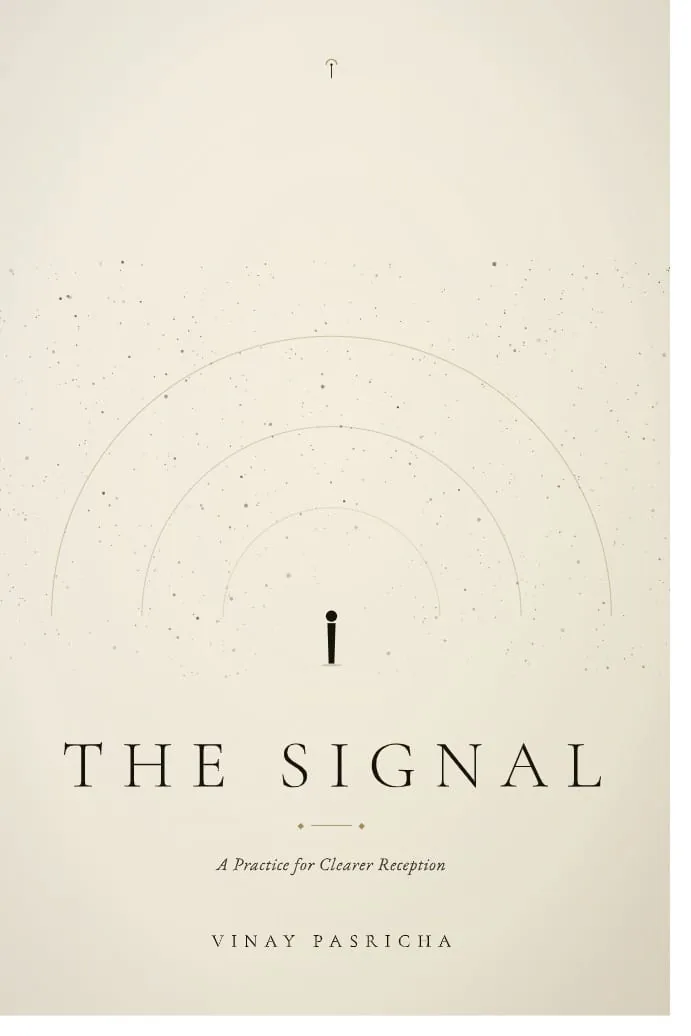
The Signal.
What you cannot detect, you cannot think about.
The path, the essays, and the videos.
For anyone who can feel the noise, and cannot yet name it.
For anyone who has noticed that something is wrong with the way they have been thinking, and has not had words for it yet. Decisions that take too long. The same conversation, every year. Books read and forgotten by morning. The earlier books are about how to act. This one is about what to pay attention to in the first place.
Six moves, one Correction Arc.
After naming six sources of noise, the book gives six moves, Chapters 5 to 10. Together they form the Correction Arc. Each line below is quoted from its chapter. Chapters 11 to 13 then turn outward: Place, Time and Hierarchy.
- iThe SplitMuch suffering comes from trying to preserve incompatible realities simultaneously.
- iiThe TradeNothing in you survives without being paid for.
- iiiThe ProtectorThe Protector does not love you. It defends you.
- ivThe InterruptFreedom lives in the gap between stimulus and completion.
- vThe FieldThe Field is not a state. It is the ordinary, finally heard.
- viIntegrityIntegrity is not virtue. It is the absence of leakage.
What it asks of you.
- To notice the six sources of noise the book names: emotional turbulence, compulsive narrative, fragmented attention, internal contradiction, identity protection and environmental overload.
- To treat detection, seeing a situation accurately before the mind rushes to interpret it, as a skill you can train.
- To read slowly. This is the most personal of the eight books, closer to a notebook than a manual.
If The Signal is about what to pay attention to, The SIV Method is its closest companion: a structured way to examine what you have noticed before you act on it. The first Field session takes about twelve minutes and starts at The Signal Field. The colophon explains what the AI does and does not do inside it. A related short, 400 Million TB a Day. So Why Don’t We Trust Each Other?, is on Watch.
Information has become abundant. Clear perception has not.
Decisions take longer than they should. Confidence reorganises itself overnight. The same conversation returns at the same time every year. Attention will not stay where it is placed for more than a minute. The inner voice does not stop talking. Books are read and forgotten the next morning. Frameworks are acquired faster than they can be lived. Insight passes through the system without changing anything.
This is not a failure of intelligence. The species has more intelligence than at any point in its history. It is something else. It is a failure of reception.
— From the Prologue of The Signal, “The Crisis of Modern Consciousness.”
Read the opening of The Signal.
Prologue · The Crisis of Modern Consciousness
There is something happening inside the modern mind that has not yet been adequately named.
It is not depression. It is not anxiety. It is not the burnout we have learned to discuss. It is quieter than all of these, and more pervasive, and it operates underneath the conditions we usually examine.
Most of the people you know carry it. Many of them are competent. Most of them are functional. Some of them are remarkable by external measures. And almost all of them, in private, would describe a sense that something has gone slightly wrong with their thinking. Not catastrophically. Not visibly. But persistently.
Decisions take longer than they should. Confidence reorganises itself overnight. The same conversation returns at the same time every year. Attention will not stay where it is placed for more than a minute. The inner voice does not stop talking. Books are read and forgotten the next morning. Frameworks are acquired faster than they can be lived. Insight passes through the system without changing anything.
This is not a failure of intelligence. The species has more intelligence than at any point in its history.
It is something else.
It is a failure of reception.
This book is about a specific structural problem and a specific structural response.
The problem is that human consciousness, in its modern condition, is increasingly captured by interference — emotional turbulence, compulsive narrative, fragmented attention, internal contradiction, identity protection, environmental overload. None of these are new. What is new is their density. The modern environment is engineered, at almost every level, to intensify the conditions that degrade reception.
The result is a generation of adults who can think faster than any previous generation, and who can detect less of what they are thinking about.
Information has become abundant. Clear perception has not.
The Signal exists to address this — not as philosophy, not as wellness, not as another framework to acquire and forget — but as a developmental architecture for reducing distortion and restoring detection.
The book introduces the architecture.
The runtime, hosted at vinaypasricha.com/signal, operationalises it adaptively, in dialogue with you, in real time.
Together they form something the species has not previously had: a developmental system that can both explain and respond.
You do not need to believe anything in advance.
You only need to be willing to notice what you have already been noticing — and to take it seriously enough to begin.
— The Prologue, “The Crisis of Modern Consciousness”, The Signal.
The book is in English.
Liked the opening? Buy the book here and read the rest now.
Before you buy.
What is The Signal by Vinay Pasricha?
A practice for clearer reception. It argues that for a century we have built horsepower while neglecting detection — the capacity to perceive a situation accurately before the mind rushes to interpret it. It is one of the eight books, and it is out now.
Who is The Signal for?
Anyone who has noticed that something is wrong with the way they have been thinking, and has not had words for it yet. It is the most personal of the books, closer to a notebook than a manual.
How long is The Signal, and is it published?
Yes. The ebook is 86 pages. The publication date is 3 June 2026.
What are the three parts?
Distortion maps what degrades reception. Signal describes what becomes available once the interference drops. The Second Book is an adaptive runtime that continues the work after the final page. You can enter that field on this site.
How is The Signal different from the other five books?
The earlier books are about how to act well inside a changing world. The Signal is about what to pay attention to in the first place. Without that clarity, the other disciplines float free of any ground.
What is The Field?
In the book, The Field is Chapter 9, the fifth move of the Correction Arc: “The Field is not a state. It is the ordinary, finally heard.” On this site, the Signal Field is a set of guided sessions that continues the practice after the last page.
Watch
Related