The gap between intention and reality is where execution lives.
That gap is universal. Every person has plans that remain unexecuted. Every organization has strategies that do not translate into results. Every mission has a vision that exceeds its delivery. The distance between what is intended and what is delivered is not a flaw in human nature. It is the fundamental condition that execution must bridge.
Bridging that gap is not trivial.
Most people respond to execution difficulty with increased pressure. When results fall short, the response is typically to work longer hours, demand greater effort, push harder, maintain higher intensity, and accept more sacrifice. This may produce motion. But motion is not the same as execution. And increased effort is not the same as increased capacity.
That distinction is crucial.
True execution is not measured by effort expended. It is measured by results produced relative to resources consumed, time elapsed, reliability demanded, and quality required. A system that produces better results using the same resources, in less time, with greater consistency, and at higher quality is executing more powerfully. A system that merely produces the same results through greater strain, longer hours, and higher sacrifice is not executing more effectively. It is merely working harder.
Over time, this exhausts both people and systems.
The alternative to brute-force execution is what we call elevated execution. Elevated execution is execution that becomes progressively stronger, more reliable, and more capable without depending primarily on increased effort or sacrifice. It emerges from seeing the work clearly, identifying what constrains it, and systematically strengthening that constraint cycle after cycle.
This shift from effort-based execution to constraint-based execution is what separates mastery from mere labor. Mastery does not emerge from working harder than everyone else. Many people work extremely hard and remain mediocre. Mastery emerges from identifying the precise point where a system is weakest and strengthening that point with methodical discipline until the capacity of the entire system rises.
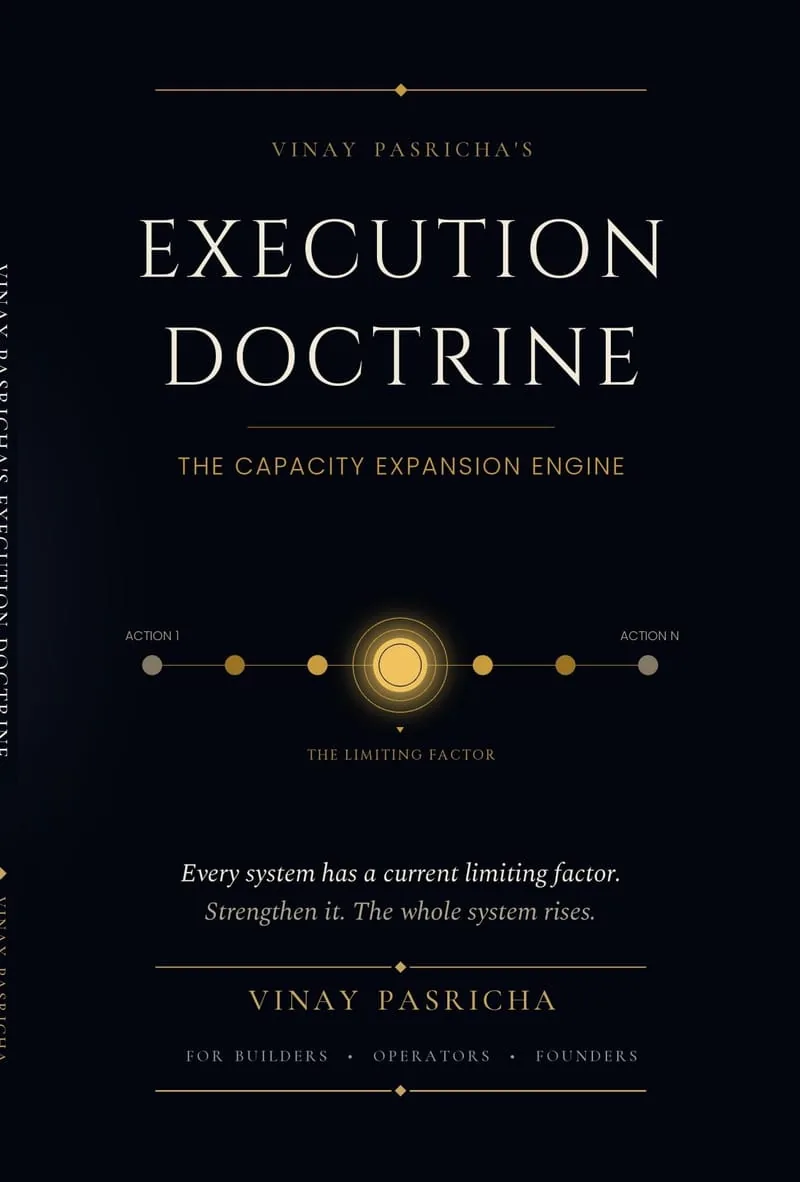
That is the premise of Vinay's Execution Doctrine.
The doctrine is not about trying harder. It is about working smarter in a very specific way: by identifying the governing constraint in any execution sequence and strengthening it repeatedly until the capacity of the whole system expands.
This is learnable, teachable, and universally applicable.
Whether the challenge is personal health improvement, a product delivery cycle, a sales organization, a manufacturing process, or a long-term mission, the underlying logic is identical. Every system has a current limiting factor. Output improves most powerfully when that limiting factor is specifically addressed. Capacity rises when each cycle of improvement leaves the system stronger than it was before. This doctrine is designed to formalize that process.
Text from the manuscript published at /library/execution-doctrine/full-text.txt. © 2026 Vinay. All rights reserved.