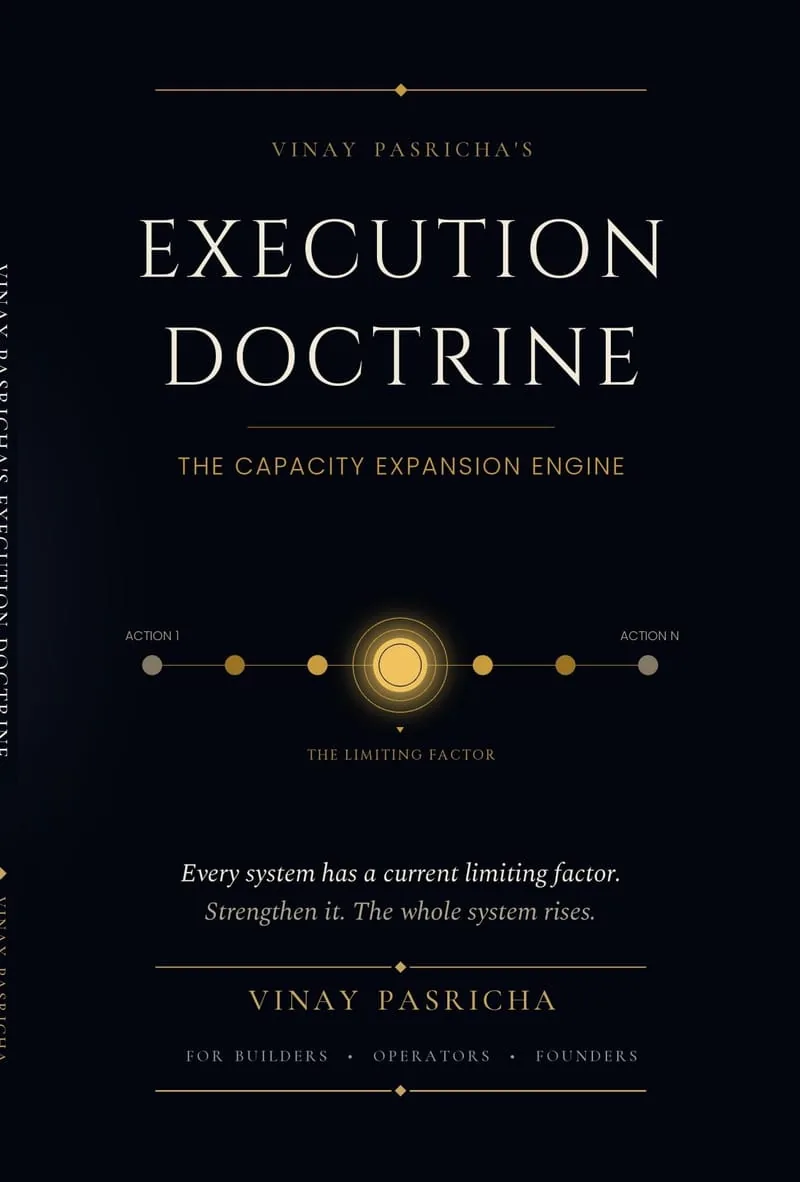
From Action 1 to Action N: defining the sequence of the work.
Chapter 6 · “From Action 1 to Action N” · by Vinay Pasricha
How do you define a process so that it runs reliably?
Chapter 6 calls the defined action sequence the foundation of everything the doctrine does. Without it there is no execution, only activity: people work, effort is spent and resources are consumed without coherent direction. A sequence is a progression from an initial state to a desired outcome, with a clear beginning (Action 1), intermediate actions, and a clear end (Action N). Order matters. Skipping ahead creates problems, and returning to earlier steps wastes effort.
Explicit does not mean exhaustive. The chapter asks that the major steps be clearly identified, the order understood, the dependencies known, the meaning of “done” clear for each step and the transitions between steps defined. Most organisations fall short: sales processes with vague steps, product development with unclear handoffs, hiring with ambiguous decision points, customer support with steps implied rather than stated. The same process then produces inconsistent results.
Once the sequence is clear, three things become possible. Progress can be measured against it. When a cycle fails, the failure can be located: at Action 1, halfway through, or at the handoff between two steps. And improvement can be aimed at the specific step or transition instead of the whole sequence. The sequence must also fit the work; one designed for a simple task or a stable environment will not serve a complex or changing one, and may need refining over several cycles.
The runtime’s Sequence Chamber is built on this chapter. Its hiring example, a process with ambiguous decision points, is the territory of Organizational Frequency, Vinay’s doctrine for hiring.
Without sequence clarity, the executor is working in darkness.
— Chapter 6, “From Action 1 to Action N”
Chapter 6 in full.
The complete text of “From Action 1 to Action N”, 665 words, as published in the manuscript on this site.
When the constraint is a leadership seat.
Vinay Pasricha leads searches for leadership and top-management roles in India: CXOs, the founder’s bench and functional heads. Tell him about the organisation and the role. The enquiry is recorded and sent to him directly.