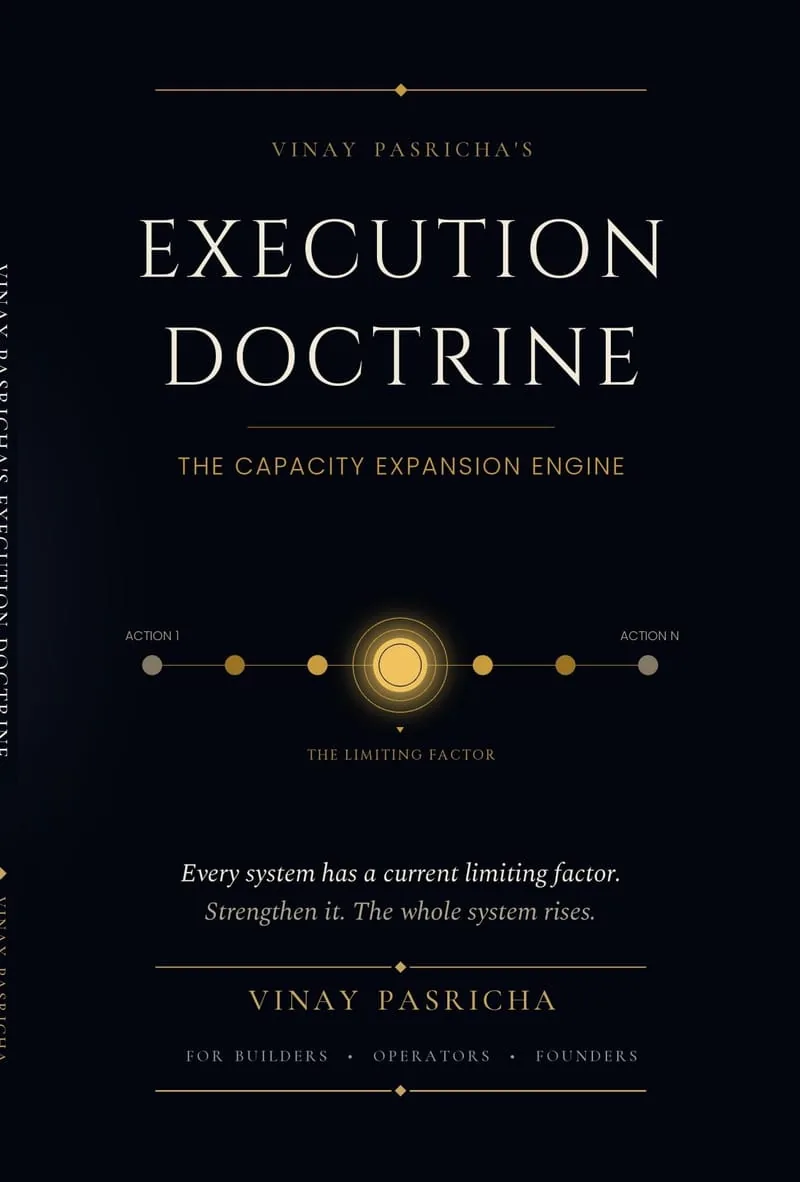
The defined action sequence is the foundation of everything the doctrine does.
Without a clear sequence, there is no execution. There is only activity. People work, but without coherent direction. Effort is expended, but it is not organized toward a reliable outcome. Resources are consumed, but without a clear purpose or progression.
The defined action sequence changes that.
A sequence is a progression of steps from an initial state to a desired outcome. It has a clear beginning (Action 1), a series of intermediate actions (Action 2, Action 3, Action N-1), and a clear end (Action N, the completion point). Each step must be completed adequately before the next step begins. The order matters. Skipping ahead creates problems. Returning to earlier steps wastes effort.
The sequence must be explicit and formal.
This does not mean every action must be written down in exhaustive detail. But it does mean the major steps are clearly identified. It means the order is understood. It means the dependencies are known — which steps must happen before others can begin. It means the person executing the sequence knows what 'done' means for each step. It means the transition points between steps are clear.
Most organizations have poorly defined sequences.
A sales process has vague steps. A product development process has unclear handoffs. A hiring process has ambiguous decision points. A customer support process has steps that are implied rather than explicit. The result is predictable: the same process produces inconsistent results. Some cycles run smoothly. Others encounter delays or failures. The output is unreliable.
Clarity about sequence is the first step toward reliable execution.
Before applying the Capacity Expansion Engine, the executor must be able to say: 'This is the sequence we follow from start to finish. This is Action 1. This is Action N. This is how we move from one step to the next. This is what constitutes completion of each step.'
Once the sequence is clear, several things become possible.
First, measurement becomes possible. If the sequence is clear, then the executor can measure progress through it. How far have we progressed from Action 1 to Action N? Are we on timeline? Have we completed Action 5 successfully, or are we encountering problems?
Second, diagnosis becomes possible. If the sequence is clear, then when the cycle fails to produce the desired output, the executor can identify where in the sequence the failure occurred. Did we fail at Action 1, meaning we never properly initiated? Did we fail at Action 7, meaning we got halfway and stalled? Did we fail at the transition between Action 12 and 13, meaning the handoff was unclear?
Third, improvement becomes focused. If the sequence is clear, then when the executor is ready to improve the system (in the Act stage of the Capacity Expansion Engine), they can improve the specific step or steps where the failure occurred, rather than improving the entire sequence blindly.
Without sequence clarity, the executor is working in darkness.
The sequence must also be appropriate to the work being done.
A sequence designed for a simple task will not serve a complex task. A sequence designed for a stable environment will not work in a changing environment. The sequence must match the nature of the work and the context in which it operates. This sometimes requires refining the sequence over multiple cycles as the executor learns more about the work.
But the fundamental principle remains:
Serious execution requires a defined action sequence. That sequence must be clear, appropriate, and actually followed. When problems occur, the executor must be able to identify where in the sequence they occurred. When improvements are made, they must be targeted at the specific actions or transitions that are limiting output.
From Action 1 to Action N is the path through which intention becomes reality.
The strength of that path determines the reliability of the execution. The executor's primary responsibility is to ensure that path is clear, strong, and progressively improving with each cycle.
Text from the manuscript published at /library/execution-doctrine/full-text.txt. © 2026 Vinay. All rights reserved.