Every execution system operates as a loop.
The loop begins with intention. There is something that needs to be accomplished. A product needs to be built. A customer needs to be acquired. A decision needs to be made. A health goal needs to be met. Revenue needs to be generated. The intention is clear. But intention alone produces no output.
From intention flows action.
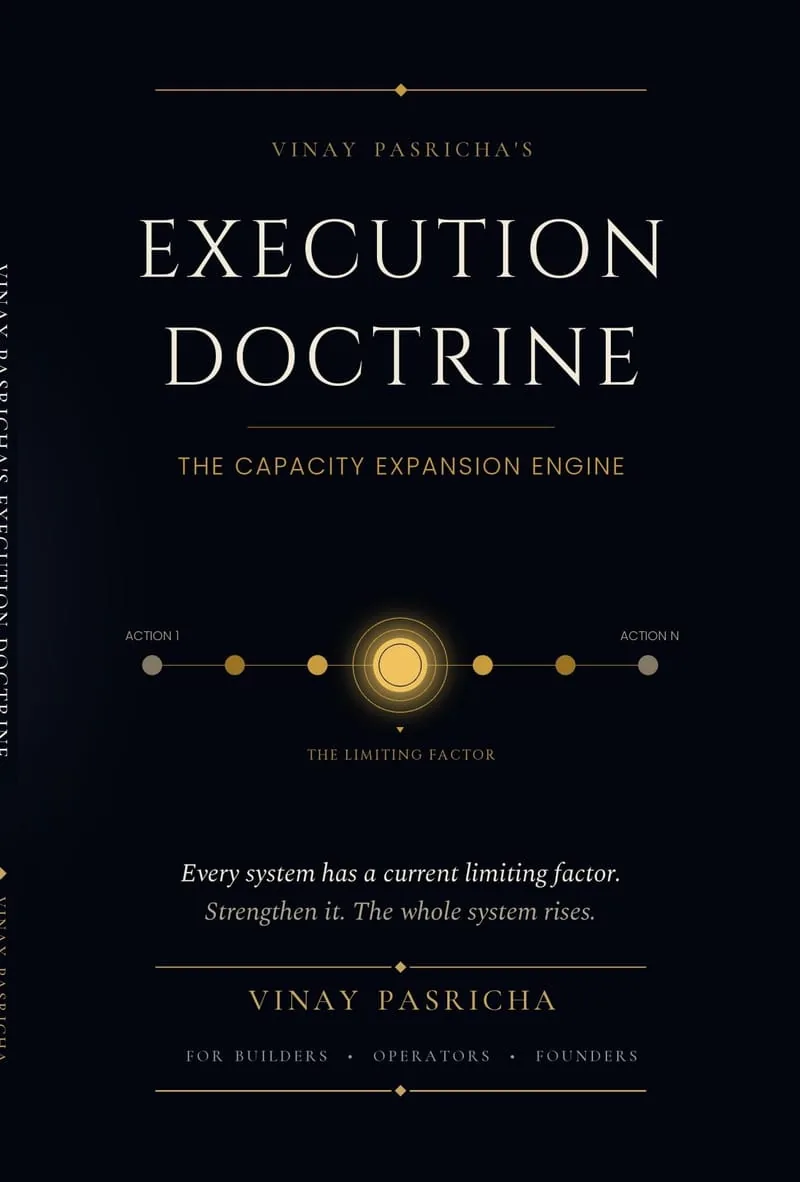
The intended outcome is pursued through a series of actions. These actions are not random. They are organized in a sequence. Action 1 must happen before Action 2. Step A must be completed before Step B can begin. The progression has an order. This is what the doctrine calls the defined action sequence, or the 'sequence from Action 1 to Action N.'
Following a sequence is not trivial.
A sequence can be poorly defined, leading to confusion about what should happen and when. A sequence can have missing steps, so the work never actually reaches completion. A sequence can have steps that are in the wrong order, so progress is blocked. A sequence can have unclear handoffs, so work gets lost between steps. A sequence can have steps that are slower or weaker than necessary, creating bottlenecks. The clarity and strength of the sequence directly impact whether the intended outcome is reliably achieved.
Execution means running the sequence.
The work proceeds from Action 1 through all intermediate steps to Action N, following the defined sequence. During this execution, the real system reveals itself. What was planned in theory meets reality. Friction emerges. People hit obstacles. Information is incomplete. Resources are insufficient. Decisions must be made. The ideal sequence encounters the constraints of the actual world.
This is where most execution systems falter.
Many organizations run sequences poorly. They leave steps incomplete. They skip ahead before prerequisites are finished. They return to earlier steps to redo work. They move slowly through certain steps and rush through others. They lack clarity about what 'done' means for each step. They produce output but not reliably.
Running a sequence well means following it as designed, measuring progress, identifying where friction occurs, and flagging where the sequence itself needs improvement.
Once the sequence is run, the output is produced.
Something has been created, delivered, decided, or accomplished. A product has moved through development. A customer has moved through the sales process. A decision has been made and implemented. The intended outcome has been pursued. But now the critical question: did the sequence produce the desired result? Was the output what was intended? Was the quality what was required? Was the timing what was needed? Did we achieve what we set out to achieve?
That is the moment of truth.
The answer to that question determines whether the system is executing or merely producing activity. A sequence that generates activity but not reliable output is not a system of execution. It is a system of motion. Real execution means the intended outcome is reliably produced, cycle after cycle.
The loop then returns to intention.
Having completed one cycle and produced output, the next intention is identified. The next sequence is planned. The work runs again. The output is produced. The cycle repeats. But here is the critical distinction that separates weak execution from strong execution:
Weak execution runs the loop with the same sequence cycle after cycle, accepting that output will be inconsistent or requires more effort to achieve.
Strong execution uses the information from each cycle to improve the sequence for the next cycle. Where did the sequence slow? Where did problems occur? Where was output lost? What was the bottleneck? Having identified the constraint, the next cycle's sequence is improved to address that constraint specifically.
This is where the Capacity Expansion Engine engages with the base execution loop.
The base loop is the foundation: intention, sequence, execution, output, repetition. The Capacity Expansion Engine is the intelligence added on top: identification of the governing constraint, systematic strengthening of that constraint, and a sequence that becomes progressively more powerful.
Together, they form the complete picture of what serious execution demands.
Text from the manuscript published at /library/execution-doctrine/full-text.txt. © 2026 Vinay. All rights reserved.