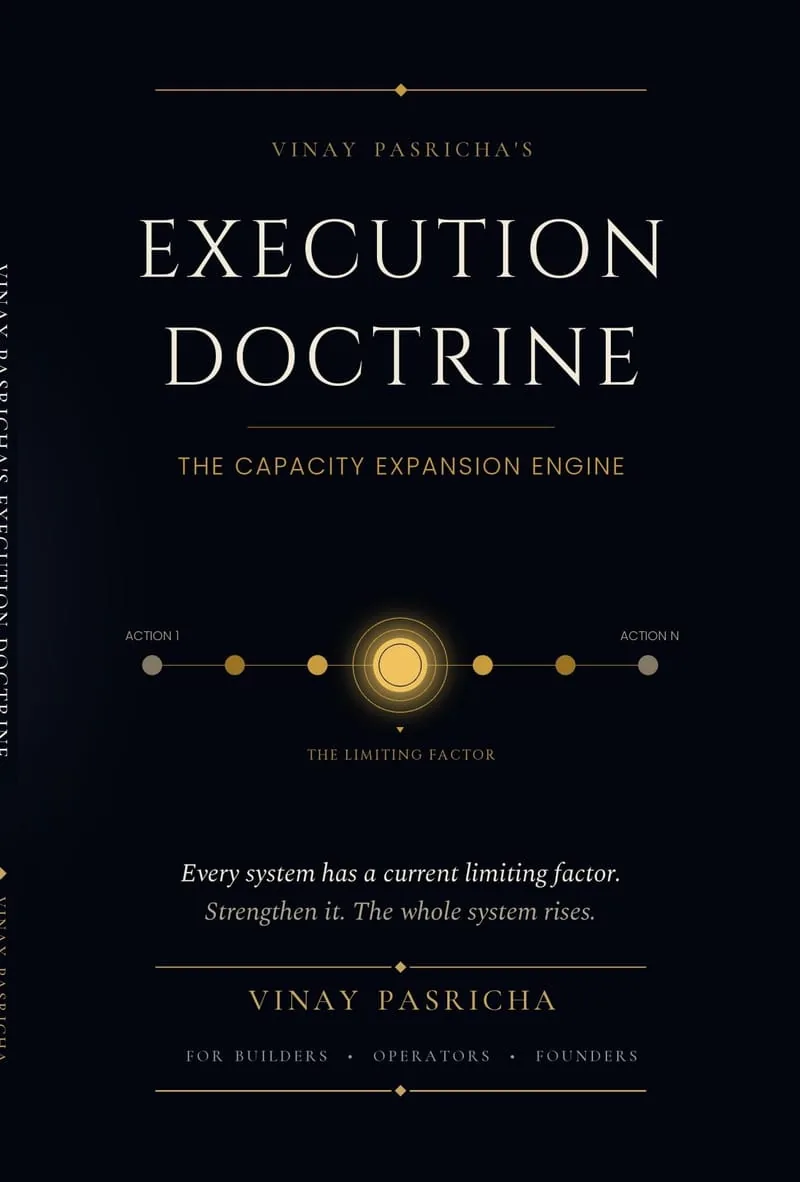
The Base Loop of Execution: from intention to reliable output.
Chapter 5 · “The Base Loop of Execution” · by Vinay Pasricha
Why do plans turn into activity instead of results?
Chapter 5 describes the base loop every execution system runs: an intention, a sequence of actions, the running of that sequence, the output, and then a return to the next intention. Intention alone produces nothing. It becomes output only through actions taken in order, which the doctrine calls the defined action sequence, or the sequence from Action 1 to Action N.
The chapter lists the ways a sequence goes wrong: steps that are poorly defined, missing or in the wrong order, handoffs that are unclear, and steps slower or weaker than they need to be. When the sequence meets reality, friction appears, information is incomplete and resources run short. Organisations then skip ahead before prerequisites are finished, return to redo earlier work, rush some steps and move slowly through others, and lack clarity about what “done” means. They produce output, but not reliably.
The test comes after every run: was the output what was intended, at the quality and timing required? A sequence that generates activity without reliable output is, in the book’s words, a system of motion. Weak execution runs the same sequence cycle after cycle and accepts inconsistent output; strong execution uses what each cycle revealed to improve the sequence for the next one. That is where the Capacity Expansion Engine from Chapter 4 joins the base loop.
The next chapter, From Action 1 to Action N, takes the sequence itself apart: its steps, order, dependencies and what “done” means.
A sequence that generates activity but not reliable output is not a system of execution.
— Chapter 5, “The Base Loop of Execution”
Chapter 5 in full.
The complete text of “The Base Loop of Execution”, 678 words, as published in the manuscript on this site.
When the constraint is a leadership seat.
Vinay Pasricha leads searches for leadership and top-management roles in India: CXOs, the founder’s bench and functional heads. Tell him about the organisation and the role. The enquiry is recorded and sent to him directly.