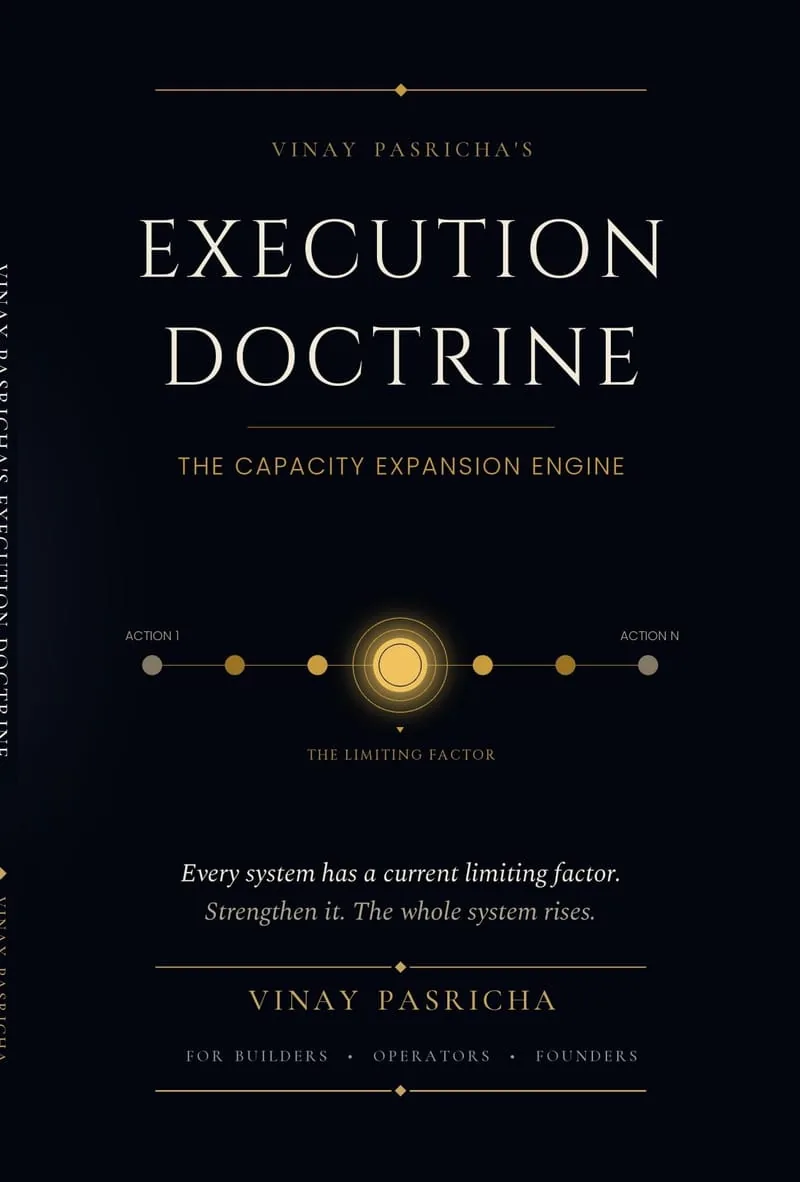
The strength of Vinay's Execution Doctrine depends on one thing more than any other: the accuracy of constraint identification.
An executor who perfectly identifies the constraint but implements an imperfect solution will still see marked improvement. An executor who misidentifies the constraint but implements a perfect solution to the wrong problem will see no improvement. Accuracy of constraint identification is the prerequisite for everything else.
Yet constraint identification is rarely done well.
Most organizations respond to poor output by distributing improvement effort broadly. When results fall short, they improve training, refine processes, add resources, and tighten accountability. This may feel productive. But spreading improvement effort across multiple areas often means each area receives insufficient attention to create real change. The true bottleneck may remain unaddressed while effort is wasted on elements that are not actually limiting output.
Reading the constraint requires disciplined observation and honest diagnosis.
The constraint reveals itself through repeated friction.
When a sequence runs and fails to produce the desired output, the failure is not random. It emerges from a specific point in the sequence where something is weak or slow. That weakness creates a bottleneck. Work arrives at that point faster than it can be processed. Time accumulates. The sequence slows. Output is delayed. The point of bottleneck is the point of constraint.
To read the constraint, the executor must observe this friction carefully.
Where does work accumulate? Where do cycles extend beyond intended timeline? Where do handoffs fail? Where do people struggle? Where is the sequence incomplete? Where is information missing? Where is a resource insufficient? Where is a decision delayed? These observations point toward the constraint.
But observation alone is not sufficient.
The constraint must also be tested against output. The question is not 'what is difficult?' but 'what is limiting output?' These are different. Something can be difficult but not limiting. A person can struggle mightily at a task that is not actually preventing the system from achieving its goal. That struggle is not the constraint. The constraint is the specific element whose weakness or absence prevents full output.
To identify the constraint accurately, the executor must ask: if this element were strengthened, would output rise proportionally?
If the answer is yes, it is a true constraint. If the answer is no, then improving it will not proportionally improve output, and it is not the primary constraint. The primary constraint is the element whose weakness would most reduce output, and whose strength would most increase output.
Constraint identification also requires understanding the type of constraint.
The doctrine recognizes two broad classes of constraints: human and structural. A human constraint is a limitation in skill, discipline, focus, judgment, or capability. A structural constraint is a limitation in process, tools, information, resources, sequence, or decision quality. The same constraint identification process applies to both, but the Act stage of improvement differs depending on whether the constraint is human or structural.
Reading the constraint also means understanding its nature.
Is it a constraint that has always been present but is now becoming binding? Is it a new constraint that emerged as earlier constraints were strengthened? Is it a constraint that is temporary, created by a specific circumstance? Is it a constraint that is fundamental to the nature of the work? Understanding the nature of the constraint helps the executor design the right solution in the Act stage.
Honest constraint identification sometimes requires uncomfortable truths.
The constraint may be a person whose performance is limiting the team. The constraint may be a tool or process that is inadequate. The constraint may be a decision that should have been made differently. The constraint may be a design flaw that should have been caught earlier. The constraint may be a resource that should have been allocated differently. Facing these truths directly is necessary for real improvement. The executor who avoids naming the true constraint is the executor who fails to improve.
The executor who confronts the constraint directly and says 'this is what is actually limiting us' is the executor who can do something about it.
Constraint identification is also iterative.
In the first cycle, the identified constraint may be approximate. In the Act stage, the approximate constraint is addressed. In the Check stage of the next cycle, a clearer picture emerges. The constraint may refine to something more specific. Or a new constraint may emerge. With each cycle, the executor's understanding becomes more precise.
Over time, constraint identification becomes a skill. The executor develops an eye for where systems break. They recognize the patterns of friction. They understand the difference between what is difficult and what is limiting. They develop the discipline to follow the data rather than their instincts. This skill, built through repeated application of the doctrine, becomes a profound competitive advantage.
That is how constraints are read in this doctrine.
Text from the manuscript published at /library/execution-doctrine/full-text.txt. © 2026 Vinay. All rights reserved.