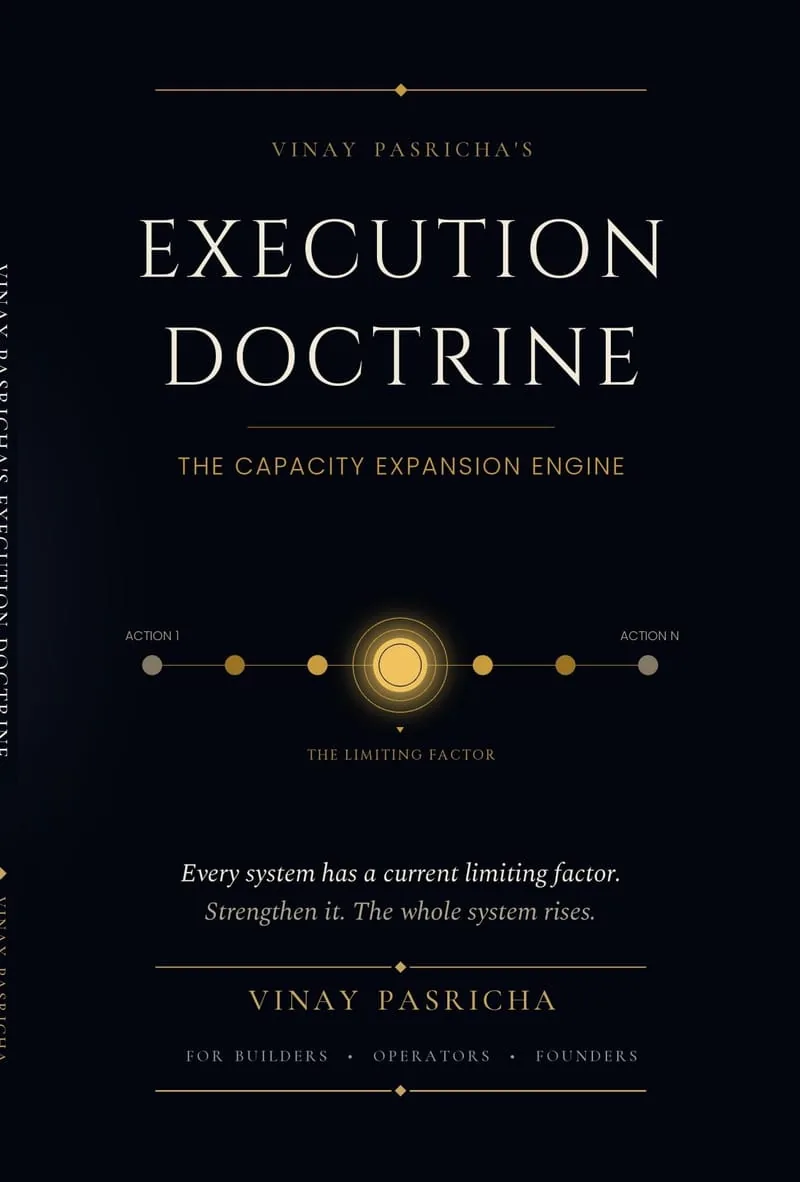
Reading the Constraint: how to diagnose the real bottleneck.
Chapter 7 · “Reading the Constraint” · by Vinay Pasricha
How do you find the bottleneck that is actually limiting output?
Chapter 7 makes accurate diagnosis the prerequisite for everything else. An executor who finds the right constraint and applies an imperfect fix still sees marked improvement; one who applies a perfect fix to the wrong problem sees none. Yet most organisations respond to poor output by improving training, processes, resources and accountability all at once, so no single area gets enough attention and the true bottleneck can survive untouched.
The method starts with observation. The constraint reveals itself through repeated friction: a point in the sequence where work arrives faster than it can be processed, time accumulates and output is delayed. The chapter’s diagnostic questions are practical. Where does work accumulate? Where do cycles overrun? Where do handoffs fail, people struggle, information go missing, a resource fall short or a decision wait?
Observation is then tested against output. The question is not “what is difficult?” but “what is limiting output?”, because something can be hard without being limiting. The test the book proposes: if this element were strengthened, would output rise proportionally? The executor also classifies the constraint as human (skill, discipline, focus, judgment, capability) or structural (process, tools, information, resources, sequence, decision quality), and asks whether it is long-standing, newly exposed, temporary or fundamental to the work.
Diagnosis can demand uncomfortable truths: a person’s performance, an inadequate tool, a decision that should have been made differently. It is also iterative. A first diagnosis may be approximate and sharpens with each cycle, until reading constraints becomes a skill in its own right.
The runtime’s Constraint Observatory puts this diagnosis into practice. Chapter 3, The Governing Limit, explains why every system has such a limit in the first place.
The constraint reveals itself through repeated friction.
— Chapter 7, “Reading the Constraint”
Chapter 7 in full.
The complete text of “Reading the Constraint”, 805 words, as published in the manuscript on this site.
When the constraint is a leadership seat.
Vinay Pasricha leads searches for leadership and top-management roles in India: CXOs, the founder’s bench and functional heads. Tell him about the organisation and the role. The enquiry is recorded and sent to him directly.