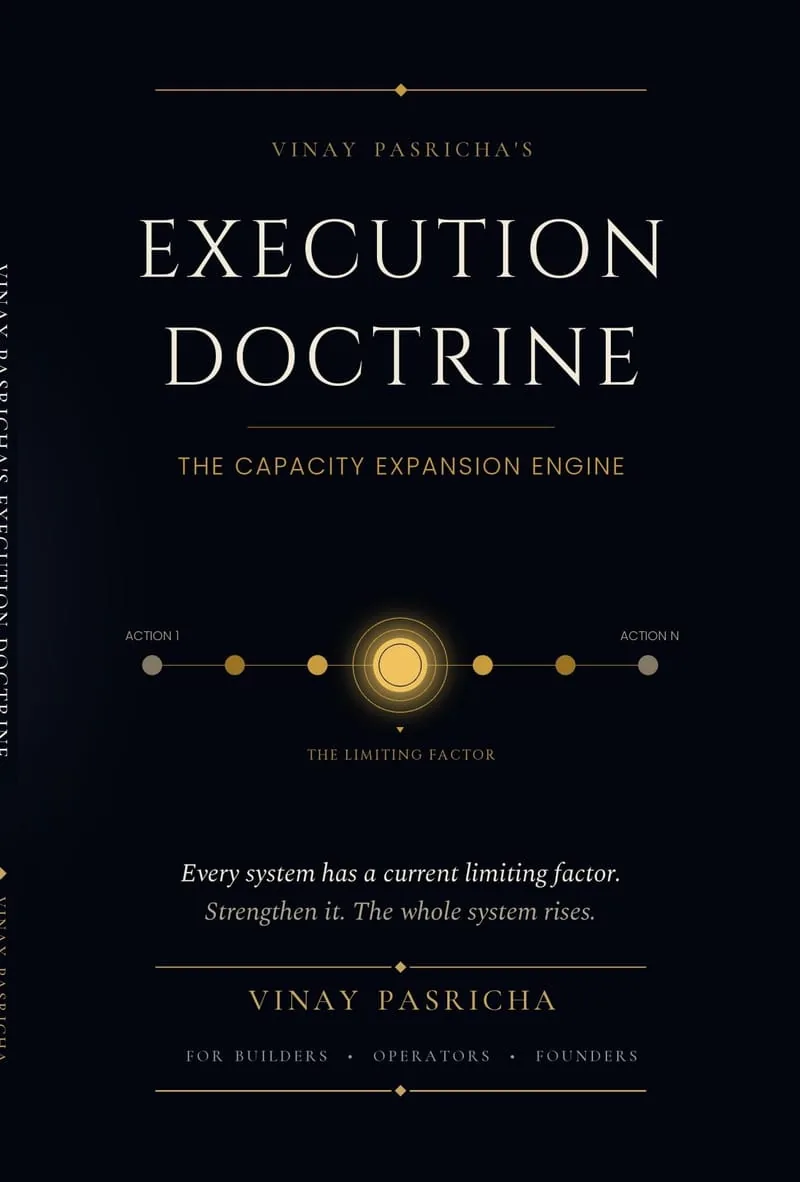
The Formal Doctrine: the principles of execution in one place.
Chapter 18 · “The Formal Doctrine” · by Vinay Pasricha
What are the core principles of the Execution Doctrine?
Chapter 18 restates the book as a formal doctrine: a universal system for converting clear understanding into reliable action and expanding the capacity of systems to produce output. It rests on one observable reality, that every system producing output has a current limiting factor, and that the strength of the output is set by the system’s weakest point, not its strongest elements.
The cycle is Plan-Do-Check-Act with a specific discipline. Plan defines the sequence from Action 1 to Action N with its output, success criteria, timeline and measures. Do runs it so the system’s limits show up as friction, delay, bottleneck or failure. Check measures actual against intended output and, above all, identifies the governing constraint. Act redesigns the next cycle around that constraint. Human constraints are addressed through training, mentoring, clarification, incentive alignment, accountability or replacement; structural ones through redesign, acquisition, better information systems, reallocation, restructuring or clearer decision frameworks.
Six principles govern the whole: one constraint per cycle; constraints identified from actual versus intended output, not opinion; constraints addressed with specificity; output measured in the context of quality, timeline, resources and sustainability; improvement compounding across cycles; and the executor’s character deciding whether the doctrine produces excellence or stays theoretical. The book closes on its shortest form: find the current limit, address it, improve, repeat.
The full book is The Execution Doctrine. Its companion on understanding before action is The SIV Method, and Organizational Frequency brings the same rigour to hiring.
Identify it. Address it. Improve. Repeat.
— Chapter 18, “The Formal Doctrine”
Chapter 18 in full.
The complete text of “The Formal Doctrine”, 642 words, as published in the manuscript on this site.
When the constraint is a leadership seat.
Vinay Pasricha leads searches for leadership and top-management roles in India: CXOs, the founder’s bench and functional heads. Tell him about the organisation and the role. The enquiry is recorded and sent to him directly.