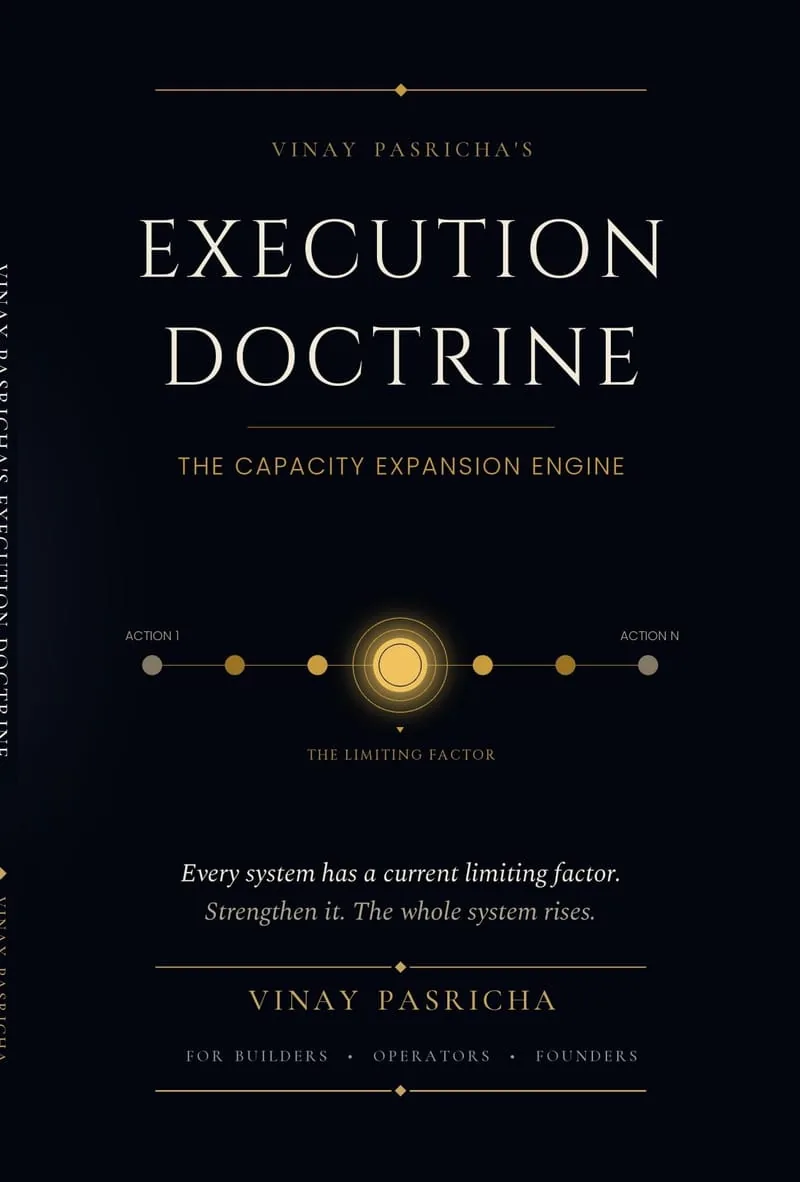
Vinay's Execution Doctrine is a universal doctrine for converting clear understanding into reliable action and systematically expanding the capacity of systems to produce output.
The doctrine rests on a single observable reality: every system that produces output has a current limiting factor that governs its capacity.
The strength of a system's output is determined not by its strongest elements but by its weakest point — the point where weakness, friction, delay, or fragility constrains flow.
A master executor recognizes this principle and builds execution around it.
The doctrine operates through a cyclical process built on the standard Plan-Do-Check-Act framework, refined with specific discipline:
PLAN: Define the action sequence formally. Specify Action 1 through Action N. Establish the intended output, success criteria, timeline, and measures of achievement. Ensure complete clarity about what constitutes execution of the plan.
DO: Execute the plan as designed. Follow the sequence. Expose the system to work so that its true limitations become visible through friction, delay, bottleneck, or failure.
CHECK: Measure actual output against intended output. Identify where the sequence failed to produce intended results. Most importantly, identify the current governing constraint — the specific point where weakness most limited output. This is the critical discipline of the Check stage.
ACT: Redesign the sequence for the next cycle specifically to address the identified constraint. If the constraint is human, strengthen the human capability. If the constraint is structural, strengthen the structure. The improvement must be targeted at the actual constraint, not at secondary problems or hoped-for improvements.
Then return to PLAN with a stronger sequence.
With each cycle, the constraint that was addressed is strengthened. A new limiting factor emerges. The cycle identifies and addresses this new constraint. Over multiple cycles, the system becomes progressively more capable.
This is the Capacity Expansion Engine.
The doctrine recognizes that constraints fall into two broad classes: human and structural.
Human constraints reflect deficiency in skill, discipline, judgment, or alignment. They are addressed through training, mentoring, clarification, incentive alignment, accountability, or replacement.
Structural constraints reflect deficiency in process, tool, information, resource, sequence, or decision quality. They are addressed through redesign, acquisition, information systems improvement, reallocation, restructuring, or decision framework clarification.
Accurate diagnosis of the type of constraint determines whether improvement will be effective.
The doctrine also establishes clear principles:
One constraint governs each cycle. Improvement effort is concentrated on the point that most limits output, not diffused across multiple problems.
Constraints are identified through rigorous analysis of actual output versus intended output, not through opinion or preference.
Constraints are addressed with specificity, not through vague improvements or hope.
Output is measured in context — relative to quality, timeline, resource consumption, and sustainability.
Improvement compounds across cycles. A single cycle may produce modest improvement. Multiple cycles produce remarkable results.
The executor's character — clarity, honesty, discipline, and long-term orientation — determines whether the doctrine produces excellence or remains theoretical.
The doctrine is neither about working harder nor about making shallow improvements.
The doctrine is about building systems that become progressively stronger, more reliable, more capable, and less dependent on heroic effort.
It is about converting execution from crude labor into a craft.
It is about identifying the precise point where a system is weakest and strengthening that point with methodical intelligence until the capacity of the whole system rises. It is about repeating this discipline cycle after cycle, year after year, until execution becomes synonymous with mastery. The doctrine is for builders and operators who understand that real competitive advantage does not come from luck, singular talent, or temporary effort.
It comes from seeing systems clearly, diagnosing what actually constrains them, and building stronger pathways from intention to outcome through repeated cycles of intelligent, focused improvement.
Every system has a current limit.
That is not a constraint. That is an opportunity.
Identify it. Address it. Improve. Repeat.
That is how mastery is built.
Text from the manuscript published at /library/execution-doctrine/full-text.txt. © 2026 Vinay. All rights reserved.