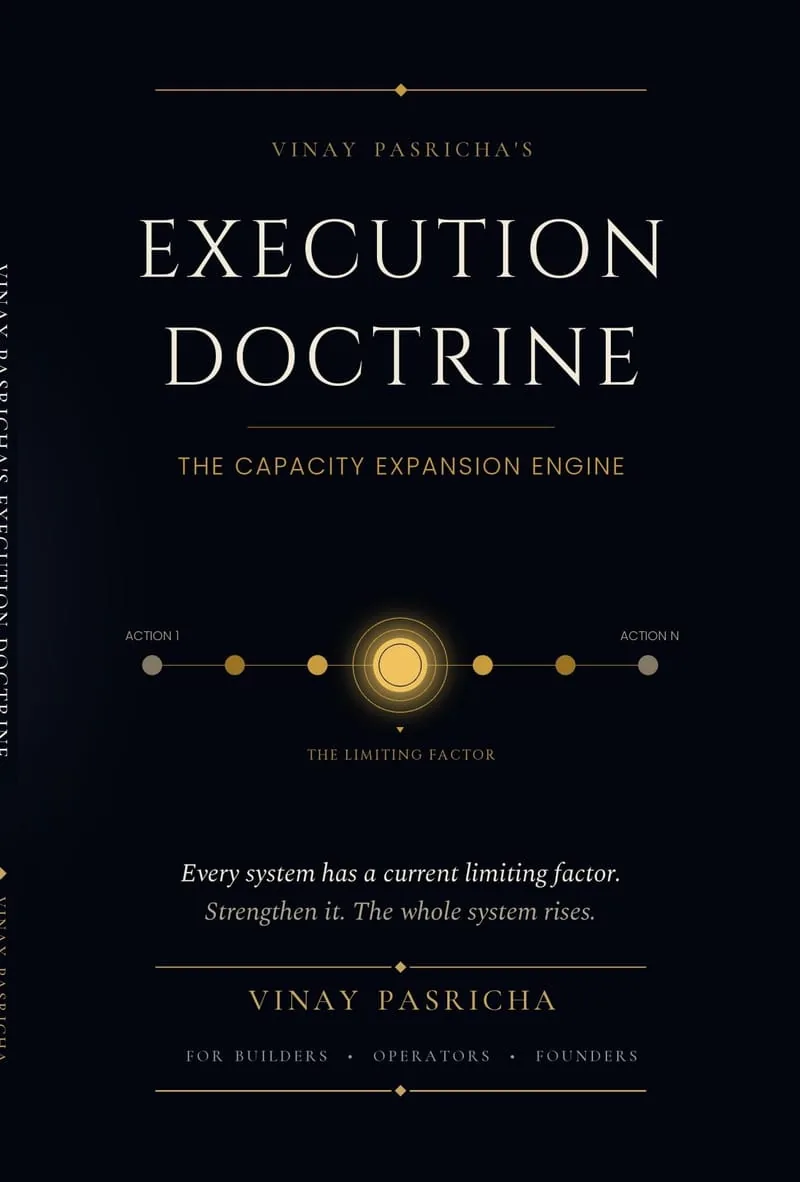
Vinay's Execution Doctrine is universal in logic, but does it operate the same way at all scales?
The core principle holds at every scale: identify the governing constraint and strengthen it repeatedly. But the specific manifestation of the doctrine varies depending on scale. At the individual scale, an individual applying the doctrine to personal goals identifies constraints in their own execution and strengthens them.
An individual might identify a personal constraint: 'I intend to write a book, but I am not disciplined about daily writing.' The constraint might be clarity (the person does not have a clear writing schedule) or discipline (the person has a schedule but does not follow it) or tools (the person lacks a quiet space to write). Having identified the constraint, the individual addresses it in the next cycle. This produces a book that is progressively more complete.
At the team scale, a team applying the doctrine identifies constraints in how the team executes collectively.
A team might identify a constraint: 'We intend to deliver a product on time, but we consistently slip.' The constraint might be unclear requirements, inadequate testing infrastructure, or poor coordination between team members. Having identified it, the team addresses it in the next delivery cycle. Over multiple product cycles, the team's delivery reliability improves. At the organizational scale, an organization applying the doctrine identifies constraints in how the organization operates as a whole.
An organization might identify a constraint: 'We have good people and good strategy, but our execution reliability is lower than it should be.' The constraint might be poor decision-making processes, inadequate communication across departments, or unclear accountability. Having identified it, the organization addresses it in operating cycles. Over time, organizational execution becomes more reliable.
At the mission scale, an individual or organization applying the doctrine to a long-term mission identifies constraints in whether the mission is achieved.
A leader might identify a constraint: 'We have a vision for what we want to build, but we are progressing slower than necessary to achieve it within our window of opportunity.' The constraint might be inadequate capital, insufficient customer acquisition, or technical challenges that are harder than expected. Having identified it, the leader addresses it in the next cycle of the mission. Over years, the mission becomes more likely to succeed.
The doctrine works at all these scales because the underlying logic is the same.
Every system has a constraint. Identifying and strengthening that constraint produces improvement. Repeating the cycle produces compounding improvement. This is true whether the system is an individual, a team, an organization, or a long-term mission.
However, the nature of constraints varies by scale.
At the individual scale, constraints often reflect personal discipline, skill, or access to tools. At the team scale, constraints often reflect communication, coordination, or resource allocation. At the organizational scale, constraints often reflect decision-making processes, information systems, or alignment of incentives. At the mission scale, constraints often reflect strategic choices, capital allocation, or market conditions.
The executor must diagnose appropriately for the scale.
What is a structural constraint at the organizational scale (e.g., decision-making authority is too centralized) might be a human constraint at the team scale (e.g., one person is making all decisions). The same problem might look different depending on which scale is being examined.
The doctrine also allows for constraints at different scales to interact.
An organizational-scale constraint might prevent a team from improving at the team scale. If the organization's incentive system rewards individual achievement over team success, then the team's constraint around coordination remains hard to address even if the team understands it. The organizational constraint must be addressed to enable the team constraint to be effectively addressed.
But the same applies in reverse.
If a team has a constraint around communication, and this is never addressed, then the team's inability to coordinate becomes an organizational constraint as the organization scales.
The executor who operates the doctrine sophisticatedly thinks about constraints at multiple scales simultaneously. How are constraints at my scale affecting performance? What constraints exist at the next level up, and how are they constraining my ability to improve? What constraints exist at the level below, and how are they affecting the system as a whole? This multi-scale thinking produces more comprehensive improvement.
That is why the doctrine can travel.
Text from the manuscript published at /library/execution-doctrine/full-text.txt. © 2026 Vinay. All rights reserved.