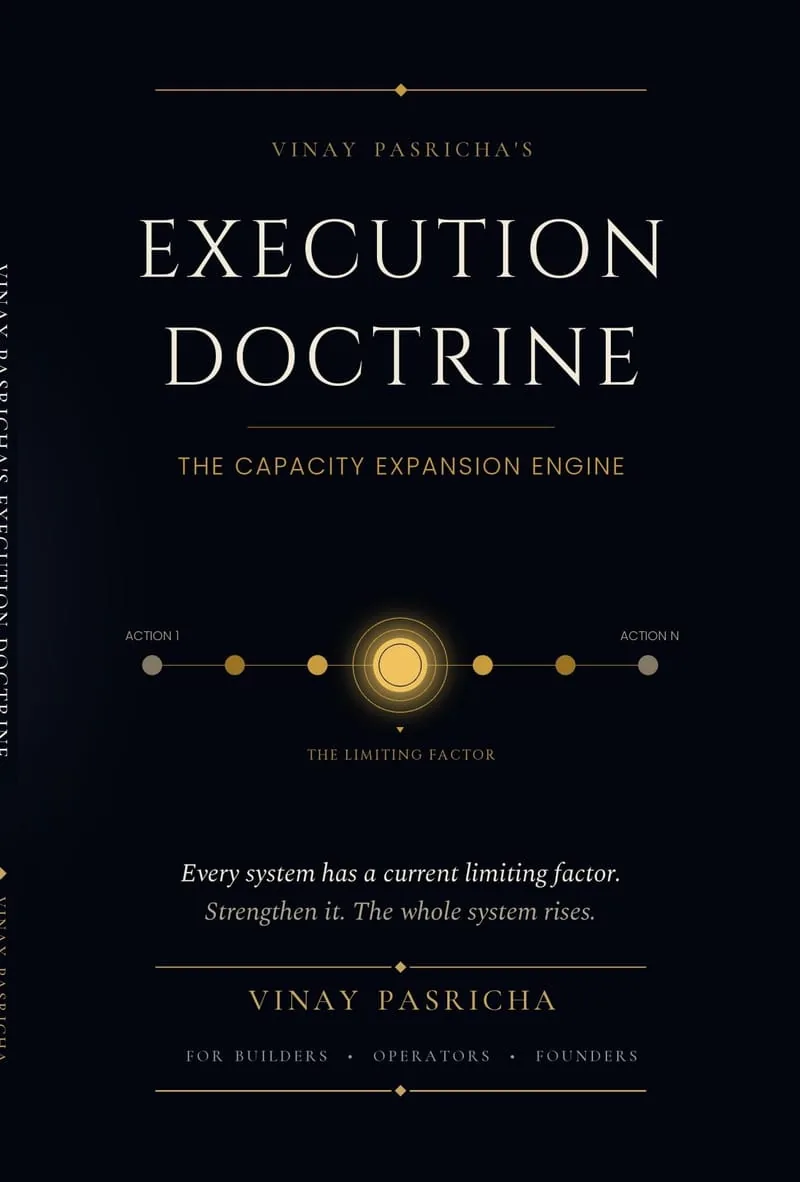
One of the hardest disciplines in execution is the discipline of focusing on one constraint.
When an executor identifies the constraint and understands that it is limiting output, they often become aware of other problems simultaneously. Perhaps while diagnosing the primary constraint, they also notice secondary limitations. Perhaps other team members are highlighting additional issues. Perhaps the natural instinct to 'improve everything' creates pressure to address multiple problems at once.
The doctrine resists this temptation.
The discipline of one constraint states that in any given cycle, the primary improvement focus is on strengthening the current governing constraint. This does not mean that other problems are ignored forever. It means that in this cycle, improvement energy is concentrated on the point that most limits output.
This discipline is necessary for several reasons.
First, focus produces results. Effort that is diffused across multiple problems produces diffuse results. Effort concentrated on one specific problem produces visible improvement in that problem. If the identified constraint is truly governing, then improving it produces visible improvement in output.
Second, resources are finite. A team has limited time, energy, and capital for improvement. If these resources are divided among many improvements, each improvement receives insufficient resource to be effective. If resources are concentrated on the true constraint, the constraint can be substantially improved.
Third, organizational psychology demands visible success. When improvement efforts produce visible results, the team's confidence in the improvement process increases. When efforts are diffuse and results are unclear, skepticism increases. By focusing on the constraint where improvement is most likely to produce visible results, the executor builds organizational capability for change.
Fourth, improvement builds on itself. When one constraint is addressed and output rises, the organization gains confidence and skill in addressing constraints. This creates momentum for addressing the next constraint. The organization that tries to improve everything at once often produces a culture of perpetual change with unclear results. The organization that improves one constraint at a time, sees results, and moves to the next constraint builds a culture of continuous, visible progress.
The discipline of one constraint is also where the doctrine differs from generic 'continuous improvement' thinking. Continuous improvement that is not prioritized can become diffuse and ineffectual. The doctrine agrees that improvement should be continuous. But it is also focused. In each cycle, the focus is on the most consequential element.
However, the discipline of one constraint must be applied with judgment.
If multiple constraints are approximately equal in their limiting effect, then focusing on one still makes sense, but the choice between them becomes a judgment call. If one constraint is significantly more limiting than others, then the focus is clear. If a secondary constraint is preventing the primary constraint from being effectively addressed, then the secondary constraint must be addressed first.
But in general, the principle holds:
Only one constraint can govern the current cycle of strengthening. Identify it clearly. Strengthen it specifically. Measure whether output rises. Then move to the next constraint. This discipline is what separates mastery from mere motion.
Text from the manuscript published at /library/execution-doctrine/full-text.txt. © 2026 Vinay. All rights reserved.