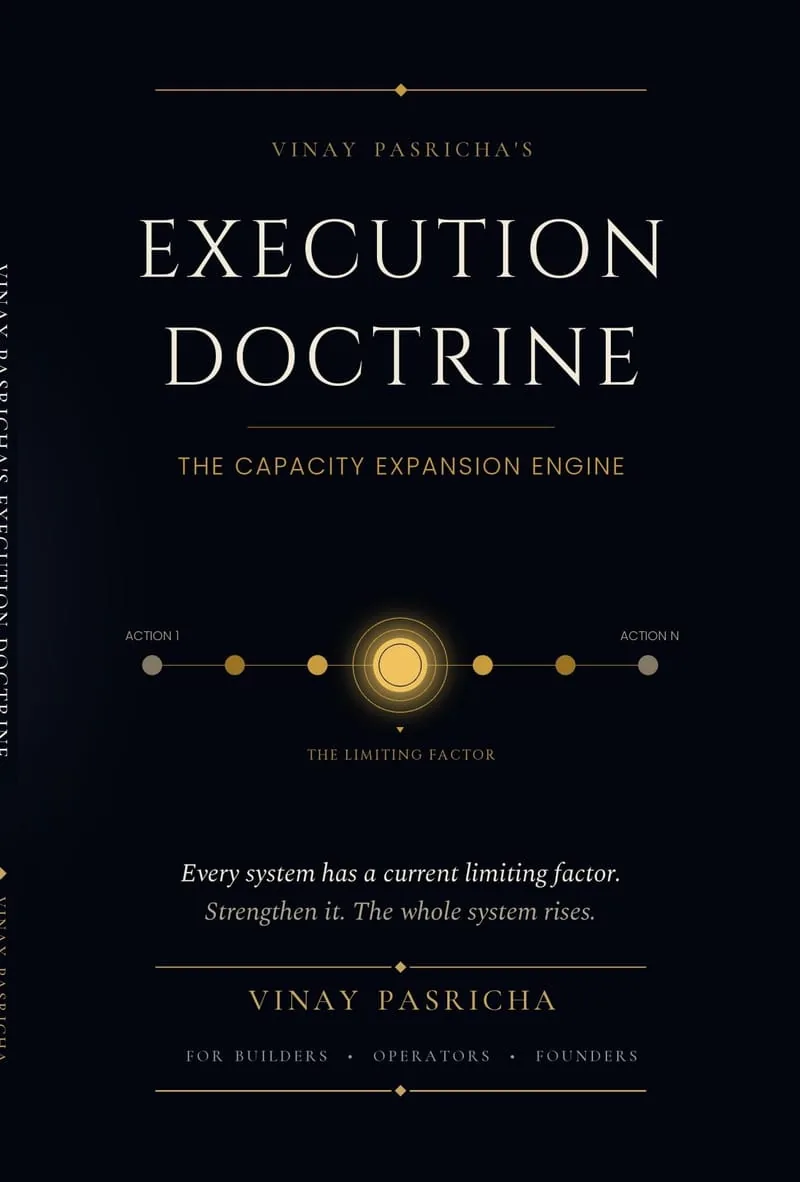
Short answer: Usually because one constraint governs output and effort is spread everywhere else. Every process has one point that limits how fast work moves through it, and until that point gets stronger, extra effort anywhere else doesn't make anything finish sooner. Find that point, put your best effort on it for one cycle, and leave the rest alone for now.
I'm Vinay Pasricha. I wrote The Execution Doctrine, a book about why plans don't get done, and I run GoodSpace AI. When a founder tells me everything runs late, it's rarely because people are lazy. It's usually because everyone is working hard on the wrong point.
Why working harder doesn't help
Picture a factory where finished goods wait for a quality check before they can be dispatched. If the sales team pushes harder, the pile in front of quality simply gets bigger. Nothing ships faster. Output is set by the weakest point in the flow, not by the parts that are already strong.
Projects work the same way. The limit is often one of these:
- an approval that waits for one person, often the founder;
- one skilled person everyone depends on;
- a handoff between two teams where work sits unowned;
- a supplier or customer input that always arrives late.
In the book I call this the governing limit. Every process has one at any moment. Effort spent elsewhere feels productive, but it mostly creates queues.
The real constraint isn't the loudest one
The problem people complain about most is not always the one limiting output. To find the real constraint, look for where work waits. Signs:
- a queue builds up in front of one step;
- the people after that step are often idle or waiting;
- the same name or team appears in every delay.
One constraint at a time
The discipline that matters most is working on one constraint per cycle. A company that launches ten improvement initiatives at once often ends up with no improvement, because the effort is spread thin and the real limit gets the same attention as everything else.
So pick one. Strengthen it: add capacity, remove work that doesn't need to pass through it, or change the rules around it. When it stops being the limit, the constraint moves somewhere else. That isn't failure. It's progress, and the start of the next cycle.
One thing to do this week
Take your three most recent late projects. For each, write down the one step where work waited longest. If the same point appears twice, that's very likely your constraint. For the next two to four weeks, make strengthening that point the only improvement priority, and tell the team that everything else can wait. The execution path on this site walks you through the same steps.
Where this comes from
This answer draws on two chapters of The Execution Doctrine: Chapter 3 · The Governing Limit and Chapter 9 · The Discipline of One Constraint. Each chapter has its own page, starting with chapter 3. The book is on Kindle.
If your situation doesn't fit neatly, describe it on Ask Vinay's books and ask where your constraint might be.
Vinay Pasricha is the founder of GoodSpace AI and the author of six books, including The Execution Doctrine.