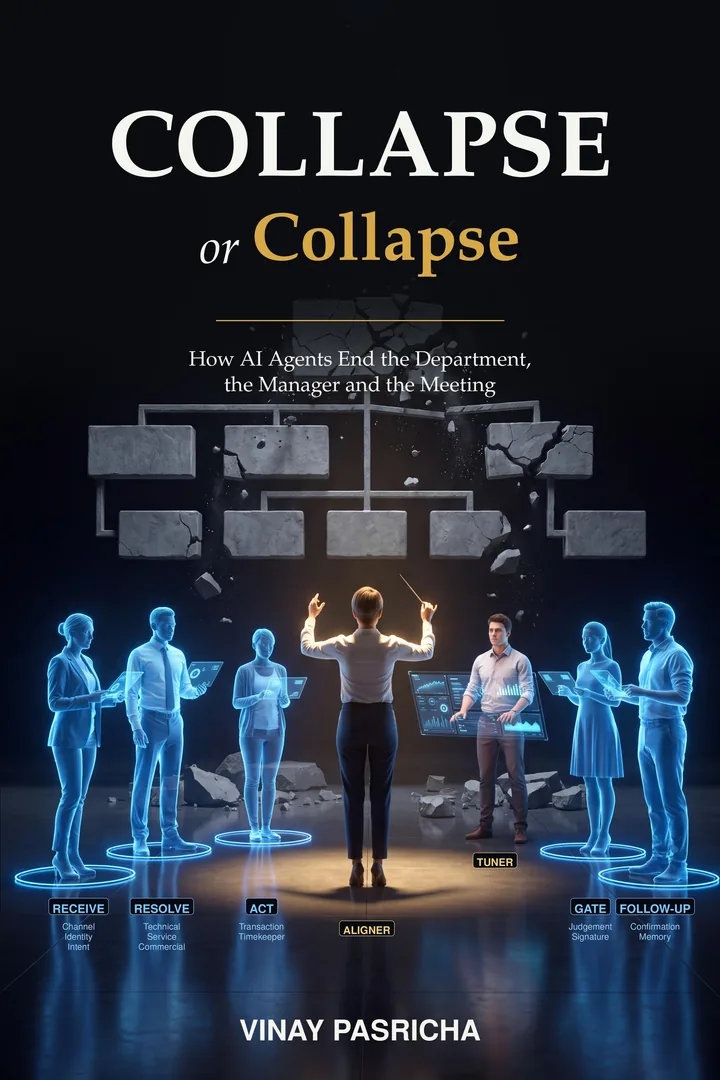
Short answer: AI agents can take the coordination managers were hired to do: passing work between desks, collecting status, chasing what is stuck. They do not replace the person who signs for a result, holds a judgement, or keeps a team’s trust. Deleting the title and keeping the department is the wrong cut. The department was why the manager existed.
I’m Vinay Pasricha. I founded GoodSpace AI, and I am founder and chairman of WLCI. Managers ask me this with their arms folded. Founders ask it with a spreadsheet. Both are asking about a title. Collapse or Collapse asks about the work the title was invented to do. A shorter answer, from a different book, is will AI agents replace managers. This page is the longer one.
What the manager was for
A department is what you build when a result needs more skills than one person can hold, so you cut the result into pieces and put a desk under each piece. Someone then has to carry the result across the desks. That someone is the manager. The layer was invented when the person who held the skill and the person who held the purpose were made, by design, into different people. Chapter 2 of the book traces that cut. The manager is not a law of nature. He is the stitch.
A large part of the week is collection. What is late. Who is waiting. Which number moved. An agent can gather that, if the facts live somewhere other than in people’s heads, and put it in front of the person who decides. The meeting that only existed to hear the status can shrink. The decision the meeting was avoiding cannot.
Another part is routing. Passing a file, reminding, booking, forwarding. Where the route is stable and the mistake is reversible, an agent can do the passing. Where the route is a fight about priority, a person still chooses. Automate the passing. Do not automate the priority and call it leadership.
The rest is judgement, care, and the awkward conversation. An agent that drafts a warning is a tool. A person who sends it without reading it has abandoned the job. The draft can be useful. The signature still means someone looked.
What replaces the stitch
In the design of the book, the chain of agents carries the result end to end, so the gaps the manager was hired to cross are gone. Status does not need to be collected, because every agent reports its own flow and a stall cannot sit unseen until Friday. Decisions do not need a committee. They sit at gates. A reversible gate opens after the period the playbook sets. An irreversible gate, where money leaves, a name goes out, or a promise is made, waits for a named person. Chapter 17 is severe about that person. The signature is the only authority in the company. A signature a senior person can overrule is not a signature. It is a recommendation, and a recommendation has no owner. Whoever signs owns the result up to the next gate.
The person who holds the chain is not a manager of six people in a room. Chapter 6 puts her at a cockpit. She sees one face at a time, the agent that answers for the whole chain, and nothing else until she asks. She samples what passed the reversible gates. She signs the irreversible ones. She can call the customer herself when the record is not enough. She does not run a status meeting, because the status is the record. The book’s line is that machines hold the baseline and humans supply the peaks: intention, urgency, judgement. A company that uses agents to make managers faster at carrying fragments has kept the stitch and automated the needle.
I am not predicting a percentage of roles that disappear. I do not have that measurement, and I will not borrow one. What I can say is narrower. Routing and status move first. The signature, the judgement and the care stay. The companies that do well name the owner of each result instead of deleting the title and hoping the work will find an owner.
The human bottleneck is still a design problem
Some founders hear “the manager goes” and reach for a headcount target. That is the same mistake as paving the cow path, aimed at people instead of at desks. The Execution Doctrine, which I wrote before this argument, treats a human bottleneck as a design problem. It still holds.
If a skill lives in one person, the fix is to teach it, write it down, or hire it. An agent that imitates the skill without the judgement produces confident errors. If a person must approve everything, the fix is to redesign what reaches them, not to add an agent that produces more for them to approve. If a team waits, find the one constraint. Spreading agents across every task hides the constraint and makes the waiting look modern. If people stop telling you what they will not tell a tool, you have not become efficient. You have gone deaf. Trust is not a feature you replace.
The useful question is not “how many managers can we remove”. It is “which meetings exist only to carry status, which approvals exist only because nobody rewrote the rule, and which results have no name on them”. Give the collection to an agent, or even to a shared record. Keep one short conversation for the decision. Rewrite the rule, or keep the person. Do not insert an agent as a third layer between the two.
AI and middle management is what this does to the career ladder, which is a different question from the weekly job. The end of departments is why the stitch was needed in the first place. Before any agent acts on a customer, rate it on the Risk Ladder and sort the tasks with Automate, Assist, Escalate.
What I would do in the next month
Ask one manager to mark last week’s hours: collecting status, routing work, deciding, caring for a person. Only the first two are candidates for an agent. If those two are small, an agent will not change the job. The design of the job will.
Then take one result that currently crosses that manager’s desk, and ask whether the result could be carried by a chain with that person at the gate instead of between the desks. If yes, you have not replaced her. You have stopped using her as a courier. If no, say why, in one sentence. The sentence will usually name a missing record, a missing rule, or a fear of letting the signature mean something. Those are design problems. They are not a reason to keep the courier.
Read the chapters
- Chapter 14: The Ladder Is Gone, what a career is when the layer of management is gone.
- Chapter 17: Accountability, Authority and the Signature, who owns a result when an agent is in the chain.
- Chapter 6: The Cockpit, the day of the person who holds the gates.
FAQ
Will AI replace managers?
It can replace the coordination and status collection managers do between desks. It does not replace the person who signs for a result or holds a judgement. The title goes when the department that required the title goes, not when a copilot is added to the title.
What should managers do as AI agents arrive?
Stop using the week to carry fragments. Move status into a record the chain can show. Keep the decisions, the signatures and the conversations where a person changes the result. If the job is only the carrying, the job was the workaround.
Does this mean fewer people in the middle of the company?
The book’s design has no middle layer whose work is stitching departments together, because the chain does that stitching. It does not publish a percentage of jobs lost, and neither will I. It says a career goes deeper, into a larger result, rather than higher, into more people.
Vinay Pasricha is the founder of GoodSpace AI and the founder and chairman of WLCI.
Read Collapse or Collapse on Kindle
The full argument is in the book, on Kindle. The chapters linked above are the whole text.